

Ponitka's Pierogi by Edward Drobinski - HTML preview
Download the book in PDF, ePub, Kindle for a complete version.
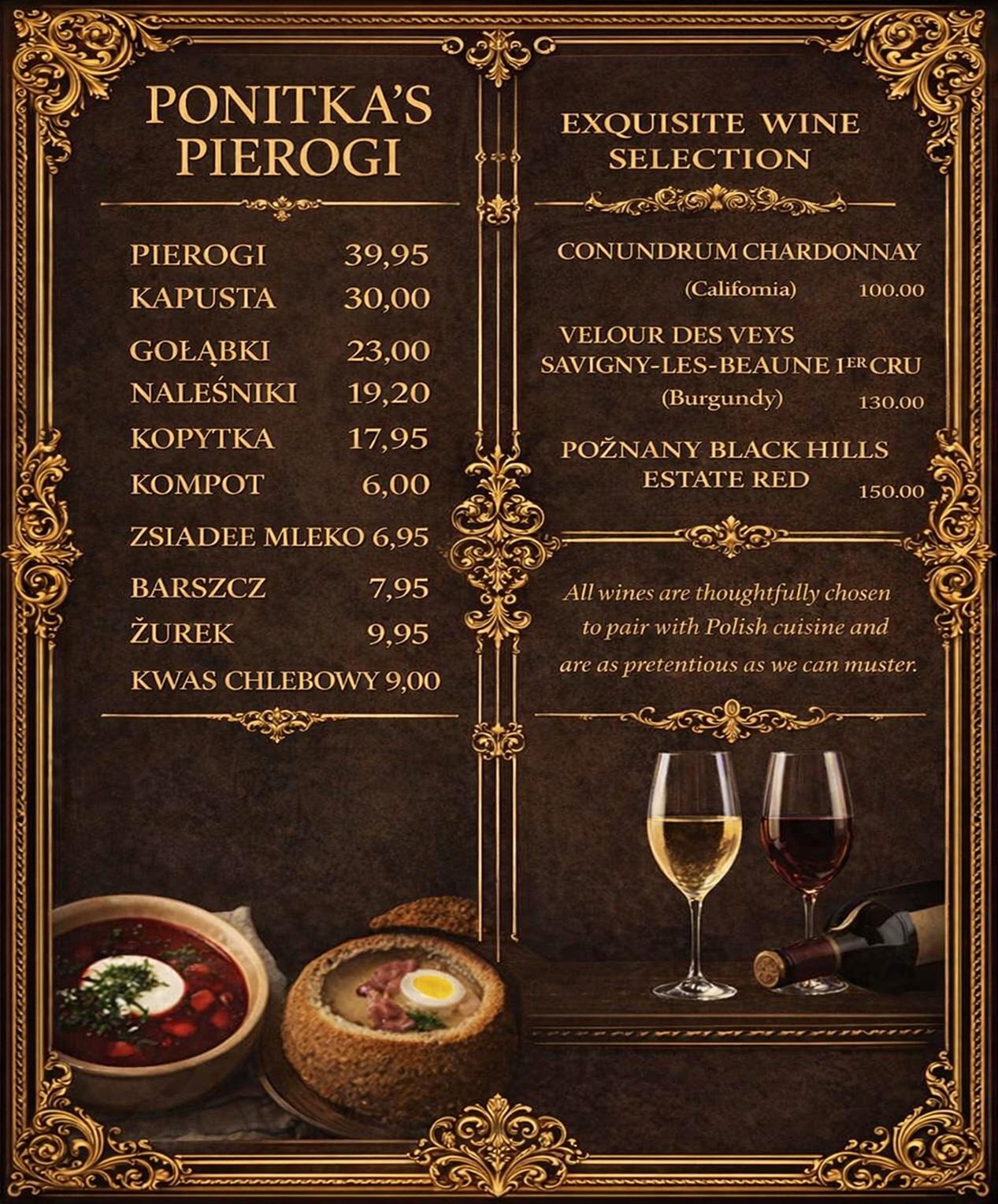
The initial reaction was mixed and confused. The third generation adult Poles who had assimilated, showed up expecting nostalgia and instead got music that felt like a parody of their grandparents. Their kids didn’t take to the Polish games outside, and looked for something they could play on their smart phones.
These people with Polish backgrounds, but had changed their surnames to things like Dobbs and Michaels, are embarrassed by the place, and wish it didn't exist, and some fantasize setting it on fire. The restaurant isn't offensive, or dangerous, or even interesting. It's just embarrassing, and embarrassment is the most potent fuel. Ponitka’s functions as a cultural uncanny valley; recognizable enough to sting, wrong enough to make people wince, and earnest enough that no one can quite bring themselves to be cruel about it.
Why people with Polish backgrounds hate it. They're not so much offended. They're mortified. They see it in these woke times as a caricature of a culture that doesn't need caricature. It's built on clichés that no one actually lives by. It feels like someone Googled "Polish things" and built a restaurant from the first page of results. It's the kind of place your old auntie would drag you to because "You're Polish, you'll love it," and you spend the whole meal praying no one you know walks in. Cultural cringe, not cultural conflict. And because third generation Poles see themselves as Americans, the restaurant feels like a parody of a parody; something that reflects nothing real about them.
Pitkin tries to "fix" the restaurant by making it more Polish, which only makes it more alien to everyone else. "Why is there a portrait of a random 19th century cavalry officer above the soda machine?" "He is national hero. You should be grateful."
It just sort of exists, like a half inflated bounce house, wobbling in the wind while everyone involved pretends it's a real business. Pitkin keeps insisting the "launch" is just around the corner. Ponitka keeps sinking money into "small improvements" that don't matter. Customers wander in, look around, and leave without ordering, the college crew stopping at the new menu. It's not yet a failure. It’ seems to be just working hard to be one. It's a slow motion non-event.
But then the miracle happened. Near elite, non-Polish, Ann Arborites; the professors, techies, and comfortable libbies, wandered in and found it funny. Word of mouth spread like wildfire, and soon others of their ilk went there to joke and get to say "funny" words like gawumpki.
Polish background customers see them and think, “Please don’t let anyone think this is us.” Everyone else sees them and thinks, “This is hilarious.”
They say that they're not laughing at Poles. They're laughing at the earnest wrongness of the place. They mispronounce golabki as "gawumpki" because that's how their weird Polish uncle said it in 1978. They take selfies with the weird Polish kids' games. They order pierogi like they're ordering exotic cuisine. They treat the place like a novelty attraction, not a restaurant. It becomes a local joke, but a gentle one; like the world's saddest theme park. The only difficulties were experienced by the Polish dressed waiters and waitresses, who constantly had to try to escort the laughing, joyous customers who were dancing in the aisles to the Polish music, back to their seats before their pierogi got cold.
Wladyslaw Ponitka doesn’t care about any of that. He was just glad that for the first time since his last NBA check, more money was floating into his account than coming out of it; the amount increasing every day.
Pitkin was as close to being right as he ever was; saying; “This is the inevitable buzz. People are talking about us! This is organic marketing! We're becoming a local phenomenon! We speed up the next phases."
The restaurant is a cultural funhouse mirror, but that only matters to the embarrassed, Polish background locals who want it to disappear. The non-Polish locals treat it like a novelty attraction. Norm Pitkin knows that it's a hit, encouraging him for more future prognostications. The “Polish” games make the place look like a Polish Chuck E. Cheese designed by someone who has never met a child, which is exactly why they are enjoyed by the non-Poles.
The Libby Family's Night Out at Ponitka's Pierogi
They arrive with the earnest enthusiasm of people who believe they are about to have an experience. Not a meal; an experience. The kind that later becomes a paragraph in a holiday newsletter.
The moment they step inside, they're hit with the sensory cocktail that only Ponitka's can deliver; steam from the kitchen drifting like battlefield fog, a crucifix slightly askew, a framed photo of 19 year old Ponitka boxing out in EuroBasket 2011, and a child sized wooden goat on springs, painted with folkloric patterns that no actual Pole has ever seen.
The parents exchange delighted glances. The kids look terrified and thrilled in equal measure.
The server in traditional Polish garb hands them gilt decorated menus printed in a font that suggests "Eastern Bloc bureaucracy meets craft brewery."
The father, who has read half of a “New Yorker” article about Central Europe, leans in with anthropological seriousness; "We'll start with the authentic pierogi flight."
The server nods, because every order is authentic if you say it with conviction.
The mother, determined to demonstrate cultural respect, pronounces golobki with such careful over-enunciation that she accidentally invents a new vowel.
The kids order the "Polish Power Platter," a neon blue soda called "Baltic Breeze," and one demands the "Pierogi Treasure Hunt," a children's game involving a map, a wooden spoon, and a prize token that looks suspiciously like a washer from the hardware store.
While waiting, the sound system, which was consistently playing traditional Polish songs, launched into a song the Libby’s found irresistible; “Who Stole The Kisha?”
Who Stole The Kishka
Krzysztof Krawczyk
Someone stole the kishka
Someone stole the kishka
Who stole the kishka
From the butcher's shop?
Who stole the kishka?
Who stole the kishka?
Who stole the kishka?
Someone call the cops!
Fat and round and firmly packed
It was hanging on the rack
Someone stole the kishka
When I turned my back
Who stole the kishka?
Who stole the kishka?
Who stole the kishka?
Someone bring it back!
Someone stole the kishka
Someone stole the kishka
Who stole the kishka
From the butcher shop?
Who stole the kishka?
Who stole the kishka?
Who stole the kishka?
Someone call the cops!
Yusef found the kishka
Yusef found the kishka
Yusef found the kishka
And he hung it on the rack
He found the kishka
He found the kishka
He found the kishka
Yusef brought it back
Heeeeeyyyyyyyy
Hey!
Huh-huh-huh-huh
Traditional
Two retirees and a teenager who looks like he was court ordered to be there hit the floor. The libby parents light up. This is their moment. They stand, clasp hands, toward the end, and begin a polka that is; technically incorrect, rhythmically optimistic, and performed with the unshakeable confidence of people who believe they are "connecting with the culture."
The kids join in, hopping in circles like caffeinated rabbits. A non-Polish couple at the next table films the whole thing for Instagram with the caption; "Local vibes #authentic #culturetrip."
They remained on the floor jubilantly when the system broke into;
I Had a Hat
The Dropkick Dubrovski’s
I had a hat when I came in
and I hung it on the rack
And I'll have a hat when I go out
or I'll break somebody's back
Andrej wore his brand new hat
to Zieniuk's wake last night
Someone stole his hat and
boys, it started up a fight;
Andrej smashed the furniture,
the radio as well,
He nearly woke the corpse up
when he began to yell:
I had a hat when I came in
and I hung it on the rack,
And I'll have a hat when I go out
or I'll break somebody's back
I'm a peaceful loving man, I am
and I don't want to shout
But I had a hat when I came in
and I'll have a hat when I go out!
Andrej kept on shouting, boys
they couldn't keep him quiet
Someone phoned up for the cops
to come and stop the riot
Two cops rushed into the room
but Andrej laid them out
He fired them through the window
they both heard Andrej shout
I had a hat when I came in
and I hung it on the rack
And I'll have a hat when I go out
or I'll break somebody's back
I'm a peaceful loving man, I am
and I don't want to shout
But I had a hat when I came in
and I'll have a hat when I go out!
Andrej kept on shouting, boys
till one eyed Paddy Flynn
Socked him on the whisker
with a great big rolling pin
He knocked poor Andrej senseless
it was an awful clout
As he lay there unconscious