

Ponitka's Pierogi by Edward Drobinski - HTML preview
Download the book in PDF, ePub, Kindle for a complete version.
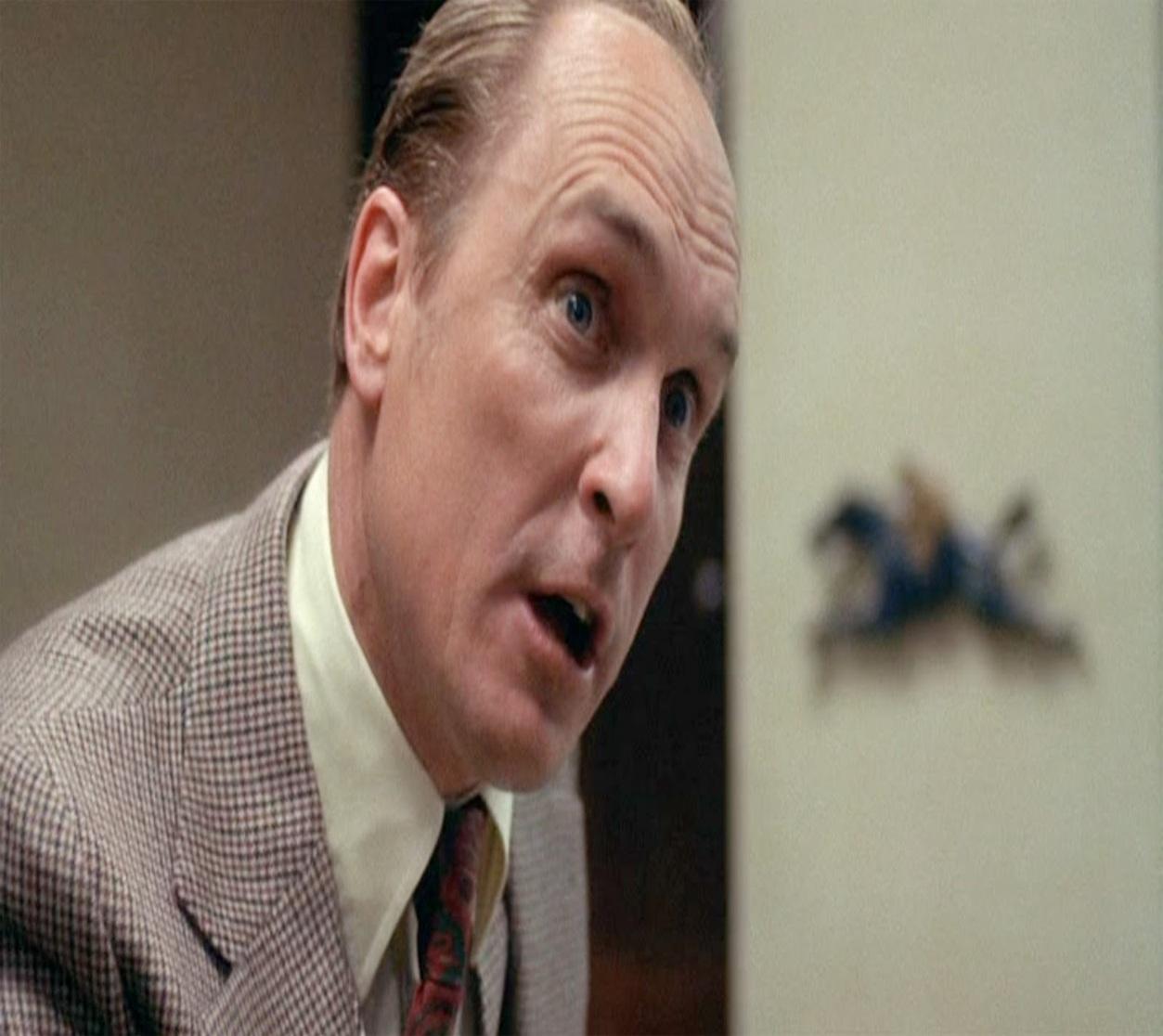
Nelson Chaney: All I know is that this violates every canon of respectable broadcasting.
Frank Hackett: We're not a respectable network. We're a whorehouse network, and we have to take whatever we can get.
Nelson Chaney: Well, I don't want any part of it. I don't fancy myself the president of a whorehouse.
Frank Hackett: That's very commendable of you, Nelson. Now sit down. Your indignation is duly noted. You can always resign tomorrow.
A confrontation happens after Diana and Hackett have maneuvered to take the news division away from Max and fold it into entertainment. Max is still nominally President of the news division, but Hackett has just executed the corporate coup that removes him. They're in the UBS offices; fluorescent, corporate, impersonal, the perfect environment for Hackett's speech. Hackett is triumphant, adrenalized, corporate militaristic. Max is exhausted, principled, already halfway out the door. Hackett storms in with victory energy. He tells Max that the Beale show is a hit, that Ruddy, the old boss, no longer matters, and that Max is finished. Hackett is not subtle. He's gloating. Max tries to defend the idea of a "news division." He argues that news is supposed to have standards, that it's not entertainment, and that Hackett is destroying the last shred of institutional integrity. Hackett makes it explicit. Max is out.
Frank Hackett says to Max Schumacher; When I take my report on the UBS News Division up to the CCA board, do you know what they'll say? They won't say, “Congratulations, Frank, on preserving the dignity and integrity of the news division.” They'll say, “Congratulations, Frank, on increasing our revenues.”
In one impassioned diatribe, Beale galvanizes the nation, persuading viewers to shout, "I'm as mad as hell, and I'm not going to take this anymore!" from their windows. He is soon hosting a new program called The Howard Beale Show, top billed as "the mad prophet of the airwaves." The show becomes the highest rated program on television, and Beale finds new celebrity preaching his angry populist message in front of a live studio audience that, on cue, chants his signature catchphrase; "We're as mad as hell, and we're not going to take this anymore!" Schumacher and Christensen's romance withers as the show flourishes, but in the flush of high ratings, the two ultimately find their way back together. Schumacher separates from his wife of over 25 years for Christensen.
Seeking another hit, Christensen cuts a deal with a terrorist group called the Ecumenical Liberation Army (ELA) for a new docudrama series, The Mao Tse-Tung Hour, for which the ELA will provide exclusive footage of their activities. Meanwhile, Beale discovers that Communications Corporation of America (CCA), the parent company of UBS, will be bought out by a larger Saudi conglomerate. He urges his audience to pressure the White House to quash the deal. This panics UBS because the network's debt load has made the merger essential for its survival.
CCA chairman Arthur Jensen arranges a meeting with Beale, describing the interrelatedness of the participants in the international economy and the illusory nature of nationality distinctions. Jensen scolds Beale and persuades him to abandon his message and preach a new gospel that serves Jensen's interests.
Christensen's fanatical devotion to her job and emotional emptiness ultimately drive Schumacher away, warning her that she will self-destruct if she continues on her current path.
Audiences find Beale's new sermons on the dehumanization of society depressing and ratings start to slip, yet Jensen refuses to fire him. To boost the network's ratings, Christensen, Hackett and the other executives decide to hire the ELA to assassinate Beale on the air. The assassination succeeds, putting an end to The Howard Beale Show and kicking off the second season of The Mao Tse-Tung Hour. A voice over proclaims, "This was the story of Howard Beale: the first known instance of a man who was killed because he had lousy ratings."
This as a film about systems, commodification, and the way institutions grind down the individual. It's loud, cynical, prophetic; the opposite of “Children of Paradise.”
For Ada, it's a shock. She sees the world that has swallowed Wladyslaw. She sees how the "business side" works. She sees how easily a person becomes a metric.
For Wladyslaw, it's recognition. This is the world he's been living in for years. This is the logic that ended his career. This is the logic that will shape Ponitka's Pierogi
And crucially; neither of them needs to say any of this out loud.
That's the elegance.
Ada is not just the wife who "doesn't understand why they have to give up their lifestyle." She is someone who thinks about art, performance, identity; someone who has an inner life.
They let Wladyslaw be human, not just a comedic engine. He's not just the ex NBA guy with a pierogi franchise. He's someone who can sit still, watch a three hour French masterpiece, and have a reaction that isn't a punchline. They created a private world between them.
Late afternoon, blinds half closed, the room still carrying the static of the film, a conversation ensues. It was expected by both parties.
Ada: Well. That was… less forgiving than “Children of Paradise.”
Wlady: It doesn’t even pretend to be forgiving. It’s like the film is daring you to flinch first.
Ada: I didn’t flinch. I just kept thinking how everyone in it believes they’re the only one seeing clearly. Even when they’re obviously not.
Wlady: That’s the part that got me. The certainty. Everyone talks like they’ve already won the argument, even before they make their point.
Ada: Max is the only one who knows he’s losing. That’s why he’s the only one who sounds human.
Wlady: Human, yes. But also ..... resigned. Like he’s narrating his own obsolescence.
She glances at him, not unkindly.
Ada: And Diana; she’s not a villain. She’s just built for a different kind of weather. She doesn’t even pretend to have an inner life.
Wlady: She has one. It’s just outsourced.
Ada: Exactly. She feels things through ratings. Through metrics. Through whatever the room reacts to. It’s not emptiness; it’s calibration.
Wlady: That’s what makes her dangerous. Not malice. Efficiency.
A small pause. They both know the line is good, but neither of them claims it.
Ada: The scene between Max and Diana; the long one, it’s brutal because they’re both right. He sees her clearly. She sees him clearly. And neither can do anything with that clarity.
Wlady: Clarity isn’t the same as compatibility.
Ada: Or mercy.
She folds her arms, thinking.
Ada: What struck me most was how quickly everyone adapts to the new reality. The moment something becomes profitable, it becomes inevitable.
Wlady: People will justify anything if it keeps the machine running.
Ada: And they’ll call it honesty. Or necessity. Or “the way things are now.”
Wlady: That speech from Jensen; the one about the primal forces of nature, it’s practically a sermon. Except the god he’s preaching is the quarterly report.
Ada: He’s calm about it too. That’s what makes it chilling. He’s not selling anything. He’s describing the weather.
Another silence. Not heavy; just precise.
Wlady: Did you notice how no one in the film ever really listens? They wait for their turn to talk. Or to be right. Or to win.
Ada: Except maybe Howard Beale. In his strange way. He listens to the voices in his head. That’s still listening.
Wlady: It’s a kind of faith.
Ada: Or a kind of surrender.
She shifts, drawing her knees up, thoughtful.
Ada: What did you make of the ending?
Wlady: It’s the only ending that fits. When a system builds a monster, it doesn’t slay it. It replaces it with a newer monster.
Ada: And calls it progress.
Wlady: Or programming.
She lets out a quiet breath; not a sigh, more like an exhale of recognition.
Ada: It’s a cold film. But not cynical. It just refuses to pretend that wanting something makes it possible.
Wlady: Or that being right makes you safe.
Ada: Or that being honest makes you understood.
They sit with that. The room feels sharper than yesterday; not unkind, just stripped of decoration, like modern architecture.
Ada: Tomorrow we watch something gentle. I need a palate cleanser.
Wlady: Gentle how?
Ada: Not naïve. Just ..... uninterested in punishment.
Wlady: I can work with that.
9 – Upscale Ann Arbor Loves Their Kapusta
Mucho dinero still in hand, Ponitka thought that it was worth splurging a bit in the sophisticated, competitive Ann Arbor market of jealous, near elites. At the last minute, he insisted on each store having its own sound system, consistently playing traditional Polish songs. Pitkin knew when not to argue.
Beer Barrel Polka
Bobby Vinton
Roll out the barrel, we'll have a barrel of fun
Roll out the barrel, we've got the blues on the run
Zing, boom, terrara
Ring of the song of good cheer
Now it's time to roll the barrel
For the gang's all here
Roll out the barrel, we'll have a barrel of fun
Roll out the barrel, we've got the blues on the run
Zing, boom, terrara
Ring of the song of good cheer
Now it's time to roll the barrel
For the gang's all here
Written by Lew Brown, Jaromir Vejvoda, Vasek Vaclav Zeman, and
Wladimir A Timm.
Orki z Majorki
G.F.Darwin
1. (Agnieszka Makowska)
Orki
Orki z Majorki
Orki z Poznania
I ze Stalowej Woli
Pan Bóg
Stworzył walenie
I bawi się z nimi
Kiedy się goli
2. (Mateusz Trembaczowski)
Orki
To takie pandy
Tylko, że w wodzie
I mają płetwy
Pan Bóg
Też chciał mieć płetwę
Ale nie może
Więc pojechał do Zabrza
3. (Anna Stela)
Pan Bóg od zawsze chciał orką być
O niczym piękniejszym nie mógł śnić
Co dzień gdy wchodzi do wanny swej - widzi delfina
Delfiny są złośliwe!
(Chór)
Orki
Orki z Majorki
Orki z Poznania
I ze Stalowej Woli
Pan Bóg
Stworzył walenie
I bawi się z nimi
Kiedy się goli
Orki
Są takie piękne
Tak pięknie skaczą
Gdy polują na słonie
Pan Bóg
Zawsze się śmieje
I macha im ręką
Bo nogą mu ciężko
Orki