

Sci-Fi Film Fiesta: The Swingin' 60s, Volume 4 – Purple People Eaters and Trippy Creatures by Chris Christopoulos - HTML preview
Download the book in PDF, ePub for a complete version.
Image generated by Chatgpt
The 1951 Sci-Fi Story That Inspired The Classic Sci-Fi Film: "The Day Of
The Triffids”
Steve Sekely’s 1962 film version of Wyndham’s novel is perhaps the best known with other superior adaptations that followed with the 1981 and 2009 BBC TV mini-series. Each seems to approach the story from the standpoint of the prevalent concerns and preoccupations of the era in which they were made.
The 1962 film version seems to opt for a more sci-fi / horror angle at the expense of Wyndham’s story with its backdrop Cold War considerations and fears along with philosophical discussions of the nature of human civilisation.
John Wyndham’s classic science fiction story opens with a man called Bill waking up in a hospital room to find the world he once knew utterly transformed - a world gone blind overnight!
The opening chapter contains an atmosphere of dread as Bill senses without the aid of his sight that the outside world sounds more like a quiet Sunday rather than a typical Wednesday. There is an overwhelming feeling of something not at all being quite right.
With only his sense of hearing to guide him, the striking of the clock indicates that it is now nine o’clock. However, the time his bandages were supposed to be removed was at eight – what on earth has been happening in the meantime?
Unknown to Bill, while he had been asleep after his eye operation, a cosmic event caused the majority of the population who witnessed it to go blind.
Added to the horror of mass blindness is the danger posed to humanity in the form of a plant known as a triffid.
Humanity in its complacency, however did not count on a cosmic event causing global mass blindness and providing the triffids with an opportunity to escape their confinement and become THE apex predator with human beings becoming their prey. For the triffids you see, cannot see but are drawn to noise and therefore their prey cannot avoid them for long!
What of are some of the changes and differences between the book and the movie?
Wyndham’s Novel Sekely’s 1962 Film Version
The triffids had been The light show of the meteor shower has
contained and were farmed caused the triffids and the plants have to produce a vegetable oil somehow been mutated by the event. substitute and help to ease
the global food supply
problem.
Bill is a biologist and triffid Bill is a merchant navy officer, who expert who had been hit by missed the meteor shower because he a triffid. was in hospital with his eyes bandaged
after an operation
Central female character is Central female character reduced to part of the important love screaming damsel in distress. story.
Josella is saved by Bill No Josella! Just a screaming biologist, from being beaten in the Karen! middle of the street.
-Modern woman for the
times.
-Unmarried by choice.
-Author of ‘Sex Is My
Adventure.'
-Gained a notorious
‘reputation.’
-Self-reliant
Appearance of Susan later
in the story.
Crowd panic, chaos in the Car and bus crashes and wreckage along streets with loss of sight with train and pane crashes. and reason. Few traffic
accidents due to
suddeness of blindness
overnight.
Greater sense of isolation Bill hops across to France and Spain and and no communication radios seem to still function with the rest of the world.
Coker kidnaps Bill and Coker is a British tourist in France. Josella to help with his
plan to look after and feed
the blind. His plan falls
apart when a sickness
starts killing off people in
London.
What individuals and a society will do and the choices that are made in the face of a calamity is a central feature of Wyndham’s story. So too is the question of the value of our cherished moral and social belief systems when put to the test by the sheer necessity of survival. Placed along side Windham’s novel, the film version is little more than a disappointing monster movie with ordinary special effects and little substance. Of greater interest are the subsequent TV mini-series versions and their respective treatments of Wyndham’s story.
I wonder how long it will be before Wyndham’s story along with the various screen adaptations are consigned to the bonfire in a final Fahrenheit 451 solution by the PC lunatic brigade on the grounds of insufficient minority representation, gender discrimination or cruelty against vegetation!
*****************
Matango (マタンゴ) (1963) /
Matango: Attack Of The Mushroom People (1965)
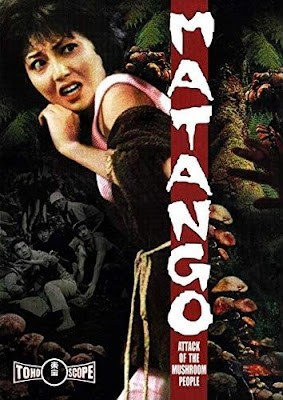
A little known atypical and interesting tokusatsu classic sci-fi / horror film, that is

atmospheric and well-crafted, but somewhat slow-paced at times
Directed by Ishirō Honda
Screenplay by Takeshi Kimura
Story by Shinichi Hoshi, Masami Fukushima
Based on "The Voice in the Night"by William Hope Hodgson Produced by Tomoyuki Tanaka
Cinematography: Hajime Koizumi
Edited by Reiko Kaneko[2]
Music by Sadao Bekku
Production company: Toho Co., Ltd
Distributed by Toho
Running time 89 minutes
Country: Japan
Language: Japanese
Cast
Akira Kubo as Professor Kenji Murai
Kumi Mizuno as Mami Sekiguchi
Kenji Sahara as Senzō Koyama
Hiroshi Tachikawa as Etsurō Yoshida
Yoshio Tsuchiya as Masafumi Kasai
Hiroshi Koizumi as Naoyuki Sakuda
Miki Yashiro as Akiko Sōma
Jiro Kumagai as Doctor at Tokyo Medical Center
Yutaka Oka as Doctor at Tokyo Medical Center
Keisuke Yamada as Doctor at Tokyo Medical Center Hideyo Amamoto as Matango
Haruo Nakajima as Matango
Masaki Shinohara as Matango
Kōji Uruki as Matango
Toku Ihara as Matango
Kuniyoshi Kashima as Matango
Tokio Ōkawa as Matango
In Summary…..
Matango (マタンゴ) / Attack of the Mushroom People (1963) is a Japanese sci-fi / horror film directed by Ishirō Honda. It is partially based on William Hope Hodgson's short story "The Voice in the Night." The story involves five pleasure-seeking young people and two crewmen who become stranded on a tropical island. They soon stumble upon a deserted, fungus-covered ship wreck which they discover had been a research vessel examining the effects of radiation on plant and animal life. The crew had eaten some of the fungus and as a result were driven mad. With little edible food on the island, the group of castaways struggle to find a way to survive only to realise that they have each other to contend with along with a mysterious presence in the form of…...deadly mushrooms!
Spoilers follow below….
(Based on the English dubbed version)
“I’m the one who died”
[Thinking to himself with his back turned to a group of observing doctors] Here I Kenji Murai, a university psychology professor find myself confined in a prison within a prison. I look out from this window in a small room of the psychiatric ward of the Tokyo Medical Center in which I am imprisoned and from where I scan the larger prison that is the city of Tokyo itself. Yes, the city that encases us with walls of glass, steel and concrete and assails our eyes with the incessant gaudy nocturnal flickering of neon inducements, while our ears are filled with the inescapable and inexorable pounding sound of its mechanical heart beat.
[Addressing the group of doctors on the other side of the room’s steel barred door] Of course you wish to know about the events that led me here and why I was the only one to be rescued. “You think that I’m insane, don’t you? All of my friends died. Every one of them. No, I’m the one who died. It’s true. They’re alive. Then you want to know why they didn’t return, don’t you? I don’t want to tell you the story. It’ll only convince you that I am insane…...”
[Murai nevertheless begins to relate his story to the observing doctors] There were seven of us aboard a yacht: the owner of the yacht, wealthy industrialist, Masafumi Kasai; the skipper, Naoyuki Sakuda; his sailor assistant Senzō Koyama; celebrity mystery writer Etsurō Yoshida; professional TV and radio singer and Mr Kasai’s ‘girlfriend’, Mami Sekiguchi; one of my students Akiko Sōma and of course, yours truly.
“We can expect some rough seas tonight”
There we “reckless children” were being happily blown onward by a carefree sea breeze “away from the masses of humanity” on course toward a destination of endless “La-La-La-” partying with no cares or responsibilities in the world to worry about. After all, Kasai had paid a lot of money for the yacht and he was confident it could weather any storm it would encounter. So there was our cartoon existence – one that would last about as long as the proverbial fifteen minutes of fame..
Suddenly a storm shook us out of our idyllic sense of complacency by snapping the yacht's main mast, destroying the radio and almost capsizing the vessel. Luckily the yacht remained upright but did sustain severe damage. At least we worked together to try and save the vessel, except of course for the wealthy industrialist Kasai who elected to retreat below taking his phony captain’s cap with him and who then set about blaming the skipper Sakuda for our predicament despite him giving the orders and playing at being skipper.
There we were left adrift on the ocean, enshrouded in fog and on a southward course for what seemed like days on end. As the food and water began to run out and all communication with the outside world was cut off, imagine the kind of malaise and despondency that began to settle over us. Seven human beings confined in a small space for an indeterminate length of time without a definite destination or sense of purpose and hope. Is it any wonder that communication between them ceases, a pall of silence descends and mutual disdain for one another eventually develops?
“It’s land, it’s land!
It’s an island, it’s an island!”
Our listless existence aboard the drifting yacht soon came to an end when land was sighted through the fog in the form of a seemingly deserted island. Upon going ashore we set about a rather arduous exploratory trek through the island’s jungle terrain where we came across ponds full of fresh rainwater. There seemed to be a distinct absence of fauna and the fruits and berries we discovered were quite inedible. There was, however evidence of human presence in the form of arranged stones at one of the pools of water.
After further traversing the island, we come upon a wrecked ship laying like a wasted and mauled beached carcass on the sand. Its sails were rotted and an investigation of its disordered interior revealed that it was covered with a mysterious fungus. Further investigation seemed to suggest that we had boarded an oceanography research ship on which experiments had been conducted possibly involving nuclear radiation. We also discovered an extraordinarily large mushroom on board that was some kind of experimental new fungus given the designation of “Matango,” A possible food source? Who knew?
For the time being we had access to some food in the form of tinned food that was located by that idiot Koyama who just dived in and started filling his greedy face with it without even telling the rest of us. In his, Kosai’s and Yoshida’s selfish minds it was strictly a case of first come, first serve.
“We better figure out what we’re going to do”
Together we attempted to work out what had taken place and decide on what course of action to take. First of all, it seemed that the ship’s identity and national origin had been purposely concealed. But why? The equipment on board was an amalgam of various national origins suggesting secrecy concerning the nature of the work being undertaken, most likely involving nuclear research.
Despite our attempt to cooperate to figure out our circumstances, cracks were beginning to emerge, as inevitably happens among any grouping of people. For instance, Kasai who was now the man with the gun had begun isolating himself in the Captain’s quarters and seemed to be under the impression that the group’s survival would depend on him and his ability to shoot game,
Out predicament involved us having barely enough food for a week on an island that was deserted and had next to no edible food. The ship's log contained a warning not to eat the mushrooms because they might be poisonous as “there seems to be a substance in them that damages the nerve tissues.” The mushrooms themselves, “grow in great abundance on the island” and that they had been subject to a strange mutation as a result of the research that had been conducted on the ship. Whenever the former crew members went out to “gather edibles to add to their diet, none of them returned.” It was no stretch of the imagination to guess what the likely cause of this was.
Yoshida balked at the suggestion that we should retrieve and use the yacht again and point-blank told Sakuda and Kasia, “it’s about time both of you stopped trying to run things.” Before any further dissension had a chance to spread, I suggested that each of us set about focusing on particular tasks from building a signal fire through to obtaining food.
Is democratic consensus such a tenuous, false and fickle concept that often amounts to a situation in which the majority of the group agree to what one or two people with powerful persuasive personalities and motivated by vested interests and ulterior motives end up deciding on the direction everyone is to move in? Then there’s the problem of group dynamics involving a combination of apathy, self-interest, group-think mentality and factions that develop and fracture group cohesion. Our little group of castaways would prove to be no exception.
How on earth did we manage to find ourselves in this situation? To you it probably sounds something like the plot of a story taken from someone else's work – like some idea that Yoshida would have come up with or even “borrowed” from someone else and “improved” upon. It all really began one evening at a nightclub around a table at which we gathered. It had been prearranged that we would all embark on this venture and each of us received a pendant to seal the deal so to speak on our commitment to it.
With the fog closing in and putting paid to the idea of a signal fire and with little prospect of finding food, all we had for our efforts was the locating of the ship’s missing mirrors. Yet another mystery to add to our collection. Not to mention Kasai’s taking pot-shots with his rifle at imaginary phantoms!
“You’ve got to DO something!”
As the days passed and our supply of food dwindled, our group was riven more and more by dissension and petty bickering. One night, our captain of industry, Kasai attempted to raid the food stores. As he was doing so, he was attacked by a grotesque-looking man-like creature who somehow managed to disappear before ‘our eyes. A ghost perhaps, we thought? But ghosts don’t leave footprints, do they?
Despite my efforts to foster rational thinking, cooperation and teamwork, cruelty and selfishness kept rising to the surface under the trying conditions we faced. Even that repulsive Koyama managed to outline the nature of our predicament and some of the factors that gave rise to our ever growing disintegration.
Koyama told the group, “in Tokyo, you’re all big shots and think you’re pretty smart. But here you go crazy. ….But there’s a reason for all this. These women. They’re on your mind all the time but you can’t do anything about it. …..Tonight (indicating Mami Sekiguchi) I might decide to take her.” With the women having been blamed for the troubles we were experiencing, no-one least of all Kasai really bothered to jump to her defense until Yoshida in an act of combative rivalry, grabbed a rifle and threatened to kill Koyama. Kasai simply sat there and glibly observed “I know what she’s like” to which Mami retorted by declaring, “you’ve always been repulsive to me” and that she was only with him because of what she could get out of him materially. Koyama managed to hit the right buttons all right - from sexual tension through to greed, avarice and opportunism.
Koyama then addressed each of us by the appellations and designations we tend to hide behind and use to define who we are: In Tokyo Kasai is a “big business man” making lots of money which in our circumstances is not worth a damn, along with me the “College man” and Yoshida the “writer.” According to Koyama, all that really mattered on the island we washed ashore on was that we had to do something and actually get to work. Well, in regards to that last observation I suggested that “we’ve got two things to do: get food and fix the yacht so we can get away.”
“A man says strange things when he’s out of his mind”
All notions of teamwork, cooperation and a shared sense of purpose had now been replaced by a Darwinian struggle for survival in which only the fittest and strongest would survive in an existence marked by opportunism.
Yoshida with his mind addled by alcohol took the rifle and went in search of the creature we thought we had seen the previous night. It became apparent that while doing so he had succumbed to temptation and sampled the mushrooms, not so much for survival but for their hallucinogenic effects.
Meanwhile, Koyama began hoarding a stash of turtle eggs which he intended to use for profit by selling them to Kasai for thousands of yen. I can just imagine him telling Kasai, “the market for eggs won’t last for ever, will it?” The industrialist still preferred to try and buy his way into self-preservation and isolate himself from the rest of us rather than assist with the work.
The social order was being crushed to pieces by an overriding quest for dominance. The men began competing with each other by trying to impress the women with how much food they had collected during their forays across the island. Also Yoshida and Koyama engaged in physical combat over Mami who obviously enjoyed this display of male rivalry over her. The knowledge that everyone seemed to want her satisfied her ego and sense of power she had over men.
After the tussle with Koyama over Mami, Yoshida soon after confronted us with the rifle and declared that he would kill us all and have his way with the women. To his warped way of thinking, if indeed the mushrooms were to turn him into an inhuman monster, then there would be no consequences for his actions as he would not be commuting any crime. Yoshida didn’t get the chance to pursue his intentions as we managed to subdue him and lock him in the captain's quarters, after evicting Kasai of course.
On the grounds that everything was now different, Kasai later attempted to convince Sakuda that they band together, take the remaining food and depart the island in the repaired yacht in the hope that they’d be picked up by a passing ship. Not surprisingly, Sakuda forcefully rejected his proposal. I learned that Kasai had previously helped Sakuda and his family over some matter and had never let him forget it. He had pretended to be Sakuda’s friend but in fact treated him like dog.
“No matter how we feel, we just can’t give up”
Akiko and I later discovered Kasai had been tied up by Sakuda who “stole all the canned food and left us” by taking the yacht. “no it’s my turn to do something.” “I don’t know how many times I’ve written something like this in my novel.”
In the meantime Mami had freed Yoshida and they both attempted to take over the ship, with Yoshida announcing that it was now his time “to do something” and as he directed Akiko and I off the ship at gunpoint told us that he didn’t know many times he had written this scenario in his novels.
Suddenly Koyama appeared only to be shot dead by Yoshida. As this happened Murai and I managed to wrest the gun from Yoshida and force him and Mami off the ship. A poignant bit of irony lay before us as we witnessed Koyama’s corpse lying amidst the strewn banknotes highlighting a lesson that he failed to learn: that money has no value when there is nowhere to spend it.
“Now that you finally know what it means to ask for help”
Kasai was on the point of giving up and contemplated suicide but lacked the courage to do it and instead pleaded with me to end his life. Of course that was unthinkable. While Akiko and I left for a while and gave him a chance to rest, Mami apparently had returned to the ship and enticed the emotionally and psychologically distraught Kasai to follow her into the forest and eat the mushrooms.
The week long constant rainfall (which gave my dear sweet, innocent and pretty Akiko the clue that “it must be the rainy season”) had caused the mushrooms on the island to grow in great profusion. Kasai would’ve soon discovered that those who ate the mushrooms would turn into mushroom creatures themselves. Once he had succumbed to temptation and started eating the mushrooms he would not have been able to stop.
What kind of strange Eden was this island whereby Man is tempted by the forbidden fruit of the mushroom? Was Mami then some kind of an Eve? Just like this modern city beyond the window and the kind of civilization we have fashioned for ourselves, we in our modern metropolises surround ourselves with temptations, distractions and enticements that only serve to infect and imprison us making escape from our collective and individual Hell on earth seem futile.
was this the kind of vision Kasai experienced in his hallucinations after consuming Matango? His fate no doubt would be to wander the Purgatory of the island, an infected mutated denizen trapped, imprisoned and surrounded on all sides in his perverse new Eden.