

Sci-Fi Film Fiesta: The Swingin' 60s, Volume 4 – Purple People Eaters and Trippy Creatures by Chris Christopoulos - HTML preview
Download the book in PDF, ePub for a complete version.
Contents:
Matango: Attack Of The Mushroom People (1965)
Night Caller from Outer Space (1965)
Night of the Big Heat (1968) he Green Slime (1968)
Introduction
If the 1950s gave us giant ants, radioactive lizards, and a steady stream of Cold War paranoia, the 1960s took those fears, turned up the volume, and dipped them in a kaleidoscope of colour. This was a decade of profound upheaval—socially, politically, and culturally—and science fiction cinema responded in kind. By the time we reach the films collected in this volume, the genre had begun to mutate into something stranger, more ambiguous, and often far more unsettling.
The “Swingin’ 60s” is often remembered for its pop art exuberance, psychedelic experimentation, and a youth-driven cultural revolution. Yet beneath the bright surface lay deep anxieties: the ever-present shadow of nuclear annihilation, the escalation of the Vietnam War, the space race between superpowers, and a growing distrust of authority and scientific progress. Science fiction—always a barometer of collective unease—absorbed these tensions and projected them onto screens in bizarre and unforgettable forms.
In Britain, America, and Japan alike, filmmakers began to explore not just external threats from outer space, but internal and ecological dangers closer to home. Nature itself turned hostile. Science, once the great savior of humanity in earlier films, became increasingly suspect. And humanity? Often it proved to be its own worst enemy.
This volume opens with The Day of the Triffids (1962), a film that captures the lingering dread of global catastrophe in the wake of nuclear testing. A mysterious celestial event blinds much of the world’s population, leaving humanity at the mercy of ambulatory, carnivorous plants. The film reflects both Cold War anxieties and a creeping awareness of ecological fragility—ideas that would only grow more urgent as the decade progressed.
From Britain we move to Japan with Matango (1963), later re-titled Matango: Attack of the Mushroom People (1965) for international audiences. Produced in the shadow of Hiroshima and Nagasaki, and shaped by Japan’s own complex relationship with science and modernity, the film offers a claustrophobic and deeply unsettling tale of castaways succumbing to a strange fungal contagion. Beneath its grotesque surface lies a pointed critique of consumerism, addiction, and the loss of individual identity in an increasingly conformist society.
The mid-1960s also saw a rise in more intimate, almost procedural science fiction horrors. Night Caller from Outer Space (1965) strips away spectacle in favor of eerie suggestion, presenting an alien presence that operates quietly, methodically, and disturbingly close to home. Its focus on investigation and infiltration reflects a world increasingly preoccupied with surveillance, espionage, and the unseen threats of the Cold War.
Similarly, Island of Terror (1966) channels anxieties about scientific experimentation gone awry. Here, well-meaning research unleashes silicon-based creatures that drain their victims of life itself. The film taps into a growing skepticism toward unchecked technological advancement—a theme echoed across the decade as breakthroughs in science brought both hope and unease.
By the latter half of the decade, science fiction cinema had begun to embrace a more overtly surreal and psychedelic tone. Night of the Big Heat (1968) blends science fiction with atmospheric horror, as an isolated island becomes the battleground for an invisible alien menace that feeds on energy and heat. The film’s oppressive, almost hallucinatory mood mirrors the era’s shifting consciousness, where reality itself seemed increasingly fluid.
Finally, we arrive at The Green Slime (1968), a riotous fusion of space-age adventure and pop-art excess. With its vivid colors, energetic pacing, and infectious theme song, the film embodies the more flamboyant side of late-60s science fiction. Yet even here, beneath the spectacle of alien blobs and space station peril, lies a familiar warning about contamination, technological vulnerability, and the unintended consequences of human ambition.
Taken together, these films chart a fascinating evolution within the genre. The monsters are no longer just external invaders; they are mutations, infections, and manifestations of humanity’s own fears and failures. The settings range from isolated islands to the vastness of space, yet the sense of unease remains constant. Whether born of radiation, scientific hubris, or cosmic mystery, the threats in these films reflect a world grappling with rapid change and uncertain futures.
“Purple People Eaters and Trippy Critters” is more than a collection of quirky titles—it is a snapshot of a decade in flux. These films may at times appear outlandish, even camp, but they are rooted in very real concerns. They reveal a culture experimenting with new ideas while confronting old fears, pushing the boundaries of imagination while questioning the cost of progress.
So sit back, dim the lights, and prepare to encounter carnivorous plants, parasitic fungi, invisible invaders, and pulsating alien slime. The 1960s were a strange and transformative time—and nowhere is that strangeness more vividly captured than in the wild, weird world of its science fiction cinema.
***************
The Day of the Triffids (1962)
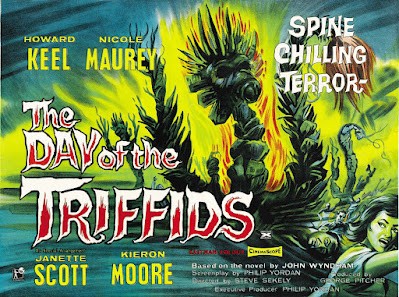
\A sci-fi film that relies on tension and imagination but is somewhat hampered by lack

of budget and struggles to rise beyond the ordinary
Directed by Steve Sekely, Freddie Francis (additional scenes) Written by Bernard Gordon, Philip Yordan
Inspired by the 1951 novel by John Wyndham
Produced by George Pitcher, Philip Yordan, Bernard Glasser Cinematography: Ted Moore
Edited by Spencer Reeve
Music by Ron Goodwin, Johnny Douglas
Production company: Security Pictures Ltd
Distributed by Rank Organisation
Running time: 93 minutes
Cast
Howard Keel as Bill Masen
Nicole Maurey as Christine Durant
Janina Faye as Susan
Janette Scott as Karen Goodwin
Kieron Moore as Tom Goodwin
Mervyn Johns as Mr Coker
Ewan Roberts as Dr Soames
Alison Leggatt as Miss Coker
Geoffrey Matthews as Luis de la Vega
Gilgi Hauser as Teresa de la Vega
John Tate as Captain — S.S. Midland
Carole Ann Ford as Bettina
Arthur Gross as Flight 356 radioman
Colette Wilde as Nurse Jamieson
Ian Wilson as greenhouse watchman
Victor Brooks as Poiret
Peter Dyneley as the narrator's voice
Introduction
On any day and even in such an idyllic setting as a pond or botanical garden in the middle of a modern city, “nature's scheme of things” can be seen to be at work if we choose to look carefully. For instance, “there are certain plants which are carnivorous or eating plants. The Venus fly trap is one of the best known of these plants. A fly drawn to the plant by a sweet syrup brushes against trigger bristles. Just how these plants digest their prey has yet to be explained. There is much still to learn about these fascinating eating plants.” Take this “newcomer” over here: “trifidus celestus.” Did you know that it was “brought to Earth on the meteorites” on the very day that initiated the events that almost spelled the end of civilisation…..
The Day of the Triffids!
The world’s attention, however was being drawn elsewhere, upwards to the heavens where all eyes were “witnessing an unprecedented shower of meteorites” and assurances were being given by so-called experts that the meteorites would “burn up from the intense heat before they reach the Earth.” No-one at the time it would seem had eyes with which to see the awful truth just yet……..