

Outline of US History by U.S. Department of State - HTML preview
Download the book in PDF, ePub for a complete version.
CHAPTER 12: POSTWAR AMERICA
These Rights, issued the next year, Plessy v. Ferguson in 1896, that seg-documented African Americans’ regation of African-American and
second-class status in American life white students was constitutional if
and recommended numerous fed- facilities were “separate but equal .”
eral measures to secure the rights That decree had been used for de-
guaranteed to all citizens .
cades to sanction rigid segregation
Truman responded by sending in all aspects of Southern life, where
a 10-point civil rights program to facilities were seldom, if ever, equal .
Congress . Southern Democrats in
African Americans achieved their
Congress were able to block its en- goal of overturning Plessy in 1954
actment . A number of the angriest, when the Supreme Court — pre-
led by Governor Strom Thurmond sided over by an Eisenhower ap-
of South Carolina, formed a States pointee, Chief Justice Earl Warren
Rights Party to oppose the president — handed down its Brown v. Board
in 1948 . Truman thereupon issued of Education ruling . The Court de-
an executive order barring discrim- clared unanimously that “separate
ination in federal employment, or- facilities are inherently unequal,”
dered equal treatment in the armed and decreed that the “separate but
forces, and appointed a committee equal” doctrine could no longer be
to work toward an end to military used in public schools . A year later,
segregation, which was largely ended the Supreme Court demanded that
during the Korean War .
local school boards move “with all
African Americans in the South deliberate speed” to implement the
in the 1950s still enjoyed few, if any, decision .
civil and political rights . In gener-
Eisenhower, although sympathet-
al, they could not vote . Those who ic to the needs of the South as it faced
tried to register faced the likelihood a major transition, nonetheless act-
of beatings, loss of job, loss of credit, ed to see that the law was upheld in or eviction from their land . Occa- the face of massive resistance from
sional lynchings still occurred . Jim much of the South . He faced a ma-
Crow laws enforced segregation of jor crisis in Little Rock, Arkansas, in
the races in streetcars, trains, hotels, 1957, when Governor Orval Faubus
restaurants, hospitals, recreational attempted to block a desegregation
facilities, and employment .
plan calling for the admission of nine
black students to the city’s previ-
DESEGREGATION
ously all-white Central High School .
T
After futile efforts at negotiation, the
he National Association for the president sent federal troops to Little
Advancement of Colored People Rock to enforce the plan .
(NAACP) took the lead in efforts to
Governor Faubus responded by
overturn the judicial doctrine, es- ordering the Little Rock high schools
tablished in the Supreme Court case closed down for the 1958-59 school
272
OUTLINE OF U.S. HISTORY
year . However, a federal court
powerful, thoughtful, and eloquent
ordered them reopened the follow- leader in Martin Luther King Jr .
ing year . They did so in a tense at-
African Americans also sought to
mosphere with a tiny number of secure their voting rights . Although
African-American students . Thus, the 15th Amendment to the U .S .
school desegregation proceeded at a Constitution guaranteed the right to
slow and uncertain pace throughout vote, many states had found ways to
much of the South .
circumvent the law . The states would
Another milestone in the civil impose a poll (“head”) tax or a lit-
rights movement occurred in 1955 in eracy test — typically much more
Montgomery, Alabama . Rosa Parks, stringently interpreted for African
a 42-year-old African-American Americans — to prevent poor Afri-
seamstress who was also secretary can Americans with little education
of the state chapter of the NAACP, from voting . Eisenhower, working
sat down in the front of a bus in a with Senate majority leader Lyn-
section reserved by law and custom don B . Johnson, lent his support to
for whites . Ordered to move to the a congressional effort to guarantee
back, she refused . Police came and the vote . The Civil Rights Act of
arrested her for violating the seg- 1957, the first such measure in 82
regation statutes . African-American years, marked a step forward, as it
leaders, who had been waiting for authorized federal intervention in
just such a case, organized a boycott cases where African Americans
of the bus system .
were denied the chance to vote . Yet
Martin Luther King Jr ., a young loopholes remained, and so activ-
minister of the Baptist church ists pushed successfully for the Civil
where the African Americans met, Rights Act of 1960, which provided
became a spokesman for the pro- stiffer penalties for interfering with
test . “There comes a time,” he said, voting, but still stopped short of au-
“when people get tired . . of being thorizing federal officials to register kicked about by the brutal feet of op- African Americans .
pression .” King was arrested, as he
Relying on the efforts of African
would be again and again; a bomb Americans themselves, the civil
damaged the front of his house . But rights movement gained momen-
African Americans in Montgomery tum in the postwar years . Working
sustained the boycott . About a year through the Supreme Court and
later, the Supreme Court affirmed through Congress, civil rights sup-
that bus segregation, like school porters had created the groundwork
segregation, was unconstitutional . for a dramatic yet peaceful “revolu-
The boycott ended . The civil rights tion” in American race relations in
movement had won an important the 1960s .
9
victory — and discovered its most
273
274
C H A P T E R
13
DECADES
OF
CHANGE:
1960-1980
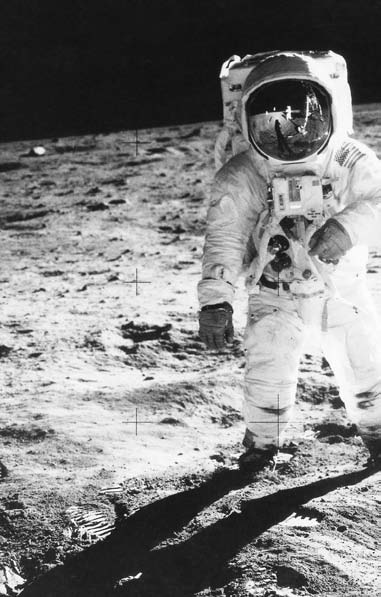
Module Pilot Edwin Aldrin Jr.
on the moon, July 20, 1969.