

Sci-Fi Film Fiesta: The Swingin' 60s - Volume 8: Way Out Worlds- by Chris Christopoulos - HTML preview
Download the book in PDF, ePub for a complete version.
A good-looking sci-fi film with a naively optimistic view of the future and
with characters that are difficult to care too much about.
Directed by Kurt Maetzig
Screenplay by Kurt Maetzig, J. Barkhauer (uncredited) Story by J. Fethke, W. Kohlhasse, G. Reisch, G. Rücker, A. Stenbock-Fermor Based on The Astronauts by Stanisław Lem Cinematography: Joachim Hasler
Edited by Lena Neumann
Music by Andrzej Markowski
Production companies: Roter Kreis group of DEFA, Filmowe Iluzjon film studio Distributed by Progress Film (East Germany), Crown International Pictures (US) Running time: 93 minutes / 79 minutes (English dub) Box office: 4,375,094 tickets
Cast
Günther Simon as Raimund Brinkmann (Robert Brinkman in the US release), the Kosmokrator's German pilot
Julius Ongewe as Talua, the African communications officer Yoko Tani as Dr. Sumiko Ogimura, the Japanese medical officer Oldřich Lukeš as Professor Hawling, a US nuclear physicist (Orloff in the US release)
Ignacy Machowski as Professor Sołtyk (Durand, a French engineer, in the US release), the Polish chief engineer
Mikhail Postnikov as Professor Arsenjew, Soviet astrophysicist and commander of the mission (Harringway in the US Release)
Kurt Rackelmann as Professor Sikarna, an Indian mathematician Tang Hua-Ta as Dr. Tschen Yü (Chen Yu in the US Release), a Chinese linguist. Lucyna Winnicka as Joan Moran, television reporter Eduard von Winterstein as a nuclear physicist
Ruth Maria Kubitschek as Professor Arsenjew's wife
The World of 1960: A Taste of the Times
• OPEC ( Organisation of Petroleum Exporting Countries ) is formed and will
eventually comprise twelve member countries: six in the Middle East( Iran, Iraq, Kuwait, Qatar, Saudi Arabia and United Arab Emirates ), four in Africa ( Algeria, Angola, Libya and Nigeria ), and two in South America ( Ecuador and Venezuela ), Collectively they will end up by the 21st century holding most of the world’s crude oil reserves and a significant proportion of its crude oil production. As the Cold War intensifies, a Soviet SA-2 guided surface-to-air missile shoots down the US Lockheed U2 spy plane piloted by Francis Gary Powers.
• In the wake of the French withdrawal from Vietnam, the United States
announces that 3,500 American soldiers are going to be sent to Vietnam. The Domino Theory involves the belief that if one country was to fall to communism each nearby country would also likely fall, especially with the
financial and military support of North Vietnam by the Soviet Union and China. Thus begins America's involvement in a long and many would argue futile war against communist North Vietnam.
• Following major food shortages in East Germany 160,000 refugees cross to
West Germany, Nikita Khrushchev orders the construction of the Berlin Wall
• The Irish Republican Army (IRA) starts it's fight against the British
• President Dwight D. Eisenhower signs the Civil Rights Act of 1960 into law.
The purpose of the law is to close loopholes from the Civil Rights Act of 1957 and mainly dealt with voter disenfranchisement.
• The United States Supreme Court decides the Boynton v. Virginia case which
arose from an incident in which Bruce Boynton, an African-American law student, being arrested for trying to order at a “whites only” restaurant in a bus terminal. The court ruled in a 7-2 decision that racial segregation in public transportation was unconstitutional as it violated the Interstate Commerce Act.
• In South Africa Afrikaner police open fire with sub machine guns on
demonstrators in the black township of Sharpeville.
• The first televised US Presidential debate takes place between Kennedy and
Nixon
• John F Kennedy wins the presidential Election with one of the smallest
margins in history.
• The sexual revolution begins with the use of birth control pills and the
opening of the first Playboy clubs in Chicago.
• Technical achievements include the invention of the Laser and a heart
pacemaker.
• With its testing of its first atomic bomb, France joins ‘nuclear bomb club.’
• 100,000 people Join the"Ban The Bomb" Campaign for Nuclear Disarmament
rally on April 18th in London.
• In the USA the yearly inflation rate sits at 1.46%. The average cost of a new
house is $12,700.00 while the average monthly rent is $98.00. A gallon of gas will set you back 25 cents to fuel your $2,600.00 new car. When you get home you can put your feet up, relax and watch your 23 inch television.
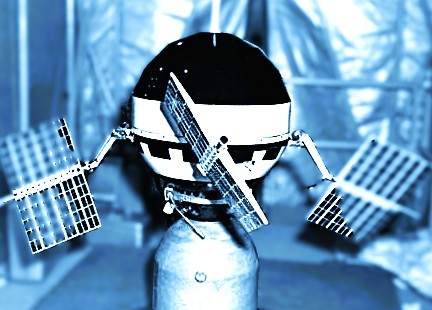
Pioneer 5
• In the new frontier of space exploration, (in which the Soviet Union seems to
be forging ahead of the US), NASA launches the Pioneer 5 space probe that will travel between the orbits of Earth and Venus to gather information about deep space between the two planets. Pioneer 5 is able to establish
communications with Earth at a record 22.5 million miles away, but contact with the craft is lost after that point. NASA also launches TIROS-1 (Television Infra-Red Observation Satellite), one of the world’s first successful weather satellites. TIROS-1 weighs about 270 pounds and measures 19 inches in height and 42 inches in diameter. The satellite can only function during daylight hours but manages to transmit thousands of photos of cloud patterns and document the formation of cloud systems. It will continue to function for about 78 days.
• The Summer Olympics are held in Rome, Italy and were the first games to be
fully covered on television. The geo-political rival superpowers, the Soviet Union and the United States, along with host country, Italy win the most medals.
Popular Culture includes:
• To Kill A Mockingbird novel
• Alfred Hitchcock’s Pscho
• Coronation Street (UK TV series)
• ( I spent many a night in the ‘60s watching that British soapy with my parents)
• The Flintstones cartoon series
• Rawhide western TV series
• Chubby Chequer and The twist dance craze.
• (I met and talked with Chubby Checker in the early 1990s in Melbourne
Australia at a rock ‘n roll dance venue where he performed. I wasn’t very coherent that night!)
• The Etch A Sketch art toy/gadget (It really seemed like magic!)
From that dawn of a new decade that was the year1960, emerged an ideological illusion and hubrisric hallucination in the form of the film, First Space Ship on Venus with its Utopian vision of a future world of 1985…….when;
**************
An alien artefact is discovered on Earth originating from from
Venus
A rocket expedition to Venus is launched to discover the
origin of the artefact and the beings that created it.
The following contains spoilers and is based on the English dubbed release….
The film begins with a narration explaining the story’s context …..
“in 1985 during the course of the work undertaken to irrigate the Gobi desert, a strange fragment of rock was discovered. Several remarkable features of this rock attracted the attention of the scientists engaged on the project. Research revealed that it contained a spool. Further analysis showed the material to be extraterrestrial in origin and not of human manufacture. Where did it come from?
Then somebody remembered that in June 1908 in Siberia an explosion had occurred equivalent in force to a hydrogen bomb - an explosion visible within a radius of 350 miles.
At the time it was thought to have been caused by a giant meteor. Seventy seven years later an international Expedition tried to determine the trajectory and the point of impact and find some debris of what was called….. the Tongu Meteor.”
“is this another hoax of the Flying Saucer variety?”
Professor Harringway from (where else?) the United States issues a public statement to the effect that the mysterious Tunga (Tunguska} meteor was in fact a spaceship from another planet which exploded in the air before landing.
In a very chummy and unexpectedly open and frank interview with international reporters, the professor discloses that he believes that the spaceship ran into trouble during its approach to earth and that the “captain of the spaceship decided to save what he considered was most valuable …... this tool (a spool)which may contain a document of prime importance in an unknown language recorded apparently by magnetic process.”
So we are led to believe that full disclosure of information is now the name of the game and that members of the media are considered as “dear friends.” While we’re feeling so positive about such openness, our attention is drawn to the rear view of a shapely camera-woman in a tightly-fitting red outfit manoeuvring her camera on the friendly media question and answer media scrum session.
An international team of scientists led by Professor Sikarna and Dr. Tschen (Chen) Yü is given access to the world's largest computer to try to decode this strange flight recorder device.
Here we have a scene that would literally bring tears of joy to modern day adherents of the orthodoxy and doctrines pf ‘inclusion’ and ‘diversity.’ We have the Chinese Dr Chen Yu. not only one of the world's leading authorities on languages but also his biological work is of immense importance. We are informed that humanity is indebted to this oh so polite and softly-spoken Red Chinese Communist replete in his Mao suit for performing the enormously altruistic miracle of “transforming inorganic substances into food.” Take that, Jesus! Hallelujah Science, the saviour!
We also have the world famous mathematician Professor Sikarna whose work we are told “rivals even that of Einstein.” Along with the good professor there appear to be more fellows from the Indian sub-continent present than one could poke a chapati at. Added to this contingent there is a liberal sprinkling of African representatives. A regular love-in of Soviet Cold War era commie friends, lackeys, allies and supposedly non-aligned partners.
This brain trust has apparently made rapid progress and despite not having managed to decipher the message, they have determined that the spaceship was launched within our solar system. Harringway narrows it down to “Earth's sister planet Venus, the Morning Star.”
Recap
• The recovered spool is an alien flight recorder.
• The artefact originally came from a Venusian spaceship.
• The ship ran into trouble on its approach to Earth in 1908 and exploded.
• The giant crater it created in Siberia had previously been attributed to a large
meteor impact.
Unfortunately, only part of the text from the spool has been decoded as it had been damaged in the crash. What has been determined is that on Venus there is a highly developed life form. A decision is soon made to propose that the world’s governments consent to train all the radio and radar stations of the world on Venus.
And yet inexplicably Venus continues to remain stubbornly silent…….
“I have news of the utmost importance to announce to you”
It is announced that the “modern spaceship,” the Kosmoskrator is now completed. Instead of its planned mission to Mars (still waiting for that to happen in 2024!) the ship’s new destination will be the planet Venus. It’s mission: to discover why contact has yet to be made with the creators of the Venusian artefact.
A female journalist from Inter-Vision presents to the world the preliminary tests of the Kosmoskrator, along with the promise of a detailed description of the final countdown and blast-off of the rocket as well as a rundown of the crew. My, my...communication is not only transparent and open, but has also gone global!
The crew consists of;
• Robert Brinkman, the American Kosmoskrator's pilot
• Talua, the African communications officer
• Dr. Sumiko Ogimura, the Japanese medical officer
• Professor Orloff, nuclear physicist
• Professor Durand, a French engineer
• Professor Harringway, astrophysicist and commander of the mission
• Professor Sikarna, mathematician from the Indian sub-continent.
• Chen Yu, a Chinese linguist
Ah,yes...Americans commanding and piloting (directing). For US audiences viewing the English sub version of the film, there’s the promise of a future detente in which America fulfils its God-given role of global leadership, stewardship and protection of the world – in cooperation of course with all the nations of the world.
The International Space Station has nothing on this lot! Except perhaps that in this film’s glowing depiction of a future 1985, human kind has already established bases on the moon with Luna 3.Yet to happen in 2026! In terms of our eventual return to the moon, I wont be surprised if the Chinese wind up landing a human crew on the moon and establishing a base there first, considering their systematic and focused approach to space exploration. By the way, you’d be hard pressed finding a Chinese astronaut on the ISS these days. Ah, the progress we’ve made. Just saying.
In the meantime, we’re entertained by the appearance of a little robot called Omega that will be on the mission. It responds verbally to questions put to it and can play chess as well as possessing a rudimentary memory. It would not last 2 seconds in a round of st Robot Wars! Yes, our own lives in the 21 century are gradually being filled with autonomous AI robots performing functions that we are too stupid or lazy to do for ourselves while hoovering up masses of data on us.
Soon after this comic interlude, we are bored silly by a stilted Mills & Boon style interaction between Brinkman and Sumiko who have had a previous romantic involvement. Brinkman hopes to rekindle their relationship while Sumiko spends her time reminding him that “on a voyage of this kind there'll be no room for excess baggage” and that it can never be….Oh for God’s sake who cares?
The drivel that sloshes between these two continues during the process of artificially induced sleep prior to take-off…. “please we mustn't speak of that ever.” Then do us all a favour and don’t!
“Rockets primed…..Ready for blast off”
After being fare-welled by a bunch of enthusiastic personnel (some looking like college students bearing large capital letters on their tunics), the rocket ship finally blasts off for Venus.
“we have covered a distance of 2,600,000 miles”
During the journey to Venus, we are presented with the usual bunch of tried (tired) and true sci-fi film tropes as if nothing new had been learned during the previous decade:
Zero gravity capers: “Don't forget there's no gravity.” We have the usual spectacle of astronauts spinning and cavorting around while being weightless followed by the ‘unexpected’ immediate effects of artificial gravity being applied. “That was a dirty trick” followed by jolly bouts of laughter. You guys!
Damn meteorites: By 1960 astronauts on film are till apparently unsure of the difference between meteorites and meteors. A swarm of the buggers are forecast to reach the ship in 48 hours. They are supposedly unexpected but in these films they are all too often expected by the audience. Well, the ship gets slapped around a bit resulting in some damage which needs to be attended to before the principal swarm arrives. Of course, this necessitates a…….
Space walk (EVA) to conduct repairs on damage to a deceleration unit. But where’s the nail-biting moment of danger?? Everything seems to turn out fine and no-one has floated off into the void, never to be seen again. Just a few crew members are shaken up withTalua receiving an injury to his noggin.
Lone woman amongst a predominantly male crew with some kind of romantic referencing which in this case unexpectedly comes to absolutely nothing. I mean Brinkman does not even wind up with the gal. How lame is that!
Captain’s Log: The captain drones on for our benefit about how the sip’s computer (“our pilot for the next 30 days”) will keep them on course and will take immediate decisions to alter speed and direction in case of “unforeseen circumstances.” A case of artificial intelligence handling operations that are too complex for mere human beings to contend with. What could go wrong? Something kind of did, but who cares? Just about every aspect of our own lives in the 21st century will be governed and regulated by artificial intelligence and algorithmic tyranny.
As the journey progresses, the crew and their spaceship serve as a kind of micro-cosm of the vision of the ideal society in which everyone like little cogs studiously and industriously perform their assigned duties and functions for the good of all and the achievement of the desired collective goal:
• The medial officer keeps “close check on our health and well-being.”
• The chief engineer” spends most of his time in his machine shop testing his
automats over and over again.”
• The grumpy expedition Professor Sikarna “devotes all his time to the
message from Venus” while he and Chen Yu “spend long hours” and are “working night and day” at deciphering the spool. Now there’s dedication and devotion to duty for you!
• The vigilant Commander (Dear Leader) of course is keeping a “constant
check on our course.” We can be confident in his stewardship.
And my, don’t they all love that liquid ‘food’ as much as we in our time are expected and encouraged to go “yum-yum” at the prospect of going Vegan! Adverts of toddlers happily shoving broccoli and carrots into their mouths…..
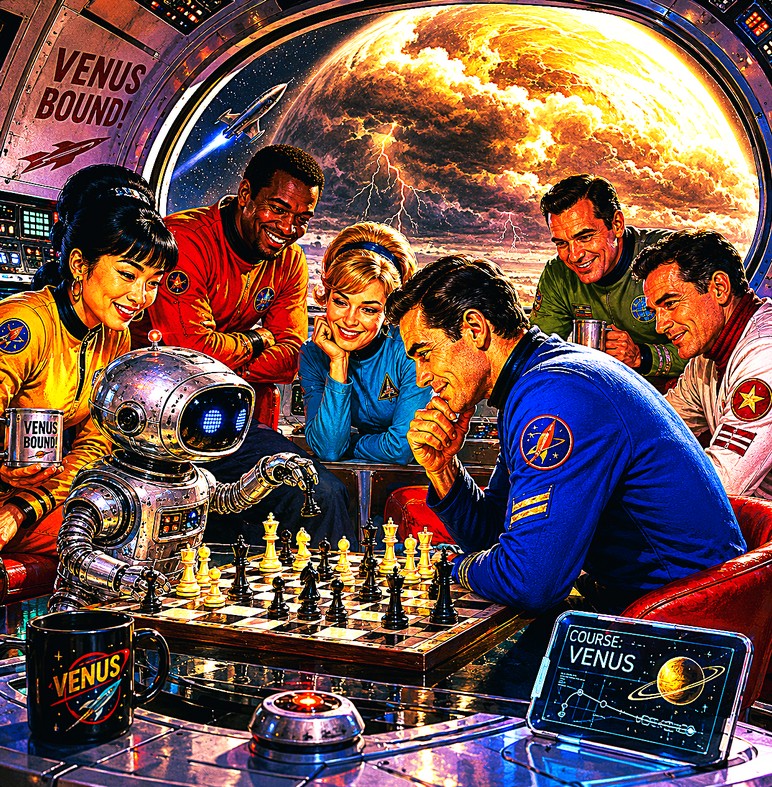
Just to show that in this ideal society that everyone can be a winner and that losers can also be winners, Omega’s programming is fiddled with so that Orloff can win at chess once in a while. One mustn’t have anyone’s feelings being hurt or ego dented. Everyone gets a participation ribbon and can happily skip off into the sunset congratulating themselves at having shown “just a little bit of heart.”
Is it me, or is all this sounding just a bit too familiar?
“it's a cold-blooded blueprint of Destruction”
With Venus just 10 days away, the planet is causing disturbances to radio communication resulting in a cessation of contact with Earth.
In the meantime, Sikarna’s diligence and efforts to translate the alien message using the spaceship's computer has paid off. The spool (“cosmic document”) describes a Venusian plan to irradiate the Earth's surface, enabling the extermination of mankind to take place prior to the conquest and occupation of the earth. This supposed "cosmic document", is in reality a cold-blooded message of destruction.
With this new information at their disposal, the question arises as to whether or not it should be transmitted to Earth. On the one hand, according to Olaff “if the Earth knew of the terrible danger threatening her “unrest and even hysteria would spread like wildfire. From pole to pole the whole world would be in a panic.” On the other hand, it is pointed out that there would be no panic since “for years and years the whole of the human race faced the danger of an atomic war yes and they survived, not through ignorance but through knowledge because they knew what the danger was.” In the end, Harringway convinces the crew to continue on toward Venus rather than return to Earth.
In this idealistic vision of the future, (or propagandised view of cold-war geo-political reality) a belief in the power of communication rather than pursuing a course leading to aggression should be the way forward. The naive sentiment is expressed in the belief that “if we meet the inhabitants of Venus we'll be able to convince them that it would be folly to start that war.” I wonder how that would have gone down if that notion was presented to certain would-be regional and global aggressors of the past….. and of the present?
“”After only 31 days of flight we have nearly reached our
destination”
The intrepid crew of the Kosmoskrator finally reach the planet Venus. They find themselves confronted by an eerily silent planet that stubbornly and inexplicably remains unresponsive to their radio transmissions.
At a meeting of the crew, it is determined they can only land and take off once. They begin to enter Venus’ atmosphere and Brinkman volunteers to descend first with Omega using a small helicopter scout ship. As Brinkman descends through the heavy clouds he soon loses radio contact with the Kosmoskrator.
Back on the ship there is puzzlement over the strange flashes of light bursting all around them. Olaff surmises that the atmosphere is ionised and that atomic radiation is involved. This seems to indicate that they are under attack. It is decided that the ship[ must get below the bank of clouds if the crew wishes to re-establish contact with Brinkman.
Upon reaching the surface, Brinkman is confronted by a dark, foggy, foreboding and radioactive landscape. With the assistance of Omega, he begins exploring the surrounding area. Added to Brinkman’s inability to contact the other crew members, his helicopter scout ship explodes and he manages to fall into a cavern filled with a collection of the goofiest-looking critters you’re ever likely to see - little jumping robot insects.
While Brinkman collects his wits along with one of the little rob0-insectoids, the Kosmoskrator manages to land on the surface, and the crew exit the ship to investigate. Brinkman’s crew mates discover the exploded helicopter and determine that the cause of its destruction is an underground high tension line.
It isn’t long before Brinkman and the crew are reunited. It seems that all they have to do is to follow the power line and it will probably lead them to the inhabitants of Venus. Brinkman thinks that would be pointless as he’s convinced he has already found the Venusians in the form of the robotic insects, one of which he has already purloined.
“Everything is strangely quiet.
Is this the calm before the storm?
Why don't the Venutians answer?”
Aboard the Kosmoskrator an investigation of all available data is conducted and certain conclusions are drawn:
The robotic insects are found to be “completely harmless” and are “not a form of life.” Instead, they appear to be a means of “storing sound in their crystalline nuclei.”
The hole into which Brinkman fell served as a “chamber of archives containing some of the records of this planet.” This begs the question as to where the inhabitants are and as they must have seen the humans’ spaceship. then why did nothing happen?
The surrounding vitrified forest is not a natural formation but is in fact “an enormous energy projector capable of destroying all life within a radius of millions of miles” suggesting that it was “made to be a weapon of aggression but then something went unexpectedly wrong.” Some catastrophe may have taken place that changed the face of the whole planet.
The discovery of a strange white sphere “that looks like an immense golf ball” suggests that it may be a machine, perhaps a giant transformer unit or even a force field generator. Could periodic tension in the main power line indicate that there might still be Venusians inside the sphere who have survived the a colossal catastrophe that befell their planet and are trying to communicate with another station?
“The only thing that is left of them is their shadows”
The crew soon decide to exit the ship and explore by following the main power line to the other end. They drive on for nearly 7 hours without finding a trace of life. Undaunted, the crew press on.
The astronauts later come across formations which are not natural in origin and may have been buildings constructed by the Venusians. It is observed that there “must have been as high a temperature here as on the sun and every living thing was destroyed by an incredible catastrophe.”
The power line eventually leads the astronauts to a structure which they enter. Their attention is drawn to a model of what appears to be Venus and the Earth and their orbits around the Sun suggesting that it might be “a model for instructing space pilots” or is it perhaps something that has “a deeper significance.”
The crew next come across a shaft and a large control room that may be a Venusian nerve centre. With power still running, this begs the question as to who is servicing it?
Perhaps the blobby molasses-like mass they encounter next might hold the answer to their question. Its presence. however only raises more questions. Is it some kid of power source? Is it an organic form of life? What the crew do know for sure is that this strange substance is making a bee-line in their direction. With discretion being the better part of valour, our explorers beat a hasty retreat up the ramp that leads higher up into the towering structure with the Venusian blob in slimy pursuit.
After a couple of close shaves involving Sumiko’s foot nearly being consumed and Duran blasting away with his ray gun at the advancing substance, the crew manage to get away. This in turn opens the door to an almost endless litany of deduction, speculation and scientific crappamajazz:
The model the crew initially spotted twas used by the Venusians to work out their plans of attack on the earth involving calculations to accurately direct intense atomic radiation beans to the planet.
The increasingly red colour of the sphere is creating an artificial force field which strengthens the gravitation of Venus or diminishes it. When the energy is inverted the field will reverse itself and the Kosmoskrator and all on board will be hurled into space.
The dark shadows that were seen on the walls of a structure are the silhouettes of Venusians “thrown on the wall when they were hit by an atomic explosion” and are “now the only thing that is left of them.” What had happened was that their attack on Earth wasn't carried out due to an accident that they didn't expect that occurred and upset their plan. Their “atomic weapons got out of their control” and “a chain reaction was unleashed and they all perished - only their shadows remained.”
[ I guess any system claiming to attain or aim for Utopian status needs to highlight its own sense of inherent superiority to that ‘other’ system by presenting the opposing system as a potential threat that has only succeeded in fashioning the means of its own destruction. We can guess who the players are in this scenario in the context of Cold War rivalry between two competing ideologies. Add to this the then recent memories of the destruction caused by the US atomic bombing of Hiroshima and Nagasaki.]
Some plant seeds that were found on the surface near the Nerve Centre and were most likely carried there by one of the big storms will confirm the presence of life on Venus if they are still fertile.
Somehow the human astronauts triggered a reaction when rock fell into the black mud and as if the Slime were alive it began to grow before moving toward the humans. The firing of the ray gun started an atomic reaction over the entire atomic installation and at 17 hours 10 the sphere turned red.
The Venusians, far advanced in the applications of physics knew how to change mass into energy and could also change energy back into mass. Shut up Einstein!
At some point in all this babbling amongst the crew, Omega seems to have cracked a mental and goes berserk by running over whats his face? Harringway. Even the main computer has downed tools. Something to do with radiation from the petrified or vitrified or enchanted forest outside. I don’t know or care that much. Any way Harringway, Hemmingway or Herringbone or whatever his damn name is has to be operated on.
Radiation increasing!
Radiation shielding insufficient!
Captain suffering internal injuries!
Operation must be performed!
Rocket motors wont operate!
Gravity field increasing!
Nothing is working!
With the Kosmoskrator reduced to “an inert lump of metal,”
what can the crew do?
“There's only one chance, we must try to do what the
Venusians did”
Th crew hit upon the idea of starting the gravity field reverse process involving changing mass into energy. To accomplish this, Chen Yu and the African guy who smiles a lot,Talua will work together at the Venusian city nerve centre. All this while a medical operation is being performed and a hurricane is raging outside.
After arriving at their destination, our stalwart heroes begin their mission with Chen Yü lowering Talua into the Venusian command centre. Suddenly, Chen Yü's spacesuit is punctured and Brinkmann ventures forth from the Kosmoskrator in the copter scout ship to save him. Before he can reach Chen Yü, Talua succeeds in reversing the Venusian weapon. This results in the sphere turning white again and the gravity field reversing. However, with the reversal of Venus' gravitational field, the Kosmoskrator is flung out into space along with Brinkmann who is also flung off-planet, beyond the reach of the spaceship’s crew to save him. As for our poor erstwhile duo, Talua and Chen Yü? As the plaintive and uncomprehending cries of Tulia (“Kosmoskrator! You're taking off? You're leaving me? ….Don't leave me! Don't leave me!”) are blown away by the wind, they are both doomed to remain on the devastated planet Venus until their oxygen runs out.
At least Chen Yu can expire first knowing that the seeds he found are growing thereby proving that there’s still ife on Venus. Lucky, lucky bastard! Added to that little bonus is the consolation that the three men died an honourable and heroic death involving self-sacrifice in the interest of a wider common cause. Ah yes, the kind of message churned out by any number of political and military leaders over the ages right up to this day to justify the courses of action they embark upon no matter how senseless, destructive and inimical to people’s lives.
“We have learned much but we have sacrificed a lot too”
The film closes with the remaining crew returning to earth and delivering sanctimonious rousing and heartfelt speeches to the assembled crowd that greets them. Fist there’s the honouring of their fallen crew-mates and an appeal that they never be forgotten.” This is followed by the revelation that they found “traces of a great civilisation that had advanced beyond our comprehension” together with a salutary lesson and warning that “Venusian science had gone beyond their power to control it” resulting in them being “destroyed by their own machines.” The speeches end with a call to humanity to “use our knowledge to establish life again on Venus and then after that go on to explore the other planets,” this “grave task” being “Mankind’s destiny.”
And thus, the kind of Utopia envisioned and inevitably achieved on Earth in 1985 via a particular ideology with its inherent superiority will presumably be spread throughout the length and breadth of the entire cosmos. Oh yes, and it will take plenty of self-sacrifice on the part of all who cooperatively embark on this grave mission…….
And the reality? What really did happen in……
1985?
Technology
• The Internet's Domain Name System is created.
• William J. Schroeder becomes the first patient with an artificial heart to leave
the hospital.
• Super Mario Bros. is released for the Nintendo Entertainment System.
• Microsoft Corporation’s first US release of Windows 1.0
Space Exploration
• Japan Aerospace Exploration Agency launches Sakigake, Japan's first
interplanetary spacecraft and the first deep space probe to be launched by any country other than the United States or the Soviet Union.
• STS-51-G: Space Shuttle Discovery completes its mission, best remembered
for having Sultan bin Salman Al Saud, the first Arab and first Muslim in space, as a payload specialist.
• New Hampshire teacher Christa McAuliffe is selected as the first person to go
into space under the Teacher in Space Project, and designated to ride aboard the Space Shuttle Challenger.
• The Space Shuttle Atlantis makes its maiden flight.
Politics, International Relations & World Events
• Ronald Reagan is privately sworn in for a second term as President of the
United States.
• Australia cancels its involvement in US-led MX missile tests.
• Lebanon hostage crisis: CNN reporter Jeremy Levin is freed from captivity in
Lebanon. US journalist Terry Anderson is taken hostage in Beirut; he remains a prisoner until December 4, 1991.
• Israel begins withdrawing troops from Lebanon.
• The ideology of Hezbollah is declared in a program issued in Beirut.
• The Provisional Irish Republican Army carries out a mortar attack on the
Royal Ulster Constabulary police station at Newry in Northern Ireland with the highest loss of life for the RUC on a single day.
• A Beirut car bomb, planted in an attempt to assassinate Islamic cleric Sayyed
Mohammad Hussein Fadlallah.
• Mikhail Gorbachev becomes General Secretary of the Soviet Communist
Party and de facto leader of the Soviet Union.
• Soviet–Afghan War: The Soviet Union begins to transfer the burden of
fighting the Mujahideen to the armed forces of the Democratic Republic of Afghanistan, a cause of the Revolutions of 1989.
• South Africa ends its ban on interracial marriages.
• State President of South Africa, P. W. Botha, declares a state of emergency in
36 magisterial districts of South Africa amid growing civil unrest in black townships.
• The Soviet Union performs a nuclear weapon test in eastern Kazakhstan.
• U.S. President Ronald Reagan joins West German Chancellor Helmut Kohl for
a controversial funeral service at a cemetery in Bitburg, West Germany, which includes the graves of 59 elite S.S. troops from World War II.
• The 3rd total Victory Day Parade is held on Red Square in Moscow in the
Soviet Union featuring T-34-85 tanks, veterans of World War II from Poland, Czechoslovakia and the Soviet Union.
• Live Aid benefit concerts in London and Philadelphia raise over £50 million
for famine relief in Ethiopia.
• The wreck of the RMS Titanic is located by a joint American-French
expedition led by Robert Ballard and Jean-Louis Michel.
• Operation Wooden Leg: The Israeli air force bombs Palestine Liberation
Organisation headquarters near Tunis.
• In Geneva, U.S. President Ronald Reagan and Soviet Union leader Mikhail
Gorbachev meet for the first time.
• American naturalist Dian Fossey is found brutally murdered in Rwanda.
Popular Culture
• Australia's longest-running soap opera, Neighbours, debuts on Seven
Network in Australia.
• The 57th Academy Awards are held in Los Angeles, with Amadeus winning
Best Picture.
• The inaugural WrestleMania is held in Madison Square Garden, New York,
•
Disasters & Crises
• Bradford City stadium fire: A fire engulfs a wooden stand at the Valley Parade
stadium in Bradford, England, during an Association football match, killing 56 people.
• Scientists of the British Antarctic Survey announce the discovery of the
ozone hole.
• Forty-four tornadoes hit Ohio, Pennsylvania, New York and Ontario, including
a rare and powerful F5. In total, the event kills 90 people.
• TWA Flight 847, carrying 153 passengers from Athens to Rome, is hijacked by
a Hezbollah fringe group.
• Air India Flight 182, a Boeing 747, is blown up by a terrorist bomb 31,000 feet
(9,500 m) above the Atlantic Ocean, south of Ireland, on a Montreal–London– Delhi flight, killing all 329 aboard.
• The Greenpeace vessel Rainbow Warrior is bombed and sunk in Auckland
Harbour by French DGSE agents.
• Japan Airlines Flight 123 crashes in Japan, killing 520 people, including
Japanese singer Kyu Sakamoto; it is the worst single-aircraft disaster in aviation history.
• British Airtours Flight 28M: The 737's left engine catches fire while on its
takeoff roll at Manchester Airport in the UK and 55 people are killed while trying to evacuate the aircraft.
• The cruise ship Achille Lauro is hijacked in the Mediterranean Sea by four
heavily armed Palestinian terrorists.
• The Nevado del Ruiz volcano erupts, killing an estimated 23,000 people in the
town of Armero, Colombia.
• EgyptAir Flight 648 is hijacked by the Abu Nidal group and flown to Malta,
where Egyptian commandos storm the plane; 60 are killed by gunfire and explosions.
• Rome and Vienna airport attacks: Abu Nidal terrorists open fire in the airports
of Rome and Vienna, leaving 18 dead and 120 injured.
In a few short years the Berlin Wall will come down followed by the collapse of the Soviet Union, the demise of the Warsaw Pact and the consigning of Soviet-style Communism to the dust bin of history. Over forty years after 1985 we’re still awaiting the return of human beings to the moon, the establishment of Luna bases and the first landing of a human crew on Mars. No hurry!
And so, when we got to Venus, what exactly did we find?
“The Soviet Venera program was a series of unmanned space missions undertaken by the Soviet Union to explore Venus. The program began in the early 1960s and lasted into the 1980s. The Venera missions were aimed at studying Venus' atmosphere, surface, and other characteristics.
Here are some key highlights of the Venera program in the 1960s:
• Venera 1 (1961): Launched on February 12, 1961, Venera 1 was the first
spacecraft to be sent towards Venus. However, it failed to make a successful encounter with the planet due to communication issues. Despite this, it provided valuable data during its interplanetary journey.
• Venera 2 (1965): Launched on November 12, 1965, Venera 2 was intended to
fly by Venus and gather data. Unfortunately, contact was lost with the spacecraft before it reached Venus.
• Venera 3 (1965): Launched on November 16, 1965, Venera 3 was the first
spacecraft to impact the surface of another planet. It crash-landed on Venus on March 1, 1966. Unfortunately, due to the extreme conditions on Venus, no data was returned.
• Venera 4 (1967): Launched on June 12, 1967, Venera 4 became the first
spacecraft to successfully enter the atmosphere of another planet (Venus). It transmitted data about the atmosphere's composition, pressure, and temperature during its descent. It confirmed Venus's hostile conditions, with high temperatures and pressures. The mission provided valuable insights into the atmospheric conditions of Venus.
These early Venera missions laid the groundwork for subsequent Soviet and international missions to Venus. Despite numerous challenges and failures, they significantly contributed to our understanding of Earth's neighbouring planet. Subsequent Venera missions in the 1970s and 1980s continued to expand our knowledge of Venus, with some even successfully landing and transmitting data from the planet's surface for extended periods.”
(With assistance from ChatGPT)
What do we know about Venus?
“Venus, often referred to as Earth's "sister planet" due to its similar size and composition, is one of the most intriguing objects in our solar system. Here are some key aspects that are definitely known about Venus:
• Atmosphere: Venus has a thick atmosphere composed mainly of carbon
dioxide (about 96.5%) with traces of nitrogen and other gases. The atmospheric pressure at the surface is about 92 times that of Earth's, which is equivalent to the pressure found at depths of about 900 meters (3,000 feet) in Earth's oceans.
• Extreme temperatures: Venus has an extreme greenhouse effect due to its
thick atmosphere, trapping heat from the Sun. As a result, the surface temperature is incredibly high, reaching about 462°C (864°F) on average. This
makes Venus the hottest planet in our solar system, even hotter than Mercury, which is closer to the Sun.
• Surface features: Venus has a relatively young surface, with evidence of
volcanism and extensive lava flows. The planet's surface is dominated by vast plains, highland regions, and thousands of volcanoes, including some large shield volcanoes similar to those found on Earth, such as Maat Mons and Sapas Mons.
• No water: Unlike Earth, Venus has no liquid water on its surface. The extreme
temperatures and high atmospheric pressure make it impossible for water to exist in liquid form. Any water that may have existed in the past would have evaporated and been lost to space.
• Retrograde rotation: Venus rotates on its axis in the opposite direction to
most other planets in the solar system, a phenomenon known as retrograde rotation. This means that the Sun rises in the west and sets in the east on Venus.
• Thick cloud cover: Venus is shrouded in thick clouds of sulfuric acid
droplets, which completely obscure the planet's surface when viewed from space. These clouds reflect much of the sunlight that reaches Venus, contributing to the planet's high albedo (brightness).
• Lack of a magnetic field: Unlike Earth, Venus does not have a significant
magnetic field. This absence of a global magnetic field allows solar wind to directly interact with the planet's atmosphere, leading to significant atmospheric erosion over geological time scales.
These are some of the fundamental characteristics of Venus that have been established through observations and spacecraft missions. However, there is still much to learn about this enigmatic planet, and ongoing research and exploration efforts continue to uncover new insights into its geology, atmosphere, and history.”
(With assistance from ChatGPT)
Sorry folks, no Venusians!
Points Of Interest
First Spaceship on Venus was a large-scale East German-Polish co-production and the first to be shot in the Totalvision widescreen process.
The film was based on Stanisław Lem’s 1951 novel "Astronauci" ("The Astronauts"). To get his novel published, Lem had to incorporate some pro-communist elements. Althoughj the communist elements were minimised in the film, one can’t escape the propagandist undertones and naive Utopian view of the future that would result under a system quite different from the capitalist West which it seems to be suggested stands as a destructive potential threat to all of mankind.
Still, the film’s propaganda content is far more watered down than many examples of American cringe-worthy sci-fi films of the Cold-War era that were overtly filled with anti-communist and anti-Soviet paranoia.
One thing that can be said about First Spaceship on Venus is that it is a good-.looking film. The design of the sets and props is excellent. The interior of the Kosmoskrator conveys the feel of a real and functional spacecraft compared with many other examples of the time. The use of surface rover vehicles and a copter scout ship are quite believable considering developments that have been made in the areas of Lunar and Mars exploration in the last few years. The idea of sending an entire spacecraft to another planet, landing on the surface and then taking off to return home was still up for consideration in 1960. It would be another couple of years before the concept of orbital rendezvous and docking involving a command and landing module would be favoured.
I have to say that I found it hard to relate to any of the characters in the film. Each of the crew seemed like hollowed-out artificial constructs all intent on expressing just the right sentiments. The whole feel of the film was rather stilted and orchestrated, even down to the laughter, probably a reflection of the kind of system that produced it?
The film was intended to be a high-profile release by DEFA (Deutsche Film-Aktiengesellschaft - the state-owned film studio of the German Democratic Republic)for the tenth anniversary of the German Democratic Republic (East Germany) and was the most expensive production for DEFA up to that time.
In the US, the film was distributed in an edited and English- dubbed version as First Spaceship on Venus through Crown International. It was at the top of a double feature with Varan the Unbelievable (1962). It became Crown's most successful double feature.
The writing process involved three writing teams and 12 screenplays before a final script was acceptable to the studio and (who else?) the government.
At one point DEFA intended to establish a co-production with a French company for financing and script-writing but Communist government officials disapproved of DEFA's pursuit of Western partners.
I know that in the English-dubbed version of First Spaceship on Venus the spacecraft is called the Cosmostrator, whereas in the original German and Polish versions it is called the Kosmokrator. I combined the two by referring to it in this post as the Kosmoskrator. Why? Coz I liked it and felt like it, so there!!
In the English-dubbed version, Brinkman an American was in the original version, an East German. In the film, he is shown flying a 2-seat MiG-15 fighter with East German markings on the plane's tail. This is rather curious as the presence of a 1950's aircraft appears out of place in a story set in the future of 1985. In fact, East Germany retired the plane as late as 1984.
It is important to keep in mind that this film was released only three or so years after the Soviet Union successfully launched the first artificial satellite and scared the heck out of the West. It was also a year or so before the Soviets sent a craft to the moon that captured images of the moon’s far side while the US lagged far behind in the space race. Not long after the film was made, the Soviet’s scored big time with the launching of the first human being into space (Vladimir Ilyushin / Uri Gagarin). It would not until 1975 and 1982, when four of the Soviet Union’s Venera probes captured our only images of Venus’ surface. The panoramic images revealed yellow skies and desolate landscapes, perhaps showing us a world that may have once been like Earth but had experienced a catastrophic runaway green-house effect. Perhaps a salutary lesson for humanity and the planet we call home?
**************
The Phantom Planet (1961)
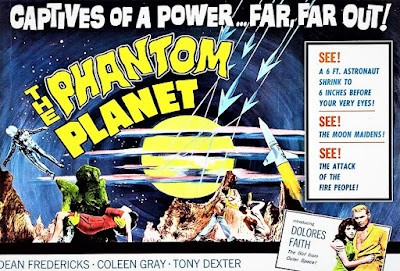
A fun sci-fi film with minimalist production values and special effects, both

matching its budgetary constraints but with interesting ideas such as anti-gravity
and magnetic fields. Unfortunately, it fails to launch far enough away from the world
of 1950s film sci-fi and take the viewer into the brave new world of the future.
Phantom Planet will, however grow on you after a couple of viewings, especially the
colourised version.
Directed by William Marshall
Screenplay by William Telaak, Fred De Gorter, Fred Gebhardt Story by Fred Gebhardt
Produced by Fred Gebhardt
Cinematography: Elwood J. Nicholson
Edited by Hugo Grimaldi
Music by Leith Stevens
Production company: Four Crown Productions Inc. Distributed by American International Pictures
Running time: 90 minutes
Cast
Dean Fredericks as Capt. Frank Chapman
Coleen Gray as Liara
Anthony Dexter as Herron
Francis X. Bushman as Sessom
Jimmy Weldon as Lt. Webb
Dolores Faith as Zetha
Richard Weber as Lt. Ray Makonnen
Al Jarvis as Judge Eden
Dick Haynes as Col. Lansfield
Earl McDaniels as Capt. Leonard
Mike Marshall as Lt. White
Richard Kiel as The Solarite
Merissa Mathes as Juror
Angelique Pettyjohn as Juror
Journal of (former) Captain Frank Chapman (USAF Space
Exploration Wing)
“Since the splitting of the atom only a few decades ago and through his god-given genius of science, man at last has succeeded in penetrating further and further into the unknown vastness of space. The moon has become the launching base for advance exploration. From this pivotal point astronauts at the risk of their lives set out to conquer nature's mysterious forces, yet many questions remained unanswered:
• What is his earth in relation to the inconceivable number of other worlds?
• Is his speed truly the fastest?
• His achievements the greatest?
• Or is he a mere unimportant piece of driftwood floating in the vast ocean of
the universe?
• Could there be life similar to our own on other planets?
• Is it not possible that atmospheric conditions of relative environments control
their shapes and forms?
• If so, would they be giants…. or could perhaps the opposite be true?
• Could their intellect have reached a scientific level far above man's dreams?
• What then will the future reveal” should the story I am about to set down here
somehow finds its way into the public domain, is believed and constitutes “only the beginning?”
Humanity had been drifting on a cloud of smug self-satisfaction since the first manned moon mission at the end of the 1960s. Since then we had established lunar bases and at the start of the 1980s we were on the eve of a mission to Mars. Suddenly just over a year ago things started going wrong.
On 16th March 1980 Pegasus 3 while on its last day of space reconnaissance research flight 361 for the US air force Lunar Base One and at 21 000 miles from the base, encountered a large planetoid object on a direct collision course with the ship. The uncharted planetoid had somehow failed to register on the ship’s long-range sensors. After Captain Leonard reported having lost control of the Pegasus, his ship seemed to have just mysteriously disappeared. Another spacecraft had inexplicably vanished seemingly without a trace and without a reason.
As rumors began to spread involving space monsters and phantom planets, I together with my navigator Lt. Ray Makonnen were ordered to investigate. Well, for me there went the Mars project for which I had been preparing!
All that was known was that there were two ships on routine missions both with flight controls and rockets in order having gone missing in less than a month with nothing within thousands of miles of their position. Despite all this, they somehow managed to crash into something that appeared suddenly on our radar big enough to be a planet and then the next instant it disappeared “against all theories of space.” This mysterious planet seemed to come and go at such speeds it was impossible to track.
There was nothing for it but to conduct a reconnaissance for “something out there that isn't supposed to be.” Otherwise, if this Phantom planet mystery wasn’t cleared up and the rumours surrounding it dispelled, there wouldn’t be any Mars project for me or anyone else to be on.
Lt. Ray Makonnen and I soon began our search aboard Pegasus 4. Our mission involved us charting the same course Pegasus 3 took. At 18 000 miles out at 270 degrees azimuth and 47 degrees ecliptic with our speed at 4.6 miles per second, we felt that we weren’t getting anywhere considering the fact that this mysterious phantom planet was dashing about all over the place. We therefore decided to change course. After all, “lightning never strikes twice in the same place” and all we could do was be patient even though we ran the risk of going nuts just waiting for something to happen.
Suddenly the electrostatic meters started going haywire. Lunar Base One then informed us that we were completely off course. We had entered a heavy magnetic field resulting in several instruments failing and with others about to fail.
With all this happening and despite an impromptu course change, Pegasus 4 sustained damage from a meteor shower, requiring Lt. Makonnen and I to go outside our ship to make repairs.
It was a fairly routine procedure to effect the required repairs, but as luck would have it a micro meteor struck and pierced my suit’s air hose rendering me unconscious.
Lt. Makonnen managed to repair the hose, but as we were at the entrance to the airlock hatch, he must have been fatally struck by a similar micro-meteor. Before being propelled into deep space, it seems that Lt.,... Ray had somehow managed to push me inside the ship and close the airlock hatch.
When I came to I found Ray gone and try as I might, I discovered I was unable to communicate with the lunar base. I then decided to record a log entry outlining what had happened and what course of action I would take now that Pegasus 4 was completely out of operation and that I was unable read my position.
The only choice I felt I had was to make a forced landing on a near-by asteroid that was somehow exerting a force on Pegasus and pulling the spaceship in towards it.
Having successfully landed on the asteroid and still feeling the effects of the EVA accident, I donned my spacesuit and exited the ship. I literally couldn’t believe my eyes for as I began to collapse I observed what appeared to be tiny six inch humanoids warily approaching me. Once my helmet visor was opened, I found that I could breathe but what happened from this point on although hazy and unclear at first, set me on a path toward a destination where I now find myself committing my experiences to paper before they dissolve into the realm of fantasy and dreams.
When I came to my senses, I discovered that I was no larger than any of the inhabitants of this planetoid which I found out is called Rheton. Even more disconcerting was the fact that my ‘welcoming party’ had dragged me off to the caves in which the diminutive inhabitants dwelt to appear before their elder ruler Sessom and their highest juridical authority, Judge Eden. I was there to face criminal charges!
I suppose you’ll wind up thinking that my story sounds like something out of Gulliver’s Travels, but I tell you it’s true! In this alien land of Lilliput, I had no trouble understanding what was said to me as they apparently had the ability “to translate all languages through voice tone waves,” whatever that meant.
Although only six inches in height, the inhabitants of Rheton are physically the same as human beings in appearance. I know this fact doesn’t help my case in terms of my story’s believability, but who’s to say what alien life has to look like or that intelligence must be determined by size?