

Sci-Fi Film Fiesta, The Swingin' 60s - Volume 7: They're Damned, Man....DAMNED! by Chris Christopoulos - HTML preview
Download the book in PDF, ePub for a complete version.
Introduction
In the shadowy twilight between the optimistic dawn of the Space Age and the deepening anxieties of the Cold War, a remarkable strain of science fiction cinema emerged that dared to ask unsettling questions about humanity itself. The films gathered in Sci-Fi Film Fiesta: The Swingin’ 60s – Volume 7: “They’re Damned, Man… DAMNED!” are united not merely by their themes of apocalypse, mutation, alienation, or social collapse, but by a far more disturbing proposition: perhaps the true danger to humanity is humanity itself.
From the eerie, platinum-haired children of Village of the Damned and Children of the Damned to the irradiated youth and moral decay lurking beneath the cliffs of These Are the Damned, and finally the plague-ravaged loneliness of The Last Man on Earth, these films reflect a world gripped by fear, uncertainty, and profound self-doubt. Produced during a decade of nuclear brinkmanship, ideological conflict, rapid scientific advancement, and generational upheaval, they channel the growing suspicion that modern civilisation, for all its technological triumphs, may have fatally compromised its own soul.
The early 1960s were haunted by the spectre of annihilation. The Cuban Missile Crisis brought humanity terrifyingly close to nuclear war. Governments spoke openly of fallout shelters, mutually assured destruction, and the possibility that entire populations could vanish in a blinding flash. Science fiction cinema absorbed these anxieties like radioactive fallout drifting through the cultural atmosphere. Yet unlike the giant monster spectacles and bug-eyed invaders of 1950s sci-fi, the films in this volume turn inward. Their horror is psychological, moral, and existential. The enemy no longer comes solely from outer space or distant laboratories; it emerges from within society, within science, within ideology — even within ourselves.
In Village of the Damned, adapted from John Wyndham’s chilling novel The Midwich Cuckoos, the children are both innocent and terrifying: emotionless beings possessing superior intelligence and frightening collective power. They represent the fear of a generation that no longer recognises its own offspring — a fear sharpened in an age when youth culture was rapidly transforming social values and traditional authority structures were beginning to fracture. The children are not overtly evil, yet their existence threatens humanity’s dominance. The film’s enduring power lies in its refusal to offer comforting certainties. Are these children monsters… or simply the next stage in evolution?
That same ambiguity runs through Children of the Damned, which expands the concept into an even more global and politically charged nightmare. The gifted children of many nations expose the impotence and paranoia of governments trapped within Cold War thinking. Military officials and political leaders react not with understanding, but with fear and violence. The children may possess terrifying powers, yet it is adult humanity’s inability to transcend suspicion and aggression that proves truly destructive. In this sense, the “damned” may not be the children at all, but the adults who cannot imagine a future beyond conflict.
Perhaps the bleakest social commentary arrives in These Are the Damned, one of the most underappreciated British science fiction films of its era. Beneath its leather jackets, juvenile delinquents, and windswept coastal atmosphere lies a savage critique of Cold War fatalism. The government’s secret plan to preserve radioactive children for survival after nuclear catastrophe is chilling not simply because it exists, but because it assumes annihilation as inevitable. Humanity, the film suggests, has become so resigned to self-destruction that it now prepares future generations not for life, but for inheritance of a ruined world. The children hidden underground are tragic symbols of innocence sacrificed to political cynicism and militaristic thinking.
Then comes The Last Man on Earth, starring the great Vincent Price in one of the most haunting performances of his career. Based on Richard Matheson’s groundbreaking novel I Am Legend, the film strips civilisation down to its barest essentials. The apocalypse here is intimate, lonely, and spiritually exhausting. The deserted streets and empty houses evoke not merely physical extinction, but the collapse of meaning itself. Price’s Dr. Robert Morgan clings desperately to the remnants of a vanished world, believing himself to be the last representative of “normal” humanity. Yet as the story unfolds, the devastating irony becomes clear: Morgan himself has become the outsider, the relic, the monster feared by a new society struggling to emerge from catastrophe.
This theme — that humanity may be judged and found wanting — gives this volume its unusual emotional and philosophical weight. These films are not merely cautionary tales about science gone wrong or civilisation under siege. They are meditations on fear, intolerance, violence, and the tragic inability of human beings to adapt ethically to the powers they unleash technologically. They ask whether humanity deserves survival if it cannot overcome paranoia, tribalism, and self-destructive impulses.
Modern audiences may find these films more relevant now than ever. Today’s world wrestles with artificial intelligence, genetic engineering, pandemics, environmental collapse, disinformation, and renewed geopolitical tension. Once again, society faces questions about whether technological progress is outpacing moral wisdom. Once again, younger generations inherit crises created by their predecessors. Once again, fear threatens to eclipse compassion and understanding.
What makes these films endure is that they resist simplistic answers. Their monsters are often sympathetic. Their humans are often flawed. Their endings rarely offer triumph. Instead, they leave audiences with lingering unease — the unsettling suspicion that the line between salvation and damnation is perilously thin.
In the end, “They’re Damned, Man… DAMNED!” is not simply a cry of horror directed at alien children, irradiated survivors, or plague-born mutants. It is humanity staring into a dark mirror and recoiling from what it sees. These films remind us that science fiction, at its best, is never really about the future. It is about the present — about who we are, what we fear, and whether we possess the wisdom to survive ourselves.
*************
Village of the Damned (1960)
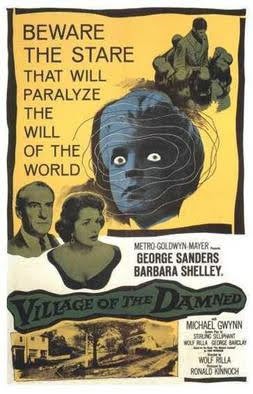
A sinister horror picture with superb believable performances, an excellent mix of

horror and science fiction genres as well as taut and suspenseful direction from
Wolf Rilla.
Directed by Wolf Rilla
Screenplay by Stirling Silliphant, Wolf Rilla, Ronald Kinnoch Based on “The Midwich Cuckoos” 1957 novel by John Wyndham Produced by Ronald Kinnoch
Cinematography: Geoffrey Faithfull
Edited by Gordon Hales
Music by Ron Goodwin
Production company Metro-Goldwyn-Mayer
Distributed by Loew's
Running time: 77-78 minutes
Budget: $320,000
Box office: $2,175,000
Cast
George Sanders as Gordon Zellaby
Barbara Shelley as Anthea Zellaby
Martin Stephens as David Zellaby
Michael Gwynn as Alan Bernard
Laurence Naismith as Doctor Willers
Richard Warner as Mr. Harrington
Jenny Laird as Mrs. Harrington
Sarah Long as Evelyn Harrington
Thomas Heathcote as James Pawle
Charlotte Mitchell as Janet Pawle
Denis Gilmore as Keith Harrington
Pamela Buck as Milly Hughes
Rosamund Greenwood as Miss Ogle
Susan Richards as Mrs. Plumpton
Bernard Archard as Vicar
Peter Vaughan as P.C. Gobby
John Phillips as General Leighton
Richard Vernon as Sir Edgar Hargraves
John Stuart as Professor Smith
Keith Pyott as Dr. Carlisle
BBC “History's Mysteries – Fact & Fiction” TV Program
Good evening, I’m your host Denis Vaughan. In tonight’s episode we’ll be examining the so-called “Midwich Time-out Incident” that reportedly occurred back in 1960 when it is said that the inhabitants of the British village of Midwich suddenly and inexplicably fell unconscious one day for several hours. Anyone entering the village also apparently succumbed to the same malady.
It is only recently that we have been able to piece together the events surrounding this inexplicable incident through numerous Freedom of Information requests. Much information has been denied to us and a great deal of the documentation (official government, scientific, military and medical sources, along with minutes from various meetings) is in some instances heavily redacted.
Surprisingly, but probably largely as a consequence of the application of the Official Secrets Act, no-one from the village in all the intervening time has come forward to give an open and public account of what transpired all those decades ago. That is apart from one individual now well into his seventies who we’ll refer back to later on. It is as if a cordon of silence has surrounded and encased Midwich and that as far as the residents of the village past and present are concerned, it is none of the outside world’s business what took place there.
To begin with though, we do know that the military established a cordon around Midwich. This was then followed by the establishment of a five-mile exclusion zone around the village for all aircraft. After a few hours, the villagers suddenly regained consciousness, and appeared to be unaffected. Or so it was believed…..
What followed these initial events with the passage of time will have the quality of a work of pure science fiction, so much so that many in government, the military and the scientific establishment scoff at the very idea of any such incident as ever having taken place.
We now take you to Midwitch village in rural England where our investigative reporter, Barbara Long will try from whatever evidence is available to reconstruct the mysterious events of what has come to be called the “Midwich Time-out Incident.”