

Sci-Fi Film Fiesta, The Swingin' 60s - Volume 7: They're Damned, Man....DAMNED! by Chris Christopoulos - HTML preview
Download the book in PDF, ePub for a complete version.
Part 5:
Midwich Cuckoos-
The Changelings
It had become quite clear to Professor Zellaby that his plan to establish communication with the children had broken down. It was apparent that they had to be stopped before they expanded their power beyond the village.
Back at Midwich, it seems that an angry and fearful group of male villagers had formed a vigilante mob and armed with farm implements and flaming torches they headed off to do something about the children seeing that the authorities appeared to be dragging their feet on the matter. They then apparently advanced on the school house intent on burning it down along with the children inside. It all went horribly wrong when one of the children, most likely Zellaby’s son, David went outside to confront the advancing mob. One of the men was reported to have fallen into a trance-like state and while under the boy’s power was forced to set fire to himself.
An entry from Major Alan Bernard’s report indicates that he witnessed the above incident and decided to enter the school-house to confront David. David then informed him that despite the destruction of the Russian colony, a similar fate would not befall Midwich’s colony. His reasoning as quoted in the report: “...because we have to survive, no matter what the cost, and you must learn that we are determined to survive.”
Yes, indeed. It would seem that life no matter what form it takes will always try to find a way to survive and spread. It is all part of a brutal process of the struggle for survival. These golden-eyed children were recognised as being intruders or “changelings” or indeed “cuckoo-children.” You see, the cuckoo’s egg somehow manages to wind up in another bird species’ nest, hatches, is slavishly reared by its ‘surrogate’ mother and is motivated by its instinct for survival. The cuckoo chicks will kill the other chicks in the nest in competition for food and parental attention. “The cuckoo survives because it is tough and single-purposed.” As indeed these “cuckoo-children” were!
Major Bernard reported that his mind had been taken control of and a message that the children just wanted to be left alone was relentlessly driven into his consciousness before he was released. Later, an examination by Dr Willers revealed that Bernard appeared to have been suffering the worst case of shock the doctor had ever seen.
In a letter left in Zellaby’s desk drawer, the professor mentioned that David later arrived at the house and informed him that the children had decided to leave the village and “spread out and disperse” and eventually “form new colonies.”
As they had already “attracted too much attention,” David insisted that his father help them to leave and it was arranged that Zellaby would return later to the school house with the necessary arrangements for the departure of the children from Midwich.
According to Major Bernard’s report and Anthea Zellaby’s personal journal, Gordon seems to have come up with a scheme involving a resolution of the situation involving the children – one of a drastic nature as evidenced by his strange behaviour, demeanour and comments. For instance, he arranged for his wife to travel back to London with Alan and as they prepared to leave, Zellaby seemed to have been very pensive and emotional. Considering what happened next, we can understand why.
Together with the information in Zellaby’s hurriedly written letter, we can infer much of what took place from this point onwards. When the others had departed and he was alone, Zellaby must have constructed a time-bomb with the aim of destroying the children. The problem with such a plan as you may have already guessed is how to carry it out without the children detecting his true intentions.
One authority in the area of psychiatry suggested to us that someone with the intellect and will of Zellaby would have to blank out his thoughts by visualising something like a brick wall and use this as a means of self-protection against the children’s mind-reading power.
It appears that Zellaby then left with the time-bomb concealed in his brief-case to conduct his usual session with the children at the school-house. Once there, he must have tried to block any thoughts of the bomb and its detection by the children by using a mental visualisation trick such as the suggested brick wall example.
In the meantime, while driving to London, Anthea realised that something was amiss, and instead headed back to Midwich to try and stop her husband from carrying out his intended course of action – whatever from her point of view that may have been.
It appears that the children did try to break down Zellaby’s mental defence barrier and actually succeeded but ran out of time. Neither the children nor Zellaby managed to escape the final fateful conclusion….
As Anthea and Bernard arrived at the school at precisely 8:27pm, an explosion tore through the building and forever rent the fragile fabric of the little village of Midwich. Denis, as we end our report and depart the village of Midwich, we might stop and ponder the following: On the one hand, there was the irrationality borne of fear of the unknown. On the other there was immense power impelled by the requirements of survival, governed by rationality and exercised without the restraint of ethics and morality and feelings of empathy. With the clash of these two opposing forces there seemed to be no room for two species to learn and help to live with one another.
Denis Vaughan: Thank you Barbara for that amazing and very unsettling report. We must also stop to consider these questions as they could just as easily apply to many of the other mysterious incidents we cover on this program:
• Did these events take in fact take place?
• Was it a result of a cruel trick played on humanity by nature?
• Was there some kind of extra-terrestrial intervention or invasion?
• If so, what would be the outcome when we surely will come into contact with
a truly alien species?
• Was it an misinterpreted gift to us from our future?
• Was a secret government or military experimental program responsible?
• Has there been a massive governmental and military cover-up?
• Or was it all just an elaborate hoax further fuelled by conspiracy theorists?
You be the judge. Until next time, this is Denis Vaughan for BBC’s “History's Mysteries – Fact & Fiction.”
Points Of Interest
“Village of the Damned” (1960) is based on John Wyndham novel,"The Midwich Cuckoos" about a British village visited by unknown (most likely extra-terrestrial) life form which leaves all women of child-bearing age of the village pregnant.
There is also a sequel, “Children of the Damned (1964)” and a remake, John Carpenter's “Village of the Damned” (1995). Neither quite matches the quality and atmosphere of the original.
“Village of the Damned” was originally intended to be an American produced picture starring Ronald Colman but MGM shelved the idea due concerns with some the issues that were to be dealt with in the film. A couple of years later the film was relocated to England and shot on location at Letchmore Heath, with George Sanders replacing Colman who had recently passed away.
The film had a shooting schedule of six weeks and a budget of £82,000. Despite the film’s small budget and sparse use of special effects, the performances of the cast and almost documentary style of story telling gives the film a very engrossing, disturbing and terrifying quality.
Most filming took place at MGM's Borehamwood Studio but it was also shot on location in the village of Letchmore Heath near Watford, approximately 12 miles (20 kilometres) north of London with Local buildings such as The Three Horseshoes Pub and Aldenham School used during filming.
The glowing-eye effect was achieved by creating animated overlays of a bright white iris; this created a bright glowing iris with a black pupil when optically printed into the film. This technique was used mostly on freeze-frame shot to create the required effect.
The blonde wigs that the children wore were padded to give the impression that they had abnormally large heads.
What makes the film particularly disturbing is the notion of children, who we ought to cherish and protect actually becoming our worst nightmare. The belief in children’s supposed innocence and our natural human attachment to our offspring is being used and weaponized for the purpose of world domination. Added to this is the unsettling fear of helplessness on the part of adults to do anything about the situation.
“Village of the Damned” is certainly a film of its time as can be seen not just from the more obvious elements but also from its avoidance of using the term “pregnant” as well as it’s subtle anti-nazi commentary relying on people’s recollections of Nazi German Aryan blond and blue-eyed superior race notions. Hell, even the Commie Soviets didn’t want any part of their children’s colony after a while and ended nuking them!
One final and interesting point of interest is when the military are testing Midwich for radiation after everyone wakes up, you’ll notice a sign in the background that reads, "Beware of Children."
***************
These Are The Damned (1962)
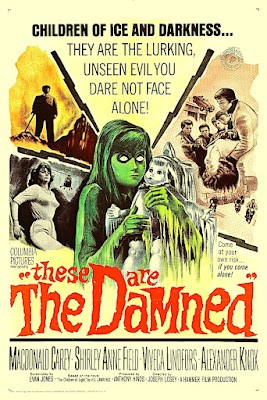
Quite a powerful sci-fi film with social commentary and philosophical / moral

implications. Solid acting performances and good cinematography.
Directed by Joseph Losey
Screenplay by Evan Jones
Based on The Children of Light 1960 novel by H.L. Lawrence Produced by Anthony Hinds
Cinematography: Arthur Grant
Edited by Reginald Mills
Music by James Bernard
Production company
Hammer Film Productions
Distributed by Columbia Pictures
Running time 87 minutes (UK), 77 minutes (US) Budget: £160 – 170,000 approx.
Cast
Macdonald Carey as Simon Wells
Shirley Anne Field as Joan
Viveca Lindfors as Freya Neilson
Alexander Knox as Bernard
Oliver Reed as King
Walter Gotell as Major Holland
James Villiers as Captain Gregory
Tom Kempinski as Ted
Kenneth Cope as Sid
Brian Oulton as Mr. Dingle
Barbara Everest as Miss Lamont
Alan McClelland as Mr. Stuart
James Maxwell as Mr. Talbot
The children
Rachel Clay as Victoria
Caroline Sheldon as Elizabeth
Rebecca Dignam as Anne
Siobhan Taylor as Mary
Nicholas Clay as Richard
Kit Williams as Henry
Christopher Witty as William
David Palmer as George
John Thompson as Charles
What could the following possibly have in common?
The southern English resort of Weymouth.
An American tourist.
A youth gang leader.
His troubled sister.
A top secret government facility.
A shocking experiment.
A group of nine children.
“The age of senseless violence has caught up with us, too”
To find out, we’ll need to begin our journey with a bird's eye view of ocean waves crashing on the remote shore below a rocky cliff on the south coast of England. Atop the cliff and along its edge we spot a collection of bronze sculptures looking like fallen grotesque, disfigured and charred human remains: Something akin to Southern England’s version of Easter Island’s mysterious stone sentinels? What do they stand as testament to? A message to a future with no0one left to decipher what they had borne witness to in the dim past?
Come now and let us descend to the land of the living at the resort of Weymouth to the accompaniment of the Black Leather Rock song:
"Black leather, black leather, rock-rock-rock.
Black leather, black leather, ta-ta-ta.
Black leather, black leather, hip-hip-hip.
I got that feeling - black leather rocks!…"
Despite the pleasant vacation setting, we’ve entered a time and place of uncertainty and fear that often comes with a sense of impending unsettling change. It is a time of fear of youth who are labelled as juvenile delinquents who seem to show a disregard for authority and long established traditions and who would rather seek thrills, kicks and validation as members of movements, groups and gangs such as Beatniks, Teddy Boys, Mods and Rockers, Bodgies and Widgies. It is a time when people also fear for a future that could be snatched away from them and carried sky-ward in a mushroom cloud at any time.
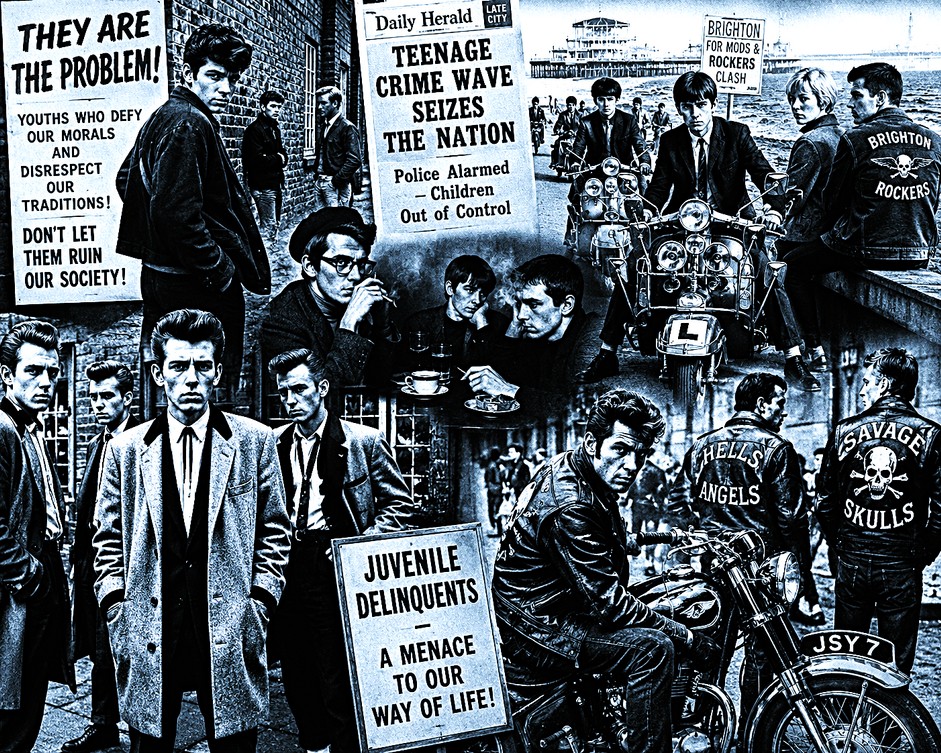
Image generated by Chatgpt
And so beneath the town's clock tower we see a leather-clad motorcycle gang known as the Teddy Boys, led by King who is attired in a checked-plaid jacket and carries an umbrella that conceals a blade. See how they disrespectfully drape themselves over and around the monument dedicated to England\s “mad” King George the third as if history had no relevance at all to them deserving only mockery and disdain.
We can tell the gang is up to no good and it seems that the unsuspecting Simon Wells is about to become the victim of a set up involving the gang and a rather attractive 20 year old by the name of Joan who is King’s sister.
Poor Mr Wells, a recently-divorced, middle-aged American tourist who just decided to drop out of the rat race by resigning as an insurance executive. Here he is on vacation having sailed in on his yacht to Weymouth. All Joan has to do is wiggle her behind and the silly old boy quickly takes the bait, hook, line and sinker. For his troubles, Simon is savagely and cold-bloodily mugged by the gang who steal his wallet and watch. So, “you 'appy in your work, Joanie?”
Well, Simon it seems that what appears to be two policemen have found you and are taking you towards a bar to recover and as fate would have it this is where you meet Bernard and his mistress, Freya Neilson.
Freya is an artistic-type who creates sculptures such as the “graveyard bird” she shows to Bernard. She is very much an unconventional free thinker and seems to recognise the irony of a situation and sees things with a rather jaundiced eye.
Here comes the battered and worse for wear Simon accompanied on to the terrace by Major Holland and Captain Gregory who are not police officers but who as Freya wryly observes “belong” instead to Bernard. It is obvious and by implication an accepted fact by the men that Simon had been beaten up by the Teddy Boys, but Freya thinks it is more to point to understand “why” they did so.
Perhaps it is just that “the age of senseless violence” has inevitably arrived or that “people who know what they're talking about” c an offer up explanations as to why such things happen. Believing that one knows all the answers might bring a sense of satisfaction but from Simon’s viewpoint that wouldn’t do as he wouldn’t “like the answers” and what they might say about humanity.
Freya feels a certain rapport with Simon “'cause he doesn't like the world.” For her “it's a good beginning” possibly because seeing it for what it is might help lead one on to doing something about it? Or, like herself, does such an attitude merely lead one to separate or divorce oneself from the rest of humanity?
Now what of Bernard, the one without the surname? He has “military friends” who apparently “belong” to his “mysterious project.” He is a shadowy man with secrets and whose entire life is stamped with “TOP SECRET.” This is an aspect of Bernard that Freya hates, but as Bernard chillingly points out, if he were to disclose any of his secrets to her he’s be condemning her to death.
Now, how’s that for laying a few breadcrumbs for you! I bet you’re dying to know more about the secretive nature of Bernard’s work and what his top secret project is all about…….
“You had the choice of staying with King or coming with me”
I’m afraid though that these discoveries will have to wait until after certain discoveries of a more personal human nature are to be revealed. See now as Joan with the gang in tow makes their way to where Wells has docked his small boat. Wells seems prepared to forgive Joan for what happened but she suggests that he asked for it after trying to pick her up believing she was just some tart.
King and the gang approach and it is soon apparent that King has a rather disturbing possessive and controlling relationship with his sister. Earlier he said to her “it's you and me against the world. It's been this way since we was kids” to which she replied “he (Wells) offered me his arm to cross the street.” Initially though, both Wells and Joan came together for rather selfish material reasons, one for the prospect of having sex with “a little tart” and the other for money and kicks.
Before the gang arrives, Wells tells Joan how he decided to give up his work as an insurance executive seeming to imply that we all have choices when it comes to changing the direction of our lives. However, perhaps for some people making such choices is not so clear cut as Joan points out to Wells that “it's a nice life…..to be able to give it up, if you don't like what you're doing...”
Now let’s turn back to King as he orders his sister to get out of the boat and appears to threaten her when she tries to defy him by warning her not to “do that again, Joanie.” His perverted controlling relationship with his sister is evidenced by his asking Joan, “do you think I'll let a man put his dirty hands on you?”
To the accompaniment of the gang’s taunts,Wells sets off on his boat but watch as Joan suddenly runs off from the others when Wells calls to her to “give it up!” and jump into the boat. An act of defiance and making a choice! But will this amount real and meaningful lasting change or is it a mere chasing after unicorns? Can it be that easy?
Not for Joan apparently who asks Wells what he’s going to do now that he’s carried her off. She can’t return to Weymouth fearing what King will do – the brother who had locked her, a 20 year old in a cupboard for a week after she went out with a man. And now she’s “stuck here in the middle of the ocean on a boat” with King waiting for her to go back.
For Wells, Joan had the choice of staying with King or coming with him and she made that choice “out of pure instinct.” Suddenly, in a “clumsy and brutal” move, Wells tries to force himself on Joan almost reinforcing what her brother had said about him. Despite Well’s regret and apology, Joan asks to be put ashore. Here she is making a decision, her decision and not one being made for her: to not spend her life running away like Simon but instead returning to deal with the life that she has.
“Some day, they'll have to be told everything”
"When the time comes"
While Simon and Joan head back to shore, let us head over to a military base that is connected with coastal caves within which reside nine children, all aged 11 and who appear to be connected with Bernard’s top secret project. There seems to be some distension among the scientific and military staff that run the facility which whether it be a “guided” or “rusty” cage, is nevertheless a prison for its young inmates. There is questioning over the project’s purpose and whether or not they can provide the children with values that will in the future mean anything. This speaks volumes as to the kind of future that is expected!
As you can see the children are exceedingly well-mannered, healthy and very intelligent. What is unusual about them though is that they know little about the outside world, that they live their lives under continuous video surveillance and are educated via closed circuit television by Bernard. The children appear to be very curious about their circumstances and like most young people they begin to question everything around them including what they told by Bernard.The children don’t want to be seen only via technology and want to be able to see and interact with Bernard in person. They also want to know when exactly does the time come when they will be told what they need to know. They are merely told that they should trust in Bernard’s judgement which the children view as being “undemocratic.” All these kids want is the right to have meaningful human contact with adults and to know about things in the wider world that will affect them and to have a say in such matters. Notice how Bernard does little but side-step and deflect their questions by reiterating that they will learn the answers sometime in the future when they are deemed to be ready to handle those answers. Is Bernard one of those referred to earlier by Simon who think they know all the answers?
“I've never found this kind of quietness before”
Meanwhile, let’s see how Joan and Simon are faring. Hello! There they are now breaking into Freya’s cliff-top “bird house” studio. It isn’t long before Simon and Joan open up to and discover more and more about each other. For instance, it is obvious that Joan is more than just some little tart and to Simon’s surprise is someone who is sensitive and perceptive enough to paint a poetic word picture of the “bird house” and its surrounds.
With Joan in his arms, Simon tells her, “Look, I'm not holding you, and you haven't moved.” They both realise that a choice has indeed been made. I think we should give them some privacy as they are about to get somewhat warm and friendly with one another!
“I know your kind…..People with no morals”
Oh, oh! It isn’t long before the “bird house” is surrounded by King's gang and our two lovers are forced to make a hasty bid to escape. In the meantime, our bohemian Freya has arrived and discovers that someone has been ‘sleeping’ and whatnot in her bed. Even more disquieting is the creepy presence of King demanding to know the the whereabouts of his sister.
King and Freya both in their own respective ways stand as society’s outsiders but also as opposites in terms of their intellectual and emotional make-up. Freya’s apparent lack of fear, her show of self-control and risky recourse to use of repartee leads King to say that he doesn’t like people making fun of him, particularly those of Freya’s ilk with their “smart talking, bad living” and “no morals.” That coming from him?
King, the destroyer instinctively knows how to strike at Freya, the creator. With her very being so wrapped up in her creative expression, King after spitting on one of her pieces, resorts to senseless vandalism of her sculptures. Freya wanted to know earlier how someone could do what had been done to Simon and now cannot comprehend how King could be so cruel knowing how much her art means to her. Freya cannot believe that King did what he did merely for personal enjoyment. It’s often incomprehensible what exactly motivates people to act with brutality and cruelty towards other people. For individuals, groups and nations alike it’s far easier to senselessly destroy than it is to constructively create.
“Where are you, simple Simon?”
You’ve probably noticed how the "Black Leather" tune incessantly and persistently weaving its way in the background. On this occasion it is delivered in the form of a whistle alerting the gang members of Simon and Joan’s flight from the vicinity of the “bird house.”
See how single-mindedly the gang closely pursues Simon and Joan who frantically make their way into a nearby military base where guards and German-shepherd dogs are in pursuit of all the intruders.
Simon and Joan are pursued to the cliff edge where they supposedly have lost their footing and have plunged into the water below. To their pursuers, the “poor devils” have met their end. But we know better, don’t we?
“These children are locked up”
Back at the base, one of King’s gang members is being detained for interrogation concerning who Wells is, and why the gang was pursuing him when the the previous day they had beaten him up. It turns out to be a stand off between on the one side, a representative of the Establishment and authority while on the other side is the epitome of youth anti-establishment, rebellion and disrespect of authority. On that basis there is little possibility of communication, cooperation or understanding between the opposing cultures.
In the meantime, Simon and Joan have managed to make their way down the cliff to the beach and emerging soaking wet discover a network of caves and an underground bunker located under the military base. It is here they make the surprising discovery of a small group of young boys and girls, all aged about 11.
One of girls by the name of Victoria seems to act as leader as the other children who readily appear to defer to her. Joan is astonished to find that Victoria’s “hand is as cold as ice” and doesn’t get warm when she touches it. The children are equally surprised to discover that Simon and Joan are both warm.
Victoria informs the two newcomers they are in a supposedly secret “hide-out” away from the pervasive surveillance that the children are forced to endure in their subterranean prison. The children are under the impression that Simon and Joan have come to save them…..but from what?
Here’s a very touching scene as the children who have “never touched warm people before” touch Simon and Joan’s faces with unabashed curiosity before they retire for the night.
It is interesting to note that the children each bear the name of an English monarch as if to establish some kind of historical tie to carry into the future. However, a walk through the historical periods covered by those leaders would lead us to the current situation which Bernard’s project is designed to deal with. One wonders what kind of world the children will wind up reigning over in the future if what is feared comes to pass.
As if we didn’t already expect it, King has been obsessively and determinedly following the two lovers right to the cave system and is now being fished out of the water by one of the boys, Henry who has come for his turn to see what he can glimpse of the world outside. The boy informs King that the “others” are already inside and leads him to where Simon and Joan are.
Back in the children’s hide-out, Simon and Joan learn that all the children are 11 years old and all have their birthdays in the same week. They also learn that the children have “been here always” and that far from having parents are under the impression that Simon and Joan are their parents having come to save them.
When asked if the children know why they are so cold, all Victoria can respond with in the absence of having any answer is to recite what she has been told over and over by Bernard: that “there are some things, Simon, that you can't understand. You'll be told everything in time, each new thing as you're able to understand it, not before.”
Hey, here comes young Henry proudly proclaiming “I found another one.” Another one being of course, King who immediately sets about trying to exert his control over Joan by ordering her to “come over here, Joanie.” This time, however he’s confronted with someone who is defiant and has made the decision to refuse to be dominated by her brother. She confronts him with the truth about himself: that he’s the one with the problem “who thinks dirty,” and who tried to lock Joan up and stop her being a woman. In short, king is a pathetic obsessive socially, sexually and psychologically warped individual whose sense of self is determined by his capacity to dominate and control. He is incapable of understanding what it means to really love someone and instead resorts to lashing out with displaced anger at the rest of the world.
Let’s leave the trio for a moment and consider the children in their hideout refuge. It is with a feeling of pity and sadness that this is where they keep pictures and other mementos of people they believe are their parents. They believe that this place is safe and secret from the prying eyes of their adult teachers. What of the bunker where they ‘live?’ The children certainly don’t know much except what they are told and what they are tasked to learn. However, they are beginning to have so many questions that demand answers.
Our point of view shifts now as we view the bunker through the eyes of someone else slowly and methodically making their way through their the children’s confined world. What do we see? A cavern divided into sections or compartments each devoted to a particular function: In one section we see banks of wall tapes for learning; another section for geographical studies; another for learning science; still others devoted to dining, medical and sleeping quarters. An existence totally functional, structured, ordered, prescribed and programmed! And what’s it all for…...the answer may again amount to just another big lie…...
“..mine has been the fate of those
to whom the goodly earth and air
are bann'd, and barr'd, forbidden fare”
Speaking of lies, the children appear to be unaware of their situation and where they are. William states with conviction that “we're on a spaceship going to a star. They're teaching us the history of earth so we can build a civilisation when we get there.”
Bernard, the purveyor of such lies is as Freya observes, “a man with a purpose” or more specifically a man with a “secret purpose.” He has made the choice as he sees it to be a “public servant” based on his own conviction that “a power has been released that will melt those stones” that Freya uses to create her sculptures. In his mind there is no question that the end of civilisation as we know it will come to an end, that there is nothing anyone can do to prevent it and that “we must be ready when the time comes.”
The children, however are unaware that Bernard knows about their secret hideout and has allowed them to use the chamber without surveillance cameras. In the meantime, the children initiate a bit organised resistance in the form of smuggling food to Simon, Joan and King int their supposedly secret space. Unable to locate the three intruders, Bernard urges the children to give them up and informs them that he knows about their secret place. He then warns the children about what might happen to the three intruders they are sheltering by reminding them of the rabbit they they had as a pet which later died. He uses fear to convince them that the same thing might happen to the other three and as Bernard points out“ they are warm, and nothing that's warm can live with you.” He also uses fear by suggesting that if the children do not cooperate, he’ll take their hide-out away from them. As you can see from the children’s reaction, a point has been reached in which trust and order has broken down as the children rebel and set about destroying the cameras.
You can also see that a critical point has been reached in which Joan. King and Simon are all beginning to feel ill. Even one of children, Mary “is developing the same symptoms.” It is becoming evident to the adults running the project that they don’t yet “know enough about maintaining their immunity.”
Things are sure getting serious now with men in radiation suits being sent into the chamber below. Although weak from sickness, King and Simon manage to overpower them. Using a Geiger counter, Simon discovers that it is the children who are radioactive. Despite protestations from one of men sent down concerning the likely risks of exposing the children to the outside world, Simon goes ahead with the plan to rescue the children from their subterranean prison.
Is this the extent of your dream:
To set nine ice-cold children free in the ashes of the universe?
It seems that Simon has succeeded in helping the children escape the bunker and and emerge to experience the world of sun and flowers for the first time. It is not to be though as the men in radiation suits descend on the band of escapees with the intention of forcing the children back into the bunker. You’ll agree that it is a harrowing scene watching young children pleading in terror and kicking and screaming as they are being rounded up against their will.
See, there stands Bernard god-like high up on his mountain looking down on his handiwork, “the man who knows all the answers.” Simon challenges him to answer his questions: “Why are you doing this? What's it all for? What are you trying to make out of these children? What do you want with us?”
King meanwhile, accompanied by young Henry scale the cliff face and escape in a stolen sports car. King is fast succumbing to radiation sickness and orders Henry out of the car telling him to "get out now. I can't take you anywhere. Go back, Henry...Get out of the car. Look after yourself...You're poison. Don't you know you're poison? You're killing me."
Like menacing dragon flies, two helicopters intercept King’s car by descending onto the road before and behind the vehicle in order to block its progress . In another harrowing scene, Henry is kidnapped to be taken back to the bunker. After fending off a couple of base personnel, King takes off in the car and is pursued by a helicopter. While being pursued, King loses control of the car and is killed when the car careens off a bridge and plunges into the water below.
Did King decide to this deliberately? Was this an act of suicide on his part? A choice? Perhaps he realised there was no hope and no future for him and that ending his life was the only course of action open to him as an ultimate act of defiance or rebellion? Had Henry somehow opened up something inside King and that King realised that under the circumstances there was no use for him or Henry to form any kind of emotional bond or friendship?
Freya has witnessed all that just occurred and is now being informed by Bernard that he allowed Simon and Joan who have escaped by boat to go. It is not an act of compassion on his part but is instead a calculated decision as “they are dying already” and “they won't make contact with another human being. When they die, the boat will be destroyed.”
Bernard at last confides his shocking secrets too Freya telling her that he regrets the children will now think of themselves as “prisoners and as freaks.” He explains to Freya that the children “were born as they are” and that “their mothers were exposed to an unknown kind and level of radiation by an accident.” The implication is that is was an accident involving nuclear radiation and that in order “to survive the destruction that is inevitably coming, we need a new kind of man.” The accident provided the nine children, “the only human beings who have a chance to live in the conditions which must inevitably exist when the time comes.” When the inevitable holocaust occurs, these children, these “buried seeds of life….will go out to inherit the earth.”
Hear the horror in Freya’s voice as she asks Bernard “what earth will you leave them?” In her view, his project, his plan, his dream is a waste considering “ ll that man has made and still has to make!” Like her unfinished-looking sculptures, much has been done and is in the process of taking shape, but there is much more to be completed. And all Bernard has offer is “to set nine ice-cold children free in the ashes of the universe.”
Bernard pathetically insists, “I have no choice, I have no choice at all!" That of course is the question for all those involved in this tragic tale with the implication being that all of us do in fact have choices. The question is can we make the right one.
Now that Freya finally knows Bernard’s secret and has chosen to refuse to join him, her fate is now sealed. Not wanting to waste whatever time she has left, Freya returns to her sculpting and is then shot dead by Bernard. Choices have indeded been made.
What of Joan and Simon? As you can see, they have have managed to escape (allowed to escape) by boat but are both obviously succumbing to the effects of radiation sickness from being in contact with the children. A possible choice presents itself in the form of an escape to France, but can they simply escape or run from the problems that confront them? Can any of us?
As Simon and Joan realise they cannot simply run away and start again, to “go back again to the beginning,” a helicopter suddenly hovers above the boat like a malignant bird of prey. The pilot has been ordered to destroy their boat once they are both confirmed dead. Observe as the boat changes course and know that a choice has been made: “We can't leave the children"
“Help! Help! Please help us! Someone help us!”
Our view now shifts along the coastline to the beach-goers’ and holidaymakers’ idyll of Weymouth. Too intent on merriment and fun, they are unable to hear the piteous and desperate cries of the imprisoned children calling for help from their cliff side prison. Some of you might very well wonder if anyone had heard when “Jesus said, ‘Truly, I say to you, unless you turn and become like children, you will never enter the kingdom of heaven.’ ”
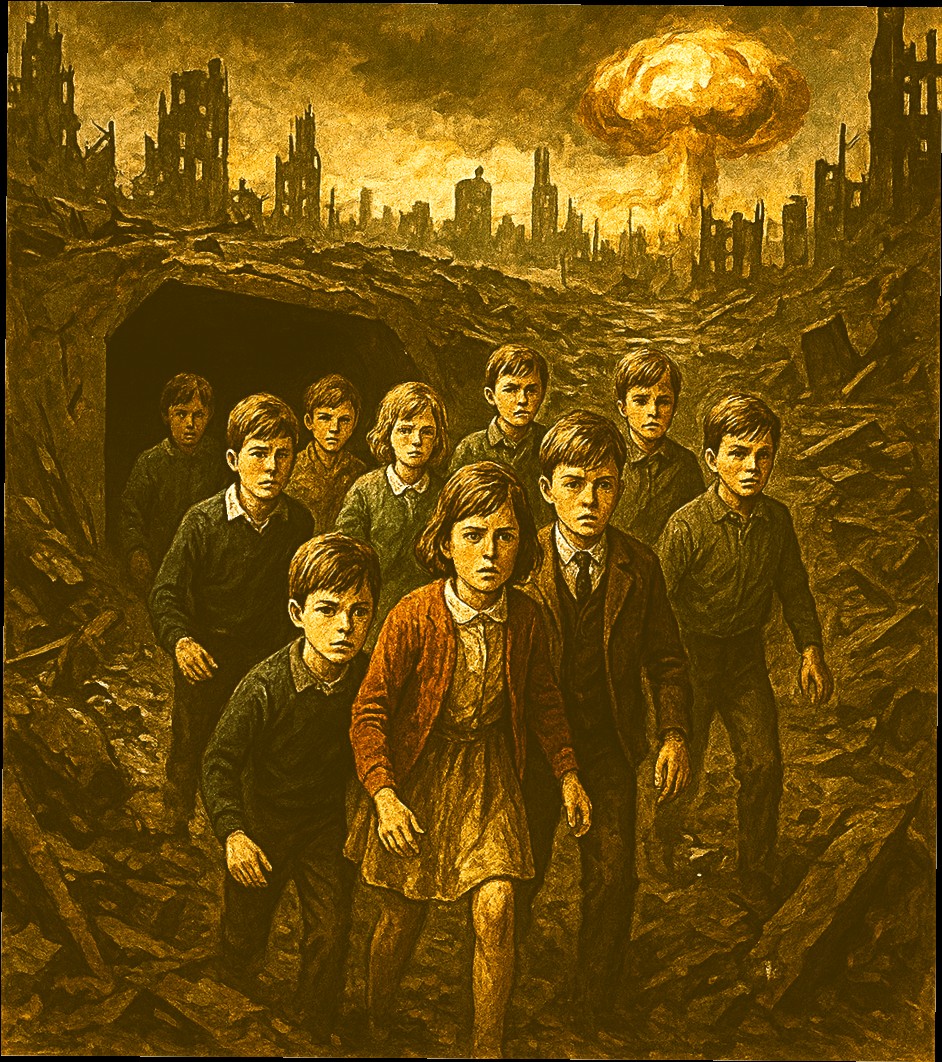
Image generated by Chatgpt