

Sci-Fi Film Fiesta, The Swingin' 60s - Volume 3: Freaky Future Shocks by Chris Christopoulos - HTML preview
Download the book in PDF, ePub, Kindle for a complete version.
Image generated by Chatgpt
[We now find ourselves many months later as part of a congregation in a large tent during a religious revival. The evangelist pastor continues with his sermon:]
Let me sing hallelujah! When he comes, hallelujah! Let me sing hallelujah on that day!
[Hallelujah! Hallelujah!]
The children of God.
[Amen!]
For we are truly God's children.
[Hallelujah!]
He will guard and protect us against the ravages of sin.
[Amen!]
Now tell me, whom do we love?
[The Lord!]
Yes, we love the Lord. And what do we hate?
[Sin!]
Yes, we hate sin. We must destroy it.
[ Hallelujah!]
And how shall we save our souls?
[Go forth]
It was then friends these many months ago I just was telling you about that the stranger came forward to save his soul. “Come forward and save your soul” I said unto him. “Are you a sinner? Do you wish to be saved?” I asked of him.
“No,” saith he. “I've come to tell you what I see. There are great darknesses, farther than time itself. And beyond the darkness, a light that glows and changes. And in the center of the universe, the eye that sees us all.
I then looked steadfastly at the stranger in our midst and proclaimed unto him, “You see sin and the Devil! But the Lord has told us what to do about it.”
[Praise the Lord!]
“Said Matthew in Chapter Five: ‘If thine eye offends thee, pluck it out.’”
[Pluck it out! Pluck it out! Pluck it out!]
This indeed the stranger did do friends, choosing to blind himself rather than continue to see the Devil’s abominations. For according to Matthew, far better be it to lose any one of your members than that your whole body be thrown into hell…….
[Amen! Amen!]
*********************
Sitting still and silent in a white padded cell within the secure environs of an asylum for the incurably insane, James Xavier seems to be staring directly ahead. No one can be sure what he might be thinking or even if he is capable of thought for he never speaks or responds when spoken to. What no-one could know is that behind the dark glasses that Xavier wears constantly and which cover his eye-less sockets, is that he “sees” what no-one else can see or should see – that which once seen, can’t be unseen…...
Points Of Interest
This was the very first sci-fi film I remember seeing. In the early 1960s, My parents operated a Milk Bar in Melbourne, Australia which didn’t leave them much free time. This was before the spread of supermarkets, and Milk Bars, which are now almost extinct, sold things like milk, bread, soft drinks, confectionery and groceries. There was a lot of competition between local Milk Bars and the operating hours were quite long in those days.
One day my dad decided to take me out for the day to get me out of the Milk Bar above which we also lived. So, leaving mum behind in the shop on a somewhat less busy day, Dad took me into the city of Melbourne to have a wander around and see what was what.
After our train ride into the city on a ‘red rattler’ train dad and I spent some time wandering around while enjoying our ice-cream cones. Suddenly, on an apparent whim dad took me on a detour into a cinema. And guess what was on the bill! Yep, “The Man With The X-Ray Eyes!”
What on earth was dad thinking taking a seven year old to see a movie like that, you may be wondering? Different times, my friend and besides I could get see it as I was in the company of an adult. Amazing what one fateful decision can lead to. In this case, a life-long fascination with science fiction films.
Well, there we were in the smoke-hazed cinema (you could puff away on cigarettes in picture theaters back then not that I did then, of course!), and it wasn’t long before I was gob-smacked at the sight of disembodied eye-balls, weird looking eyes and suggestive glimpses at what lay beneath women’s normal attire, which I felt sure was supposed to be somewhat rude. I had to look away at times for a bit of relief only to see dad systematically stuffing his face and puffing away on a cigarette. Just when I thought it was safe to look again at the screen, the film’s ending hit me in the face. You’ll understand what I mean when you see the movie. For some reason the scene with the helicopter really sticks in my mind from that time.
After the film, dad tried to feign nonchalant disinterest in it but I knew better. He thoroughly enjoyed it. As for me, I just couldn’t shake the idea of the prospect of having the power to see through people’s clothes! Was I traumatized by the film being so young? Probably, but if I was I got over it as I later became acquainted with such films that appeared on TV as “The Monolith Monsters,” “Them,” “Tarantula” and….well..all I can say is….thanks dad!!
I guess the other reason as to why the film has a bit of a personal resonance for me is that now my own eye-sight has been steadily deteriorating for several years with a condition for which there is no treatment. Not that I’d want someone like Dr. Xavier fiddling around with my peepers! Still, you play the hand you’re dealt with and there’s many folks much worse off. Luckily these days technology provides a fairly good work-around. In fact, advances in technology would render Dr Xavier’s research rather redundant. Unfortunately for me it does take a bit longer than it used to put together long pieces of writing like this. A bit like wading througvh treacle.
*******************
The film was shot in three weeks on a budget of under $300,000. It’s running time was reduced to 79 minutes due to the removal of a five-minute prologue about the human senses from all post-theatrical prints of the film.
The effect of being able to see through a building was achieved by filming the building while it was under construction. For instance, the skeletal building seen from Dr. Xavier's point of view was the Department of Water & Power General Office Building in downtown Los Angeles that began construction in 1963 and was completed in 1965.
The Man with the X-Ray Eyes (hereafter ‘X’) was Morris Ankrum’s final film. This stalwart veteran character actor featured in many of the classic sci-fi films of that era.
In 1964, the film was released in Great Britain in a double-bill with another Roger Corman film, "The Masque Of The Red Death".
The film won the Astronave D'argento ("Silver Spaceship") award in 1963 at the first International Festival of Science Fiction Film (Festival internazionale del film di fantascienza) in Trieste, Italy.
‘X’ contains a very salutary lesson concerning human hubris and the catastrophic consequences of the quest for knowledge which rises to the level of attempting to see through the eyes of God.
Academy Award-winner Ray Milland delivers a fine performance as a character who we can feel sympathy for and whose motives are initially laudable. Even as Mentallo, the “man with the miraculous mind” he still tries to help people, but gradually and inevitably his drive, his quest for knowledge and his arrogance leads to a decent into hell. Ray Milland, had worked with Corman previously on the Poe adaptation “Premature Burial.”
Don Rickles delivers a very good performance as the ruthless carnival barker and it is a wonder that he didn’t take on more serious roles throughout his career.
Beautiful blonde, Diana Van der Vlis plays Diane Fairfax as the highly supportive girlfriend of Xavier. If only Xavier could have taken the time to see her, really see her for what she is. Then he might have come to understand what really is important in life.
The special effects are fairly crude by today’s standards but they are used to good effect to portray Dr. Xavier's greatly enhanced vision and to convey the new reality from the protagonist's point of view. Some people, however might relish the idea of a remake of the film using modern special-effects. Perhaps, but there is the danger of having the special effects overwhelm the entire point of the story. Not to mention the inevitable inclusion of PC twaddle and lashings of virtue signaling!
I can just see it now….
***************
Francois Truffaut’s,
Fahrenheit 451 (1966)
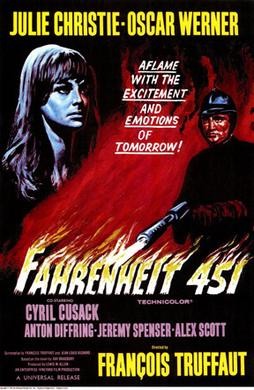
An excellent adaptation of a great novel and in keeping with the spirit of Bradbury’s

classic story.
“Fahrenheit 451” is a 1966 British dystopian sci-fi film directed by François Truffaut, starring Julie Christie, Oskar Werner, and Cyril Cusack. The film is based on the 1953 novel of the same name by Ray Bradbury. The story is set in a future tightly controlled society in which the government deploys firemen to incinerate all literature in order to prevent any independent thinking that might upset the established order of things.
We’ll be concentrating here Truffaut’s film version of Ray Bradbury’s “Fahrenheit 451.”
“An Enterprise Vineyard Production.
Oskar Werner, Julie Christie in
Fahrenheit 451.
“Co-starring: Cyril Cusack, Anton Diffring,
Jeremy Spenser, Bee Duffell,
Alex Scott.
“Screenplay by Francois Truffaut and Jean-Louis Richard.
From a novel by Ray Bradbury.
“Music by Bernard Herrmann.
“Director of Photography: Nicolas Roeg.
Color by Technicolor.
“Art Director: Syd Cain.
“Production and Costume Design Consultant:
Tony Walton.
“Film Editor: Thom Noble.
“Associate Producer: Mickey Dalamar.
Produced by Lewis M. Allen.
“Directed by
Francois Truffaut.”
(Spoilers follow below…)
Ah, there you are Guy Montag. Another day at your job as a fireman and a good one you are at that as you efficiently burn books, all of which have been outlawed by your government. You and your crew have been charged with the weighty responsibility of seeking out and destroying all literature. You have a license to search anyone, anywhere and at any time, and incinerate any books you find.
Transgressors of the law flee in terror upon hearing the approaching sound of your fire engine’s siren followed by the storm-trooper march of your fire crews’ feet as you close in on their lair of printed contraband.
You know all the tricks and hiding places that the poor deluded fools use to conceal their horde of “sheer perversity” from you: “a little bit of everything - novels, biographies, adventure stories.” But you don’t really look, do you Montag? With brutal efficiency they are all gathered up in a pile and reduced to ashes by your fire-hose as adult civilians look on with obedient acceptance and the young watch with curiosity as their futures are being indelibly burned in their minds.
Your Captain Beatty summons you Montag. He seems pleased with your performance and yet he is a strange character. Always seeming to be testing and probing you and that habit of referring to you in the third person when speaking to you!
Well, you must be confident that the captain cannot possibly doubt your loyalty especially after hinting that you are in line for a bit of a promotion! “I trust that the thought makes Montag happy?”
Happiness is one emotion that does not radiate from your face during your usual commute home on the mono-rail. A carriage full of fellow human beings cut adrift from one another not knowing what to say to each other and not knowing what each thinks and feels nor how to express such things. And so they instead mutely escape into the pages of a pictorial version of reality.
It seems Montag that one of the passengers has noted something in your bearing and expression, so much so that she takes it upon herself to approach you and make contact. It turns out that she’s your neighbor, near block 813. But “isn’t that where you live?” And you didn’t even know that you both “make the same trip together almost every day!” Ah, but isn’t that the sign of the times?
It doesn’t take long for you to note that this Clarisse is quite a chatter-box, a – what did she say? - “veritable well of words.” Kind of ironic considering what you do for a living, eh Montag? Most people are frightened of you, Montag with you being a fireman and murderer of….words. Words and all that they convey and represent fall to ash in flames of Farenheit 451, “the temperature at which book paper catches fire and starts to burn.”
You are struck, Montag by just how much Clarisse reminds you of your wife, “except her hair is long.” And your wife doesn’t question anything or display anything like the kind of curiosity that Clarisse seems to about everything. In fact, you’ve never met anyone who does.
Clarisse has some very strange notions, among them being that “a long time ago firemen used to put out fires and not burn books.” Everyone knows it to be a fact that “houses have always been fireproof.” Besides nothing exists to prove the contrary, does it? Everyone also knows that “books are just so much ... rubbish….they have no interest…..Books disturb people. They make them antisocial” and unhappy. That is why they are forbidden.
So, firemen like you, Montag perform good work according to their motto: “Monday, we burn Miller; Tuesday, Tolstoy; Wednesday, Walt Whitman; Friday, Faulkner; and Saturday and Sunday, Schopenhauer and Sartre. "We burn them to ashes and then burn the ashes."
Read the books you burn?! What an absurd idea! After all, you have better things to do with your time and books are simply forbidden.
You try to say what you think are the right things to Clarisse and give the right answers to the questions she poses. You even claim that you are happy when she asks her final question “You happy?” before you both part, she to her non fire-proofed house of old-world character and you to your approved modernist functional abode. Why wouldn’t you be happy
Upon entering your house, your version of ‘Hi honey, I’m home’ involves a wife whose attention is totally absorbed by instructional material emanating from a large wall-screen TV. Your presence is barely registered and only after you have to raise your voice to gain her attention. The joy of sharing good news with your spouse has its value diminished by her viewing your likely promotion in purely material or monetary terms.
Moments ago you were enjoying a conversation with a young woman full of vitality, unorthodox ideas and an abundant interest in life. It is as if you now find yourself speaking with an alternate version of Clarisse that has been drugged into stupefied compliance and conformity and whose main desire in life is to “have a second wall-set put in” which “they say when you have your second wall-screen, it's like having your family grow around you.” Material acquisitions at the expense of forming meaningful connections and relationships. Can they ever be a substitute, Montag? Hope you’re enjoying the illusion of happiness.
Having consumed her pills, your wife, Linda snatches at some semblance of happiness by playing a part in Our Family Theater: "Come Play With Us."a banal interactive show that involves her (and anyone else named Linda) answering preset prompts from the TV set. The show is devoid of any meaningful plot, has characters that might as well be constructed of cardboard and dialogue taken from old school readers like “Run Spot, Run.”
“The Family” (like most families including your own relationship with Linda, Montag) is devoid of passion and instead is filled with numbing predictable routine.
Don’t you fret though, Montag. The TV announcer is about to proclaim the success of the government’s campaign of which you have played your own part so well:
“Our campaign against the enemies of the public peace is
gaining momentum. Today's figures for
operations in the urban area alone account for the elimination of
the total of
2,750 pounds of conventional editions.
Eight hundred and thirty-six pounds of first editions and 17
pounds of manuscripts were also destroyed.
Twenty-three antisocial elements were detained, pending re-
education.”
As a tool of your government that maintains its control by reducing to ashes all history, people’s memories and all independent thought, you prepare the next generation of firemen to continue the good work. Under your instruction, Montag they will learn such techniques as “how to detect books hidden during the actual construction of the house” and “concealment inside furniture.”
The eager young minds will have to wait for the Captain wants to see you, Montag. Such an odd man is our Captain. First, he asks you the time when in fact he already has a watch, a fact which he tries to conceal from you. What else might he be concealing from you? Suddenly, the Captain moves off into an adjoining room and proceeds to savagely berate a couple of the trainee firemen who were summoned to his office from your class. He warns them that this is the last time – the last time for what? Now he questions you about various sports, your opinion of them and then makes an odd observation about society’s need for more sports for everyone in order to “strengthen the group spirit,” to “organize the fun” and keep people busy. Either he’s testing you Montag, giving you advice in a round about manner or he’s being somewhat sardonic, but to what end?
It seems as if the Captain wants you to be promoted seemingly on the basis of your wife’s approval, the fact that you don’t have children and that you say very little – one quality he very much appreciates.
It is as if the Captain is deliberately trying to unbalance you Montag by conveying the impression that he is saying one thing but meaning something else and that he knows a lot more than what he is letting on. Take the matter of your personal file, Montag. Why would he point out to you that it contains only six back view shots of your head when it ought to contain 12 – “two sets of six.” Before you leave he reminds you to “remember that.” Is the Captain just obsessive compulsive? Is he reminding you that you are being observed and that what you do and don’t do is continually being noted? Or is he being conspiratorial, warning you for your sake to be careful especially with small details – If so, then to what end?
The nature of the empty existence of your life and your relationship with your wife is brought home to you with the sight of Linda lying unconscious at home on the floor. She has swallowed a whole bottle of pills as part of a suicide attempt that has become almost routine. Her predicament doesn’t even require the presence of a doctor or ambulance crew – just a couple of workers or orderlies who turn up when called to pump Linda’s stomach, take a few liberties with her while she’s unconscious and get her feeling like new once again when she wakes up.
By the way, Montag. What kind of pills did she take? Oh, “red number two.” No name of the drug written on the bottle? No written list of active ingredients? No written information as to required dosage or product warnings? Oh, someone told you what they were over the phone, right.
“Do you ever read the books you burn?”
Heaven forbid, Montag. Clarisse may wonder but for someone in your position that would be unthinkable. It is not as if you were some rebellious boy trying to “boycott the barber shops.” You know, like the ones you occasionally see on the wall screen where a mop-up squad arrives on the scene and goes to “work on one of these messy know-it-all's.” It is all so entertaining and “goes to show law enforcement can be fun.” But as for reading the books you burn, that would be an act of criminal sedition – no laughing matter at all! You would burn along with the books you read.
And yet despite this, what do we find you doing one evening when you return home from work? Hiding books in your house! Why Montag? Why?
In the middle of the night while your wife sleeps, you furtively take out one the books you’ve hidden and set yourself up (somewhat ironically) next to your wall-screen and begin reading by the illumination it provides: "The Personal History of David Copperfield by Charles Dickens.”
You begin with this classic in which for you every letter and every word is of importance and not to be taken for granted even if it merely mentions the number of illustrations and the book’s publishers.
Montag, you have now made a start on a perilous journey with which you are unfamiliar and along which you must chart your course slowly, deliberately and carefully, just like your halting syllable-by-syllable and word-by-word reading of the first chapter of the first book you are reading. For now, childlike you will need the guidance of your index finger to traverse the words on the pages and to slowly guide you along the path toward greater understanding and meaning until you gain confidence and manage to forge ahead and reclaim your humanity.
Still, you have to get up each day and perform your role as a fireman. The personal privacy and civil liberties of the young, the old, male, female, even pregnant women are violated in the performance of your duty to root out non-conformist and unorthodox activities. Aha! What’s this? This fellow you’ve stopped near the children’s playground appears to be concealing contraband, namely books under his overcoat. Suddenly, it is as if all existence around you has focused itself on this one moment in time, this one fateful decision, this one act you are about to perform: you decide to wave him on…….
Don’t think that you and what you have begun harboring in your mind and heart has escaped the notice of others, Montag. Have you noticed that you are being followed by Clarisse who is accompanied by an old woman? Conspiratorial? For what purpose?
Also, is it just a coincidence, Montag that Clarisse bumps into you just as you are leaving for work? She discloses to you that she has been dismissed from her teaching job ostensibly for not getting along with the staff, failure to stick to the timetable and for having fun in her classes. Apparently it has become a crime to not be a team player, to be non-conformist and to display individuality!
As you escort Clarisse to the coffee shop to discuss her dilemma, did you notice that you are being observed by Fabian, your potential rival for the promotion?
Speaking of being observed Montag, you and Clarisse witness the antics of a hesitant informer (sorry, informant) across from the coffee shop as he struggles with the idea of inserting information about someone else into the information box. He obviously knows someone who has books and is probably using that as a means of settling a personal score, perhaps to “get rid of his noisy neighbor or his brother-in-law who has got a better job or even his mother.”
Having already planted doubts in your mind about your life and forcing you to question the nature of your work, Clarisse manages to get you to conspire in an act of deception as she pretends to be your wife on the phone and informs the Captain that you’ve been taken ill and can’t come into work.
You then accompany Clarisse to the school and when you enter the corridor, you notice how ordered and regimented everything appears to be, from the items hanging from the pegs to the children reciting: “Nine thirteens are a hundred and seventeen. Nine fourteens are a hundred and twenty-six. Nine fifteens are a hundred and thirty-five. Nine sixteens are a hundred and forty-four. Nine seventeens are a hundred and fifty-three.”
You’ve both entered a microcosm of the wider world in which everything is in its place and what is known to be true is learned by rote and conformity is valued. It is no place for curiosity or imaginative and independent thought and action of the kind that individuals like Clarisse displays. For the likes of those like her, ostracism and exclusion is their fate.
And yet, Montag despite your function as defender and upholder of the established order of things, here you are with Clarisse, sharing her concerns and by implication running the risk of sharing her fate. So, “how did it come about? What made it begin? What made you want to do….. this kind of work?…….Why did you choose this job? For you it doesn't seem to make any sense.”
In answer to Clarisse’s questions you trust her with the information that you cannot disclose to anyone else. You tell her that last night you read a book – a book that you were supposed to burn. An act of defiance, Montag! A revolutionary act, indeed!
And so Montag, you continue to read but clandestinely for your wife Linda is no Clarisse despite their similarity of appearance, a fact borne home to you when one night Linda finds your concealed stash of books.
Linda is frightened by the books and their presence in the house. She is more concerned with being popular enough to be a member of “The Family,” an interactive television program that has become her world on a wall peopled with her “cousins.”
As for the real world, Linda cannot even remember when and where you and she first met. As for you Montag, your family is now the books you read in secret and world they represent is far more real than the artificial soul-destroying construct that spills forth from a screen in the wall. For you, Montag “behind each of these books, there's a man.”
The next day you fail to notice the warning irony of the information box as you walk right past it on your way to work. And why is Fabian questioning you in an annoying knowing tone about being on sick leave?
This day is definitely not beginning well for you Montag. It seems that you can’t access the fire station pole to enter the upper level. Is it just you? What is the matter with you, man? The alarm has just sounded and your reaction time is so much slower than usual. You don’t seem to have your heart in it today. Hey, don’t forget your helmet! Remember the pole doesn’t work for you – for you alone - something noted by the Captain who asks of you, “what's this, Montag? Something wrong between you and the pole?”
The job you are on involves the house of an illegal book collector, the very same old woman who accompanied Clarisse who pointed you out to her.
Having located a secret library in the house containing the mother load of contraband printed material, the fire captain calls out to you to enter and begins talking to you about what he sees as the nature of the library’s contents.
The Captain begins by declaring to you that “once to each fireman, at least once in his career, he just itches to know what these books are all about. He just aches to know. Isn't that so?” Why ask you? Is he letting you know that he is on to you, Montag? Does he then understand what you are going through having gone through something like it in his role as a fireman? Has he too read the books he was meant to burn?
The Captain goes on to explain to you that for people who read books such as the ones in this room only “makes them unhappy with their own lives.” Notice how he is becoming more and more manic as he proceeds to convince you that books on philosophy present contradictory points of view, the truth of which is determined by what is considered to be popular and fashionable. Biographies and autobiographies according to the Captain serve to enable the writers to “satisfy their own vanity, to stand out from the crowd, to be different, to be able to look down on all the others.”
Who is the Captain trying to convince, Montag? You…..or himself? Having obviously read such books as are stored in this library and being acquainted with their contents, has something snapped in his psyche as he tries to rationalize what he is required to do in his role: “we must burn the books.” The logic of his position dictates that doing so will result in everyone being made equal and alike, this being “the only way to be happy.”
As the Captain brandishes a copy of Adolf Hitler’s Mein Kampf, you may not notice the waves of irony being cast in your direction, Montag. However, do you have the words to describe the unsettling waves of uncertainty and rebellion being stirred within you? Are you becoming…...”anti-social” as defined by the society in which you live – the very quality or trait that was scorned by the Captain in the library?
Now let us go back downstairs to the book collector. It seems that the old woman refuses to leave her house and is choosing instead to burn along with the house, so she can die with her precious books.
She defiantly proclaims to the firemen present, “I want to die as I've lived.” See how this diminutive old woman throws these brave fire-wielding men into confusion and indecision with her defiance.
"Play the man, Master Ridley. We shall this day light such a
candle, by God's
grace as I trust shall never be put out."
The little book collector’s quoting of Bishop Latimer’s words to Bishop Ridley as they burned at the stake in 1555 elevates her stature to the kind of dissent and martyrdom that is associated with someone like Joan of Arc.
The authorities drilled in “Nine elevens are ninety-nine. Nine twelves are a hundred and eight. Nine thirteens are a hundred and seventeen” are prepared to efficiently murder an old woman and destroy the books that are her life. However, she has the last disdainful laugh and it is she herself who chooses with a strike of a match to die with dignity with what was important to her life rather than submit to them.
“Everybody, outside! Come on, you too, Montag! Montag! Get out of there! Montag! Come on, this way! Montag! Montag!” Your Captain’s calling out to you. Now, which way will you go, Montag?

Image generated by Chat GPT
After witnessing the old woman who martyred herself for her books and what they represent, you go home only to find a woman announcer on your wall screen reminding the audience “to tolerate your friends' however alien and peculiar they may seem to you” and not to “despise minorities.” Rather ironic considering what happens to “minorities” and “anti-socials” who don’t conform.
Gathered around the screen are Linda and her vacuous friends receiving the electronic tablets containing the commandments to “be tolerant today,” to “strangle violence,” and “suppress prejudice.”
Oblivious to the announcer’s oxymoronic exhortations, the “zombies” are instructed to arrange their furniture in such a manner that “no one will ever notice that your chairs don't match, and you'll be as popular as ever.”
How can you even look upon such empty-headed people, Montag who willingly subject themselves to being told what to think, how to act, what to believe and whose one main aim in their collective empty lives is to be liked – to be popular! THIS, after you have just witnessed an old woman who “chose to be burned with her books rather than being separated from them.”
Montag, it’s time to confront these women with the truth about what is really going on in the world and what their husbands are in fact doing. Show them that they are just killing time instead of really living life.
That’s too much to expect though, isn’t it Montag. Linda’s friends are disturbed by your strange behavior and are making a move to leave – to run away from the truth. Then you must make them stay and perhaps try to get them to understand by reading a passage from one of the books you’ve been reading. I know! What about Charles Dickens, “David Copperfield?”
Quickly read before the reflex action takes hold and your audience block their ears to what is forbidden by law…...
"There can be no disparity in marriage like unsuitability of
mind and purpose.”
My, how your reading has improved Montag, along with your understanding and appreciation of the writer’s meaning and intent. See the effect it is having on the one called Linda! She breaks down crying, as the floodgate of long repressed feelings is opened and her emotions are released.
Alas, your efforts are met with feelings of disgust by those who are frightened of the kind of emotions awakened by such books as you were reading from that contain “idiotic words, evil words that hurt people.” I’m afraid, Montag that all you’ve succeeded in doing is spoiling their little party by disturbing them with (from their and society’s point of view) “that sort of filth.”
"There can be no disparity in marriage like unsuitability of
mind and purpose.”
As for your wife, Linda? Her only concern is that her friends won't come back, that she’ll be all alone and won't be popular anymore. Even worse, she will no longer be used in “The Family.” Oh, to be so unfriended and unloved!
There’s no peace even for you at night, Montag for your sleep is disturbed by nightmares of Clarisse in the role of the old book collector who killed herself.
Unknown to you, that very night Clarisse's house is raided, but thankfully due to her uncle’s warning and stalling tactics she has managed to escape through a trapdoor in the roof.
The next day you find Linda making some (to her at least) very important changes! From the position of the chairs, to the curtains and through to the laundry basket. After all, that’s what the lady on the wall screen suggested, so it must be the right and proper thing to do. Anyway, a few superficial changes to one’s life is as good as a holiday and provides a lovely distraction. It must give Linda a wonderful sense of regaining control over her life, don’t you think Montag? If only she can do something about those pesky books!
Suddenly, Linda tells you point blank that she can’t live with those books in the house and that you have to make a choice. Her or the books! Well, the fact that you can’t answer her on that matter speaks volumes - for both of you.
Montag, you’ve lived a life which in some way or another you have sensed somewhere deep down inside of you that you were apart from everything and everyone around you, even though you may not have been able to articulate it. Just a feeling deep within your core. Just one more commuter alone and isolated and feared in a crowded train carriage full of isolated passengers encased in cocoons of emotional repression. Still, you’ve managed to convince yourself that you were upholding the values of your society and of the importance of your role, and you played your part well.
Until…...Where’s Clarisse?? Her house boarded up and her and her uncle missing! Their neighbor, a shell of a human being informs you that “they came to take them away.” After all, “they do that now, don't they?” Especially those who aren’t like us and don’t even have TV antennas on their roofs without which “there's nothing” which makes one an anti-social non-person.
Feeling feverish, panicked and hollowed out, you must get to the bottom of Calrisse’s whereabouts. Any information will surely be filed in the Captain’s office.
You finally get to your work place and spot the Captain berating a young trainee and yelling at him, “Why can't you do what you're told?” How odd! There’s that almost crazed manic quality coming out of the Captain again. Is this a symptom of some kind of mental and emotional repression that’s a product of this society we’ve created and which those like the Captain are charged with upholding? To know deep down that what one is doing to others is wrong but nevertheless to convince oneself that it is for the greater good. To be aware of other possibilities, other ways of thinking and being and yet to steadfastly maintain order and control in order to uphold the status quo and false notions of peace and security. And so we have the sight of an old man furiously obsessing over a kid’s appearance and uniform. Deranged. Psychotic.
While the Captain is busy with the hapless trainee, you manage to break into his office, looking for information about Clarisse. A very tense time you have when the Captain enters and catches you there, not to mention that little fainting performance of yours, Montag! At least there seem to be no repercussions for you - unless you have managed to arouse the Captain’s suspicions?
You manage to meet later on with Clarisse and help her break back into her house to locate and destroy papers containing “a list of addresses, friends of my uncle, who they are and where they're hiding,” all of which could fall into the hands of the Firemen. What a piece of irony, Montag that you should be using your skills as a trained Fireman to both search for such material and then to set about destroying it with fire in order to protect a group of anti-social subversives. And now you are an accomplice – an enemy of the state, no less!
Who exactly are these flouters of the law? According to Clarisse they are called "book people, “people who vanished. Some were arrested and managed to escape. Others were released. Some didn't wait to be arrested. They just hid themselves away, up in the farm country, the woods and the hills.” Each member of the community memorizes a book and by doing so “they become the books.” It is a way of circumventing the law and maintaining human knowledge that can be passed on.
You could go with Clarisse and join their community, Montag but it is too soon for you. Of course you have a plan that you must carry out: to defeat the system from within. You intend to go back and “hide a book in every fireman's house and then denounce him” thereby causing the system to “eat itself.”
While you and Clarisse go on what you take to be your final separate paths, back at your house Linda decides she cannot live with you and your book obsession anymore. If only you could see your own wife now turned informant as she performs that oft- repeated ritual pantomime of irresolution at the information box before making her final decision and escaping under cover of dark sunglasses.
So now you are ready and resolved to tell the Captain that you are resigning. Ah, but the Captain is equally resolved to have you go on one more call! After all, Montag you can't let him down like this in front of the men. “Just this one last call, then you can do what you like. Montag.” He can be very persuasive.
What’s this you see as the fire truck enters you neighborhood, then your street and finally stops outside…...your own house?? As if this wasn’t enough, Linda exits the front door, walks past you, suitcase in hand and tells you that she “just couldn't bear it anymore.”
The Captain kindly lets you do the honors, Montag by giving you the flame thrower to burn the books that have been located but you intend to burn more than just books. Your anger is such that you want to burn all bridges that connect with what you were starting with that symbol of your success and complicity - your own soulless home and that fucking wall-screen.
Oh, and the voice of that psychotic little man! “This gibberish is enough to drive a man mad…..Now let this heap of contradictions burn itself out…. it's we who, at this moment, are working for man's happiness.” Shut up you fucking little pyromaniac! But on he drones: “Look, isn't that lovely? The pages, like flower petals or butterflies, luminous and black. Who can explain the fascination of fire? What draws us to it?”
Suddenly two destinies come together with a chuckle, a reach for one last book and a meeting of eyes before a final burst of flame purifies the souls of two men: One now lies burnt to death in the ashes of an edifice constructed of contradictions and madness. The other has no choice but to escape to a place where he truly belongs and be with those with whom he can at last begin to live.
You are now a man on the run, Montag. “Wanted for murder.” Each citizen harkens the call and dutifully stands outside the front door of their identical, functional, ticky-tacky cookie-cutter houses, all at the ready to “look and listen.”
After a long trek by foot you finally make it to the land of the Book People where you are greeted by The Journal of Henri Brilard. You are just in time to witness your capture which of course is fabricated and made into a piece of entertaining propaganda with a foregone conclusion in which “a crime against society has been avenged.” How does it feel to know that you are now dead, Montag?
What a Bohemian tramp kind of community we have here. You’re introduced to so many books from “Pilgrim's Progress,” and “Waiting for Godot” to Jean-Paul Sartre's “The Jewish Question.” Hello, there’s even “The Martian Chronicles” by Ray Bradbury, would you believe! I hear he’s written a few other worthy stories too.
You learn that there are about 50 or so Book People in this group but that there are “many, many more scattered around. In abandoned railway yards, wandering the roads. Tramps outwardly, but, inwardly, libraries.” For the time being they consider themselves to be “a minority of undesirables crying out in the wilderness” but that one day they’ll be called on to recite what they’ve learned followed by the eventual printing of books. The Journal of Henri Brilar goes onto explain to you that “when the next age of darkness comes, those who come after us will do again as we have done.”
And so, Montag. Who are you to be? Ah, "Tales of Mystery and Imagination” by Edgar Allen Poe. Nice! Learn it so that they can burn it and then no-one can take it away from you and it can be passed on one day.
Look now at “The Weir of Hermiston” by Robert Louis Stevenson who hasn’t got long to live. But the book itself will live through his nephew who will become the book. Listen carefully and you’ll understand how real-life emotions and human relationships are portrayed: shame, hate, love, death; sorrow, fear. The uncle is in fact now reciting more than just a book. He is reciting himself and his humanity in a very real and poignant way: “He was more afraid of death than of anything else. And he died as he thought he would, while the first snows of winter fell.”
Having selected your book to memorize and having once again met up with your soul mate, Clarisse, become now one of the book people, Montag and commit to memory what it is to be a human being with freedom to think, feel and live as a human being needs to do.
THE END
Points of Interest

Image generated by Chat GPT
Background & Production Truffaut’s film is based on Ray Bradbury's famous novel, Fahrenheit 451. It was Truffaut's first color film and his only non French-language film. At the 1966 Venice Film Festival, Fahrenheit 451 was nominated for the Golden Lion.
In a detailed diary Truffaut kept during the production, he referred to Fahrenheit 451 as being his "saddest and most difficult" film-making experience, mainly because of intense conflicts between Werner and himself, about which much has been made by others. For instance, Oskar Werner supposedly cut his hair for the final scene to create a continuity error being motivated by his hatred for the director. For the last two weeks, both men reportedly didn't speak to one another. Still, what work place doesn’t have conflict and difficult interpersonal relationships? Not all films that have cast and crew holding hands and singing Kumbaya turn out to be masterpieces. It’s the end result that counts and in the case of Truffaut’s film, it’s a pretty good result.
Julie Christie was originally cast as just Linda Montag, with the part of Clarisse being offered to Jean Seberg and Jane Fonda, with even Tippi Hedren being considered. Truffaut ultimately decided that Christie be cast in both roles as two sides of the same coin so to speak. Julie Christie agreed to star in this film for $200,000, while her asking price at the time was $400,000.
The film was shot at Pinewood Studios in England. The monorail exterior scene was taken at the French SAFEGE test track in Châteauneuf-sur-Loire near Orléans, France. It was dismantled shortly after filming. The film featured the Alton housing estate in Roehampton, south London, and Edgcumbe Park in Crowthorne, Berkshire. The final "Book People" book reciting scene was filmed at Black Park near Pinewood. It was hoped the weather would improve for the final days of shooting. Instead, it had begun snowing during the night. The presence of snow in the final shots was unexpected and unplanned but proved to be effective.
The production work was done in French, as Truffaut spoke virtually no English but co-wrote the screenplay with Jean-Louis Richard.
The movie's opening credits are spoken rather than displayed in type, which suggests what life would be like in a society in which the printed word is banned. Truffaut’s “Fahrenheit 451” doesn’t offer us a sleek whiz-bang futuristic view of the future. Unlike Bradbury’s book, there is no deadly mechanical hound. Even Bradbury wasn’t focused on anticipating the possible great technological advancements of the future. Instead of such details, he would focus on presenting “what if?” scenarios and considering implications and consequences for humanity. What we do have though in the film version are commuters traveling via monorail and living rooms with wall screens uncannily resembling our own 21st century HDTV sets. The houses are uniform ‘60s style modernist functional but soulless structures that seem to contain retro gadgets like the wall phones. Even the red fire engines look like dinky Tonka toys rather than massive high-tech futuristic beasts. Such elements seem to suggest to the viewer that we are dealing with a world that is not too far removed from our own experience.
Characters
As already mentioned in Part 1, “Fahrenheit 451” deals with a tightly controlled society in which books are outlawed and firemen use hoses not to put out fires but instead to burn books which are outlawed.
One such fireman, Montag is caught between his wife, Linda who anesthetizes herself on pills and is absorbed by the banal content on her wall-screen TV all day, and Clarisse, a neighbor who is full of life and who encourages Montag to ask questions about his job and his life.
Julie Christie as has been mentioned above is cast in both roles with the competing forces of conformity (Linda) and non-conformity (Clarisse) competing to influence the decisions Montag ultimately makes.
Clarisse helps to reveal to Montag that he is merely a tool of a system of authority that maintains control by virtually incinerating human history, personal and collective memory, and independent thought.
As for Montag’s personal life, when he enters his own house after having interacted with the ebullient Clarisse, he is confronted with a shell of woman whose only joy and aspiration in her life involves playing a role in a banal interactive TV program called “The Family.” For Linda any sense of personal renewal seems to come from the aftermath of a routine suicide attempt and resultant stomach pump from a couple of orderlies.
The Clarisse character in Bradbury’s book is killed off early in a suspicious hit-and-run accident. In Truffaut’s film, she reappears towards the end and being reunited with Montag helps to offer the viewer a sense of future hope.
Relevance
The film’s story deals with matters that have extended far beyond either side of the 1960’s era. Namely censorship, conformity, and omnipresent surveillance and control by government. In this sense, "Fahrenheit 451" delivers a very relevant message. Book burning had indeed occurred in humanity’s past, in Nazi Germany and Communist Russia during the 20th century.
People in many countries today have to endure censorship of ideas and restriction of free speech. Ideas that conflict with their government’s view of reality and which challenge established authority are banned outright and those who express such ideas in print, over the airwaves and on the social media and the internet are often punished.
Nor should we in so-called democratic Western countries feel particularly smug about our perceived freedoms as we sit transfixed in front of our huge flat panel smart TV screens satiated with binge streaming; sopping up social media stupidity on our devices; reveling in the unreality of “reality” TV and televised dumbed-down bread & circuses; documenting every trivial and stage-managed aspect of our lives for our “cousins” and hoping beyond hope we’ll be liked and friended, all the while ensuring we’re constantly plugged in and not wasting our time taking time out to sit, think and wonder.
And so we sit agape at the screens as the countless experts, celebrities, officials and functionaries of the information/influencer industry try to tell us what we should be doing, thinking, eating, drinking, behaving, accepting, considering, knowing, wanting, hoping, valuing, and on and on and on they babble at us with advice on the most effective way to wipe our bums.
Then there are the largely useless corporate pimps: the advertisers and on-line influencers who primp, pirouette and pout at us from our devices getting us to turn tricks as consumer whores. And so off we go to tap-and-go or buy now and pay later to fill our lives up with the latest stuff which we can one day happily dispose of on the nature strip or local tip.
Thank god for the ever wakeful and watchful Woke-brigade with their fire-hoses of political correctness at the ready to be trained on any hint of independent, contrary, unorthodox, and unsanctioned thought and deed. “Gone With The Wind” – take that! “Dr Seuss” – take that! “Huckleberry Finn” – take that! All such books and films might upset and make people feel uncomfortable. We can’t have that, can we? Onward Cancel Culture! Burn those books, topple these statues, ban those films, re-write and censor history, prescribe what words can and cannot be used: He, she, husband, wife…..Coon cheese! What? Edward William Coon? No, no, no, ban it, change it now! What’s that? You can still buy a copy of Mein Kampf! Shut up! Take that!
Our freedom of expression and right to privacy is even being slowly eroded by corporate entities and social media platforms who hoover up our personal information, determine what we can and cannot do with QR coded arrogance and restrict what we can think and say based on what they judge to be acceptable or not with the punishment of finding oneself being excluded, fined, removed or de-platformed – a non-person.
Both Oskar Werner and Julie Christie’s performances are quite good, as is Truffaut’s direction along with the tight editing, effective camera work and Bernard Herrmann’s suspenseful and thrilling musical score.
Of particular note is the scene featuring the burning of the illegal book collector along with her library of books. The viewer cannot help but feel impacted by the sense of suffering and cruelty being inflicted on the book covers and pages that are burning and curling before turning black as they are consumed in a mass of searing orange flames. This together with the Joan of Arc-like defiance of the old woman as she herself strikes the match and succumbs to the flames.
The old woman represents that kind of spirit that still exists in the form of a single soul standing defiantly in front of a Chinese tank, or young Hong Kongers and Iranians putting their lives on the line in the face of brutal repression, or ordinary citizens in Myanmar who face bullets fired by those who are supposed to serve and protect, or Palestinians resisting the suffocating and overwhelming oppression being imposed on them.
In the 21st century we are fortunate that we are awash with reading material whether it be in the form of traditional printed books, ebooks, on-line web-sites and blogs, social media, newspapers, and even audiobooks. But access is not always equitable and censorship still does occur in many places.
Despite the prevalence of the written word and the many various platforms it is conveyed by, along with the amazing opportunities that exist for ideas to be conveyed and exchanged, I can’t help wondering if whether people are any better informed than say someone like the character Montag who wasn’t aware that firemen like him once had the role of putting out fires. It is like, for example the situation in my own country when some people are asked what Australia Day means to them and they reply that it is an occasion to celebrate the discovery of Australia by Captain Cook!! (not to mention those idiots who try to demolish this great explorer’s statue.) Well, for the correct answer, you’ll just have to check the facts for yourselves by reading up on it.
We certainly know about the myths and approved sanitized, nationalistic and sanctimonious versions of our history, but the fact remains that people (particularly so in my own country) just don’t really know their history. This despite the availability of information about it: written and audio-visual. So, who is to blame?
It also must be remembered that information that is not mentioned, is withheld or is left out ought to be of concern when it comes to matters of free speech and the free flow and access to information.
The story of “Fahrenheit 451” serves as a cautionary tale that reminds us to be on our guard whenever ideas are outlawed by a governing elite that fears an independent-thinking public and that we should always be prepared to question its motives for doing so. Only our own apathy, our preference for convenience and our succumbing to distractions will prevent us from doing so. In this era of increasing use of information technology, it is of primary importance that we resist attempts by established and new rising political, social, technology and media elites and vested interests to engage in intellectual repression and manipulation through the media and elsewhere.
Fahrenheit 451 Reading List:
Books shown or mentioned in the movie:
Don Quixote She Might Have Been Queen
Othello, the Moor of Venice Social Aspects of Disease
Vanity Fair The Ethics of Aristotle -
Madame Bovary The Brothers Karamazov Le monde a coté The Sorrows of Young Werther
Alice's Adventures in Wonderland & The Martian Chronicles Through the Looking-Glass
Gaspard Hauser Plato's Republic
Robinson Crusoe Fahrenheit 451
The World of Salvador Dali Pride and Prejudice
Jeanne d'Arc Gone with the Wind
Life and Loves Animal Farm
The Weather No Orchids for Miss Blandish
My Autobiography by Charles Chaplin Jane Eyre
Les negres Moby Dick
Confessions of an Irish Rebel The Picture of Dorian Gray
The Ginger Man The Adventures of Tom Sawyer
Petrouchka The Trial.
The Catcher In The Rye
The Moon and Sixpence
Lolita
David Copperfield
Mein Kampf
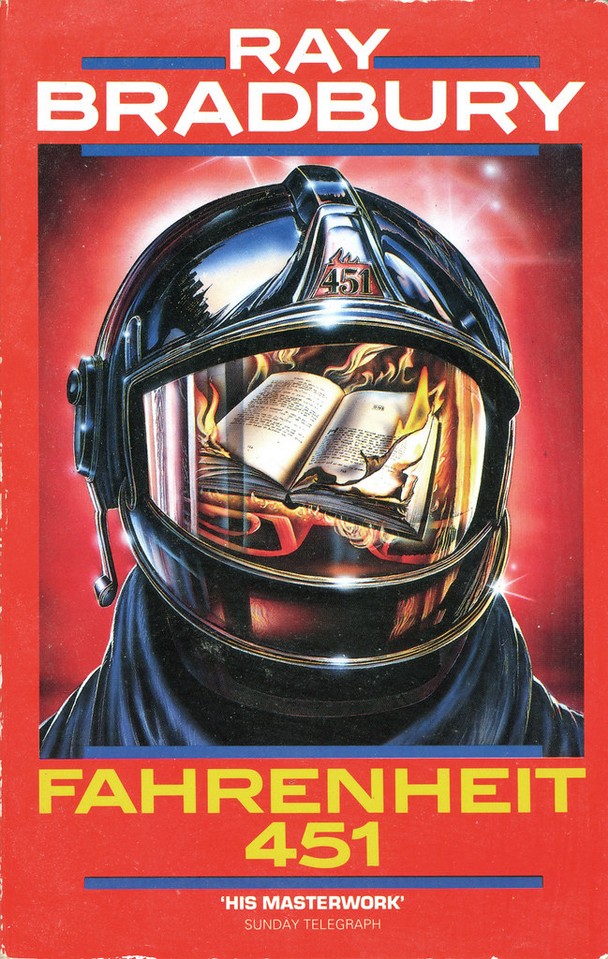
Planet of the Apes (1968)

An imaginative ground breaking sci-fi film with biting cultural commentary
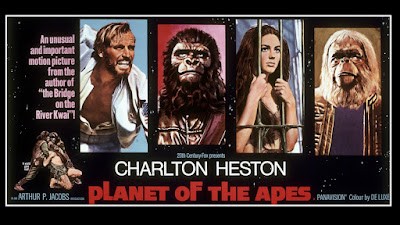
Directed by Franklin J. Schaffner
Screenplay by Michael Wilson, Rod Serling
Based on “Planet of the Apes by Pierre Boulle
Produced by Arthur P. Jacobs
Cinematography: Leon Shamroy
Edited by Hugh S. Fowler
Music by Jerry Goldsmith
Production company: APJAC Productions
Distributed by 20th Century Fox
Running time: 112 minutes
Budget: $5.8 million[2]
Box office: $33.4 million
Cast
Charlton Heston as George Taylor
Roddy McDowall as Cornelius
Kim Hunter as Zira
Maurice Evans as Dr. Zaius
James Whitmore as President of the Assembly
James Daly as Honorious
Linda Harrison as Nova
Robert Gunner as Landon
Lou Wagner as Lucius
Woodrow Parfrey as Maximus
Jeff Burton as Dodge
Buck Kartalian as Julius
Norman Burton as Hunt Leader
Wright King as Dr. Galen
Paul Lambert as Minister
Dianne Stanley as Stewart
Thrust into the year A.D. 3978!
Three astronauts emerge from deep hibernation…
Their vessel crash-lands on a mysterious planet!!
One of the crew has accidentally died in space!
The space craft sinks under the waters of a lake.
The three survivors head off to explore their new home.
With limited rations
&
A hostile arid desert plain,
They trek in search of food, water and evidence of life,
Only to discover that they are not alone,
and that their troubles have only just begun…….
(Spoilers follow below….)
Musings
It’s almost 6 months into a deep space flight from Cape Kennedy, when astronaut George Taylor completes his final log report before returning to hibernation and initiating an automated touchdown sequence.
His other three fellow astronauts, Landon, Stewart and Dodge are in deep sleep hibernation.
The crew’s ship date reads July 14, 1972, but back on Earth it is the year 2673 due to the effect of their vessel traveling at the speed of light. On Earth 700 years have passed since they had left, but they have hardly aged at all.
Taylor’s musings indicate that he is rather cynical and bitter about humanity, “that marvel of the universe, that glorious paradox” who has sent he and his crew to the stars where “everything seems different, time bends” and where “space is... boundless.” For Taylor, it is a realm that puts things into perspective including a man’s sense of importance and self-worth in that it can squash his ego and make him feel small, insignificant and…. “lonely.”
And yet, Taylor wonders, armed with such knowledge and with the passage of time, does humanity “still make war against his brother” and “keep his neighbor's children starving?” Has humanity progressed morally and ethically along with its technological and intellectual progress?
It is all a matter of perspective and point of view when it comes to perceiving space and the passage of time along with the nature and worth of the human species. What of human certainties in the face of the universe’s paradoxes?
Taylor self-administers an injection before entering his hibernation capsule in which he will remain until he and the rest of the crew are revived when the voyage is completed…...
Abandon Ship!
As the crew sleeps, their ship continues its journey through time and space before eventually encountering a planet. The vessel enters the atmosphere and crashes into a lake surrounded by large desolate-looking stone formations. The crew is then awakened and are quickly made aware of their situation. Their facial hair testifies to the passage of time within the ship since they left earth. Sadly, they soon discover that one of their crew mates, Stewart has died in stasis. A crack in her hibernation capsule caused an air leak which led to her death.
Suddenly a bulkhead gives way and the ship begins to sink. The three crewmen quickly scramble to evacuate their doomed craft after unsuccessfully attempting to send a message to Earth.
Realizing that the atmosphere contains breathable air, the crew blows open the hatch and abandons ship, with an inflatable raft and survival kits containing three days’ worth of food and water supplies.
Prior to his departure, Taylor notices the ship’s chronometer indicates that it is now November 25, 3978 - 2,006 years into the future. He determines they had been away from Earth for only 18 months.
Using the raft, Taylor, Landon and Dodge begin paddling to shore just as the last vestige of their technological cocoon sinks below the surface of the water. Taylor hypothesizes that they are some 320 light years from Earth on an “unnamed planet in orbit around a star in the constellation of Orion.” As to their exact location and what might have gone wrong, Landon points out that “the question is not so much where we are as when we are.”
Coming ashore, the three men take stock of their situation and set about appraising their immediate surroundings. They determine they have sufficient food and water for three days and a handgun.
It becomes apparent that there are distinct differences between the men’s characters and personalities. Landon appears to be more reflective and thoughtful while Taylor is more pragmatic and cynical. For instance when it comes to the matter of Stewart’s death, Taylor almost brutally, matter-of-factly and unfeelingly puts it down to “air leak. She died in her sleep” and suggests that there is no point dwelling on the matter as “it's a little late for a wake. She's been dead nearly a year.”
For Taylor it is the circumstance in which they find themselves that has rendered all other concerns and feelings redundant. As he says to Landon, “time's wiped out everything you ever knew, it's all dust…..It's a fact, Landon. Buy it. You'll sleep better.”
Having mentally and emotionally reconciled himself to the dictates of the laws of relativity, it is no wonder that Taylor laughs uproariously at the absurdity of Landon’s taking the trouble to stop and plant a tiny American flag before moving off with his crew-mates.
Desert Trek
Dodge conducts some soil tests and concludes that "nothing will grow here," but that there is no dangerous ionization.
The three men make their way through the arid desert landscape which has an alien feel to it but is also somewhat strangely familiar to behold. Claps of thunder and flashes of lighting emanate from a cloudless sky devoid of life-giving rain. There’s “cloud cover at night” together with a “strange luminosity.” It also appears that their new planet has no moon.
Together the three men trudge onward toward the goal of finding life, but the separation and differences of their individual natures, characters and motivations become more starkly apparent. Taylor harbors a disgust for his fellow human beings Right now “there is just one reality” of the here and now and that it would be better to be dead than lose sight of that fact and waste time and energy mourning for their “precious planet” which is 300 light years away and where their “loved ones are dead and forgotten for 20 centuries.”
Taylor rejects the sentimentalized bullshit espoused by the likes of Landon whom he believes readily volunteered for the mission motivated by personal glory, the display of heroic spirit, a willingness to self-sacrifice for a higher goal and not forgetting a good old dose of flag-waving patriotism. All this in exchange for a chance at “immortality” commemorated by a pigeon-poop encrusted tarnished statue proclaiming his heroism. Taylor, on the other hand can appreciate someone like Dodge whose motivations seem to “make sense.” Dodge is driven by the quest for knowledge and understanding – of making the unknown, known.
Taylor is also on a quest of sorts. The mission offers him a chance to escape a meaningless life of earth in which he “despised people” and seek out some place in the universe where “there has to be something better than man.”
And so the men’s quest for life on this alien planet continues until…..Dodge locates a single flowering plant, indicating: "Life." It occurs to them “where there's one, there's another, and another and another.” Life always finds a way.
The journey through the rocky desert terrain continues while unseen figures move across the cliff tops observing the men’s progress. Eventually more signs of vegetation are seen along with unmistakable indications of intelligent life advertised by a clearly defined border-line consisting of strange scarecrow-like constructions on the clifftops. They are reminiscent of ancient Roman crucifixes. Some kind of a warning perhaps?
As the three men make their way past the curious and ominous artifacts, they came upon a lush oasis of rushing waterfalls and a large pool of water. They need no encouragement to throw off their attire and plunge into the inviting waters of the oasis.
Very shortly two more discoveries are made. The first is the evidence of footprints, and the second being the theft of their clothes and equipment by the likely makers of the footprints..
Hunt & Capture
Taylor and his fellow survivors pursue the light fingered thieves and locate their damaged supplies and ripped clothes. When they come upon the pilfering tribe gathering food from a cornfield, the men discover that they are mute, harmless primitive humans.
Suddenly all present freeze as a trumpeting noise reverberates over the area. The alarm or signal sends the tribe into a stampede with our three crew-mates becoming swept up in the onrushing tide of humanity.
It is not quite apparent who is responsible for the sound of gunfire or who the riders of the oncoming horses are. It isn’t long, however before realization dawns that the humans have been led into a trap and that they are being hunted by ape-like creatures riding the horses!
During the pursuit, Taylor is shot in the throat and captured with others of the tribe, while Dodge is shot and killed and Landon rendered unconscious.
The hunt ends quickly with Taylor being taken to Ape City, along with dozens of captured humans. Before he passes out, Taylor notices that many dead humans are collected as trophies and that the ape-creatures pose for pictures with the victims’ bodies.
Two chimpanzees, animal psychologist Zira and surgeon Galen, remove the bullet from Taylor's neck and continue to treat him in their facility, though Taylor's throat injury renders him temporarily mute. Dr. Zira considers the human "animals" as being vital for their research work and experimental brain surgeries.
Taylor is placed in a cage and is considered to be a recovering patient who Zira nickname "Bright Eyes." One of the staff notices that "he keeps pretending he can talk."
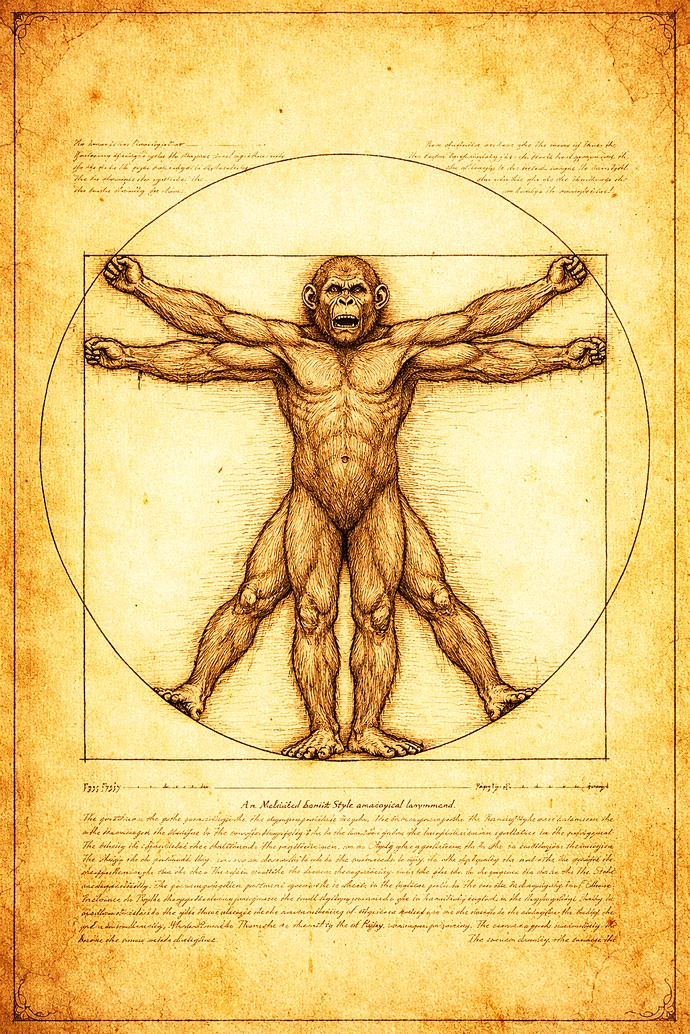
Image generated by Chatgpt
Taylor tries to communicate but can't speak due to his throat injury. Doctor Zaius, the orangutan Minister for Science, arrives at the facility to investigate the latest batch of captured humans. Zira draws Zaius’ attention to Taylor who futilely struggles to speak. Zira might be convinced of Taylor’s intelligence, but Zaius is not and merely remarks that Taylor’s merely "a man acting like an ape” and that “he has a definite gift for mimicry." According to Zaius’ orthodox view of Ape and Man, "Man has no understanding. He can be taught a few simple tricks, nothing more." He then cautioned Zira about her behavioral studies pointing out that "to suggest that we can learn anything about the simian nature from a study of man is sheer nonsense." Humans are only be been seen as a nuisance, who ravage the apes' crops. As Zaius begins to exit, the door to the subject of human intelligence is firmly shut with his parting observation that "the sooner he is exterminated, the better. It's a question of simian survival."
The captive female (Nova) Taylor had earlier noticed at the cornfield is placed with him in his cage in the expectation that they might mate – in front of an attentive audience no doubt! No pressure!
The irony of Taylor’s earlier comment upon seeing the tribe of humans for the first time, “if this is the best they've got around here, in six months we'll be running this planet” is palpable. Ah, nothing like human hubris!
“This beast has lost a lot of blood.”
“Doctor, these animals are dirty.
They stink and they carry communicable diseases.”
“Do we want some sugar, old-timer?”
“You know what they say.
Human see, human do.”
“He can be taught a few simple tricks.
Nothing more.”
Such observations about the nature of human beings from the apes’ perspective forms a very uncomfortable mirror image of humanity’s attitudes towards what it has long considered as the lesser species of the planet Earth. Here, the shoe is definitely on the other foot.
Evidence
Later on, Dr. Zira is keen to show off “Bright Eyes” to her fiancee, archaeologist Dr. Cornelius. When Dr. Zaius joins them, Taylor imprisoned within an outdoor confinement cage containing humans, attempts to communicate by writing in the dirt "I CAN WRITE," most of which is unintentionally obscured by Nova.
Taylor is then restrained and taken away after a fight erupts between him and another human. Meanwhile Dr. Zaius notices that a portion of the message remains in the dirt which confirms that Taylor is an intelligent being. What does Zaius then do? Why, he obliterates the legible portion of the message with his cane.
The evidence before his very eyes before being plowed into the dirt flies in the face of accepted Ape society orthodoxy which Dr. Zaius feels he must uphold. Better to obliterate the truth to ensure that the prevalent orthodoxy is maintained by those under him like Cornelius to whom he issues a “friendly warning: As you dig for artifacts, be sure you don't bury your reputation.”
While confined in another cage, Taylor snatches a piece of paper from Dr. Zira when she approaches too close. He has time to write: "MY NAME IS TAYLOR" before Julius the gorilla assistant, enters the cage to give Taylor a hiding and retrieve the Zira’s items. Zira notices that Taylor has written a note, the message of which she understands. She now realizes that Taylor really is intelligent.
Dr. Zira quickly orders Taylor’s release to her own home to study him further. Once there, she tries to convince Cornelius of Taylor's intelligence. Cornelius refuses to believe in such an idea and is convinced that what Taylor seems to be able to do is nothing more than a hoax or stunt. Even when Cornelius begins to concede that Taylor might be intelligent, he also thinks he’s merely crazy.
As much as he tried without the power of speech, Taylor could not convince Cornelius of his origins on Earth, or the possibility of space flight. Cornelius can only repeat accepted dictums such as “humans can't write” and after a paper airplane demonstration, he repeats the prevailing belief that, “flight is a scientific impossibility.” Zira points out to him that he’s a scientist and asks him, “don't you believe your own eyes?”
Despite having an obviously intelligent human standing right before them, it is almost too much for Zira and Cornelius to accept that Taylor had survived the "Forbidden Zone" after he landed there from space before trekking through the desert to the jungle area. After all, as Cornelius points out “no creature can survive in the Forbidden Zone. I know. I've been there. I've seen it.” It is as we have seen of late truly amazing what people choose to believe and not believe even when confronted by verifiable evidence.
During their discussion, it turns out that Cornelius' has a theory that "the ape evolved from a lower order of primate - possibly man." In the Forbidden Zone, Cornelius claims to have discovered artifacts that suggest the existence of a civilization that predates the current ape society -"older than recorded time." It could turn out that Taylor could prove his theory, in that he might be a "mutation, a missing link between the unevolved primate and the ape." For Ape society this is a very heretical idea and for Taylor an unacceptable one, he being presumably firmly grounded in Darwin’s theory of evolution on Earth. Same principle, same controversy but just turned on its head!
Despite his work in the field and the evidence it is turning up, Cornelius is reluctant to advance his hypothesis for fear of getting his “head chopped off” by the authorities who wont accept it on the grounds of heresy. If Taylor’s existence were to confirm Cornelius’ theories, for Ape society it would mean “the sacred scrolls wouldn't be worth their parchment.” Not to mention placing Cornelius and Zira’s “fine futures, marriage,” “stimulating careers” and future prospects in jeopardy.
Dr. Zaius and Dr. Maximus, Commissioner for Animal Affairs arrive to discover the human outside the compound without a leash. Both apes epitomize the authorities’ preparedness to employ fear and force to enforce compliance in word, thought and dead on the part of all members of ape society. Taylor is soon muzzled and led back to his cage.
While in his cage, Taylor overhears that Dr. Zaius has issued orders for him to be gelded with a surgical procedure! With one’s ballocks at stake, what is a man to do? Get the hell out of Ape City! You would think it is only humans that castrate (or any other euphemism) animals?
While fleeing through Ape City and causing great consternation to the inhabitants, Taylor tries to hide in a place of worship during a funeral service for a deceased “defender of the faith, cherished husband, beloved father, generous master...a font of simian kindness." Apes with such fine qualities, with a religious belief system, honoring their dead and a belief in an after-life! So human-like!
After fighting off gorilla police at a market place, Taylor flees into a museum with human tableaux displays and most shocking of all he stumbles upon the taxidermied body of Dodge in one of the displays. Isn’t that what humans do to the so-called lesser creatures of our planet for people’s edification and amusement?
It isn’t long before Taylor is eventually surrounded, cornered and recaptured in a net. In the process he reveals that he can speak now that his throat seems to have healed. To the ape’s shock he yells out: "Take your stinkin' paws off me, you damn dirty ape!"
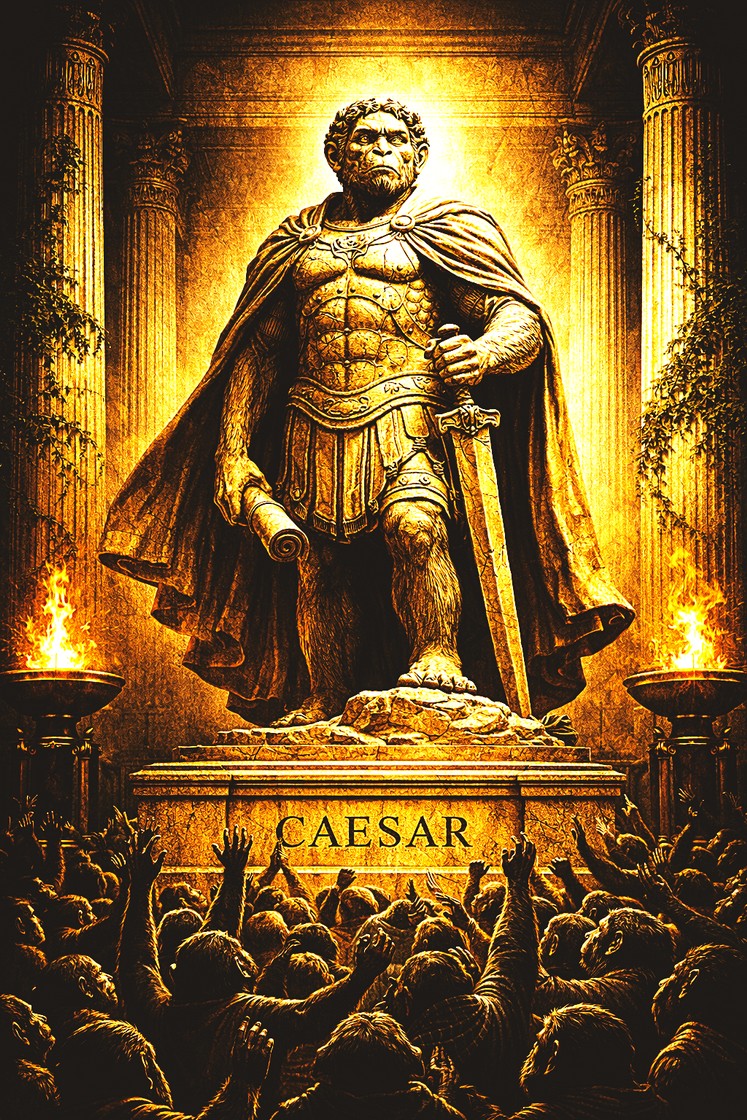
Image genertaed by Chatgpt