

Sci-Fi Film Fiesta, The Swingin' 60s - Volume 3: Freaky Future Shocks by Chris Christopoulos - HTML preview
Download the book in PDF, ePub, Kindle for a complete version.
Points Of Interest
Filmed in just 11 days, Beyond the Time Barrier is a 1960 low budget American science fiction film. It was released in September 1960 on a double bill with, The Angry Red Planet. It was one of two low budget sci-fi films shot back-to-back in Dallas, Texas by Ulmer, the other being The Amazing Transparent Man. The film's working title was The Last Barrier.
Director Ulmer’s daughter Arianne Arden appeared as the Russian pilot, Markova, named after ballerina Dame Alicia Markova.
Edgar G. Ulmer directed The Man from Planet X which is also featured in my eBook, The Big Fat Book of Sci-Fi Films of the 1950s.
Producer Robert Clarke directed and acted in his production, The Hideous Sun Demon which can also be found in The Big Fat Book of Sci-Fi Films of the 1950s.
Filming took place in the Texas Centennial Exhibition Fair Park buildings with cooperation secured from the United States Air Force and Texas Air National Guard, which enabled filming at Fort Worth's Carswell Air Force Base and the abandoned Marine Corps Air Station Eagle Mountain Lake. The badly deteriorated buildings conveyed what the air base would look like in ruins.
Film footage of a Convair F-102 Delta Dagger-first introduced into service in 1956- was used for the fictional "X-80" test plane. The film's action sequences featured Air Force weapons, M1 carbines and M1911A1 pistols.
The inverted triangular sets of "The Citadel" were leftovers from an exhibition at the 1959 Texas State Fair.
Vladimir Sokoloff, who was originally from Russia played "The Supreme" and had also played the old man in The Magnificent Seven (1960)
Some of the sound effects in the film had been taken from George Pal's The War of the Worlds (1953) which you can find in The Big Fat Book of Sci-Fi Films of the 1950s.
Beyond the Time Barrier was one of two time travel films released in 1960, the other being The Time Machine (1960) by George Pal, included in this volume. American-International Pictures took advantage of MGM's publicity for The Time Machine, and released this film a month earlier. Yvette Mimieux who had been considered for the role of Trirene, starred in The Time Machine.
Beyond the Time Barrier is one of those films that seem to improve with each additional viewing. Although a low-budget film, it is quite entertaining and engaging which is a tribute to the director and the able performances of the cast. Although not a fan of the process, I particularly liked the colourised version which seemed to give the film a new lease of life.
****************
The Time Machine (1960)
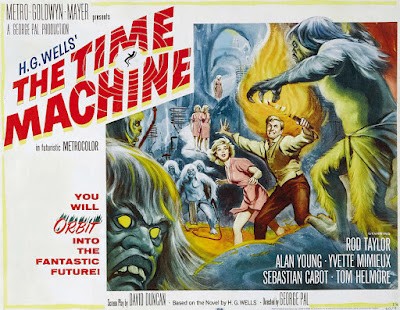

George Pal’s film version brings HG. Wells' original story to life with a good
combination of suspense, action and effective special effects.
Directed by George Pal
Screenplay by David Duncan
Based on The Time Machine,1895 novel by H. G. Wells Produced by George Pal
Narrated by Rod Taylor
Cinematography: Paul C. Vogel
Edited by George Tomasini
Music by Russell Garcia
Production companies: Metro-Goldwyn-Mayer, Galaxy Films Distributed by Loew's
Running time: 103 minutes
Budget: $827,000 - 829,000
Box office: $2.61 million
Cast
Rod Taylor as H. George Wells
Alan Young as David Filby/James Filby
Yvette Mimieux as Weena
Sebastian Cabot as Dr. Philip Hillyer
Tom Helmore as Anthony Bridewell
Whit Bissell as Walter Kemp
Doris Lloyd as Mrs. Watchett
Paul Frees as voice of the Rings (uncredited)
A man’s quest for a future Utopian society.
The means: travelling forward in time in a machine.
The Journey: different time periods leading to increasing
disillusionment.
Final destination: a civilisation several thousand years into the
future divided into cannibalistic subterranean and docile gentle
surface dwellers.
But is there any escape from the one constant that might
transcend time itself: human nature in all its facets?
PART ONE: HAPPY NEW YEAR 1900
“That's exactly what I have - All the time in the world!...”
Out of the dark void flows the dimension of time itself in the form of familiar objects crafted by the ingenuity of humankind to mark,measure, quantify and tabulate its seemingly inexorable passage: sundials, hour-glass, water clocks, chiming mechanical clocks and the seemingly eternal and comfortingly familiar presence of Big Ben with the reassuring tolling of its bell.
The sounds marking the passage of time rise to a crescendo before coming to abrupt halt as we shift to the other three dimensions that also formed after the Big Bang that ushered in our universe and through which we conduct our day-to-day affairs within the strict confines of the four dimensional parameters.
January 5, 1900, a new century. It is the end of the Victorian and the beginning of the Edwardian era – a time of great advancements in scientific discoveries, engineering marvels, empire-building and the ‘heroic’ age of exploration. And yet, for all the advancements there is inevitably a price to be paid as is the case in any era…..
It is a time in which life moves at a pace still dictated by the horse-power of real horses and the leg power of cyclists which the lonely figure of David Filby manages to avoid as he makes his way to the front door of a cottage. It's wintertime and Filby draws his coat firmly around himself and knocks on the front door.
His knock is answered by Mrs. Watchett, the house-keeper. Upon entering, he hurriedly makes his way toward the library where three men are seated impatiently awaiting the arrival of their host. The silence is punctuated by the cacophonous ticking of innumerable timepieces situated about the room.
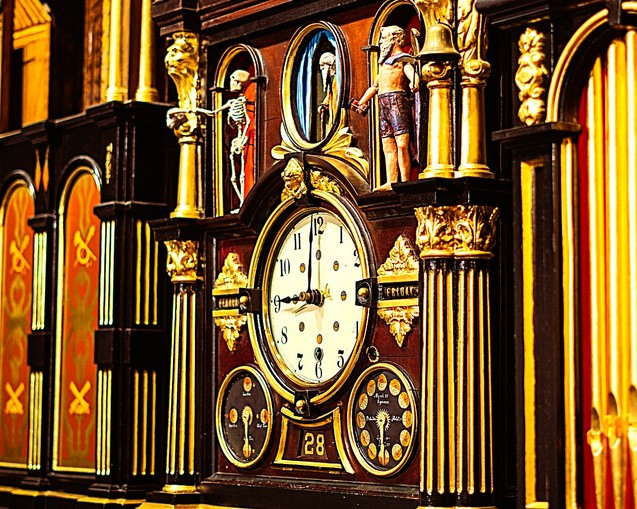
Image by Chatgpt
As Filby self-consciously takes his chair he is observed by the other three guests:
Dr. Philip Hillyer, a portly no-nonsense man who does not appreciate a lack of punctuality and views it as being unacceptable conduct and is “outright rude of the man!” In fact, to his way of thinking, “it’'s not the behaviour of a gentleman.”
Anthony Bridewell, a fashionable man of means who spends his time being acquainted with the bottoms of whiskey and wine glasses. Although an amiable fellow, he is of a class whose life amounts to little more than a dissolute waste of time without much purpose.
Walter Kemp, a middle aged practical man who has a strong dislike of having his time wasted. George’s non-attendance is to him “a confounded waste of time!” and that he has “any number of more important things to do.”
As the clocks continue ticking marking the passage of time with a mechanical consensus, the atmosphere of impatience and discomfort increases and still the unoccupied chair remains vacant. As the time reaches the hour of eight, Grandfather clock and its smaller brethren suddenly proclaim the arrival of the appointed hour. Time marches on irrespective of what anyone can and cannot do. In this shrine to time, the men’s host seems to pay little head to Time’s dictates. Very unusual for someone who is “usually very prompt, precise and punctual.”
The guests have been invited to dinner by their friend and host George, the owner of the cottage. He asked them to arrive at 8:00pm. and it is that time now. However, as we have seen, George himself has yet to arrive. Remove the element of certainty and predictability and see how disconcerting it can be. The men are less than happy about being kept waiting except for Filby who is far more patient, tolerant and understanding and concludes that George has “undoubtedly been detained, that's all.”
Shortly after 8.00 pm George’s house-keeper Mrs. Watchett, enters the room and hands a note to Filby. She informs the men that George has been missing for several days and that she’s hardly caught a glimpse of him lately and that “he never leaves the laboratory and comes out only to nibble at his meals.” The note states that George thought he might be late, and if that was the case, then they could start dinner without him.
Just before Bridewell is about to indulge in his favourite liquid pastime, the figure of a man abruptly bursts through the doorway of another connecting room and staggers exhausted into the dining area. Although swathed in shadow, it is evident that the man has undergone physical duress and is in a disheveled state.
The man staggers closer and manages to take a seat at the table. In the light it can be seen that it is the men’s friend and host, George. His clothing is tattered and filthy and his face bares the marks of bruises and lacerations. Wanting food and drink before providing answers to any queries from the others, Bridewell is on hand with a glass of wine which George drains with alacrity. George follows this up with a request that would cause any vegetarian to shudder with horror: “Meat...I'm hungry for meat!”
Soon it is time for George to tell the others what had happened and despite his fatigue he is quite keen to relate his tale to them which began when they were all together five days previously, “the last day of Eighteen Hundred Ninety Nine.”
Between a tick and a tock of a pendulum clock memory melts and dissolves the present and transports us back in time…..
“Why is it that we usually ignore the fourth dimension? Because
we have no freedom to move in it…...when it comes to Time, we
are prisoners”
The image of an ebony box atop a table begins to emerge and resolve itself. It is the “result of two years' labor” and has barely been completed before the beginning of the new century. In the library, all four men consider the box before them.
When informed that the object in question “has to do with time,” Hillyer’s mind naturally and predictably turns towards the likelihood of its being a practical device such as a “reliable timepiece” that can be utilized by the nation’s military. Filby, however knows better and leaves the way open for George to explain what he means when he refers to time.
When speaking of time, George is referring to the fourth dimension, the other three being height, length and breadth which one can move through. These dimensions form the parameters that our universe has bestowed upon us. Humanity, however has yet to figure out a way to travel through the fourth dimension of time and that is what George has been working on: the invention of device that will allow him to do so.
George goes on to explain that “for an object to exist at all, it must exist in the fourth dimension....and that fourth dimension is duration....Time.” Th problem however, is that unlike the other three dimensions “we usually ignore the fourth dimension because we have no freedom to move in it…..we are prisoners.“ ”
Meeting with skepticism from the others, George resorts to providing them with “a demonstration of the possibility of movement in the fourth dimension.”
Despite his friends’ skepticism, some interesting objections are indeed raised;
Bridewell: “If you start floating around in the future, aren't you likely to mess things up for the rest of us?” Perhaps that could also be asked about time-travelling tot the past and inadvertently altering the future with potentially dire consequences?
Hillyer: “The future is already there. It's irrevocable and cannot be changed.” Is that true? Can the future be affected or indeed changed by the decisions we make now? Or iff the future is pre-determined or pre-ordained, then what is the point of our existence? Could knowing what may happen in the future help us change it for the better by acting differently in the present? Or will whatever we decide to do now will simply result in the same future outcome?
The answers to such questions are what George is hoping to find out, namely “can Man control his destiny?” And in a nod to another work of the great science fiction author HG Wells, “Can he change the shape of things to come?”
George opens a box on the table to reveal a scale model of his machine. It is a thing of beauty consisting of a seat, a control panel with a lever in front, and a rotating disk in back, surrounded by a brass railing. It is a product of craftsmanship from a by-gone era. No mass-produced futuristic ugly angular concept crap here!
The other men begin to question George’s sanity when informed how the machine can occupy the same space while being able to move through time. George proceeds to demonstrate by taking a cigar from Hillyer and bending and shaping it to represent a time travelling man. He places the cigar man on the model machine’s saddle. Using one of Hillyer’s fingers, the lever on the machine’s front panel is pushed forward. Amid the sound of a high-pitched humming, the clinking of glasses and the movement of a chandelier, the disk on the back of the machine begins to rotate. After just a few seconds, the machine becomes transparent and vanishes from their sight on a one-way journey into the future, never to return.
“Happy New Year…..Goodbye, George….Happy Twentieth
Century”
As the on-lookers try to recover their composure, the question arises as to what to do with “such a contraption?” For George it is simple, he intends to take a journey into the future while accepting the associated risks. However, his demonstration is met with disbelief and is put down to being some kind of clever conjuring trick. Rather than wasting his time on such nonsense, it is put to George that with wars being fought elsewhere in the Empire, Britain could use inventors like him.
When even Filby seems to acknowledge Dr. Hillyer’s seemingly sensible and practical point of view, George with an air of disappointment and resignation closes the lid of the machine model’s box with a decisive snap as if a final decision has been made in his mind.
After donning their hats, capes and coat, George's friends take their leave and exit the house, wishing George a happy new century.
“Why this preoccupation with Time?”
George re-enters the cottage after closing the front door, leans his back against it and thinks to himself in silent contemplation. Here stands a man who feels himself to be both out of place and out of time, ahead of a world that is just not ready to accept the seemingly impossible. George suddenly catches sight of a nearby newspaper with a headline proclaiming another victory by the Boer Army.
So this is what stirs the imagination and fires the hearts and minds of humanity in this day and age: the beating of war drums and the blaring of military bugles as nations march blindly off off to war. It is in this destructive capacity that a man of his talents would best be appreciated!
With clear-eyed resolution George proceeds to do his own marching toward a different destination. Fired with anger, he begins in the library at his writing desk but before he can do anything he stops upon hearing his name being softly spoken. He then looks behind him and notices Filby sitting in a chair with his back turned to him near the fireplace.
Filby has deliberately remained behind out of concern for his friend who has been “behaving oddly for over a month” and seems to have changed enormously. A very Edwardian way of asking someone, “are you OK?” Filby goes on to inquire of George why it is he is so pre-occupied with time. George replies that he doesn’t care much for the time he was born into in that it seems that “people aren't dying fast enough these days” and that science is called upon to “invent new, more efficient weapons to depopulate the earth.”
Filby feels that all we can do under the circumstances is deal with what we are confronted with and if George believes that he doesn’t’ have to, then what? Escape into the past and become a Greek, a Roman or one of the Pharaohs?
George says he prefers the future. Confronted with the seriousness of his friend’s intentions and his determination, Filby questions the authenticity of the earlier experiment with the model time machine asserting that “there are a number of ways of doing that trick.” Even if it were possible to travel through time, Fllby states that he would have “no desire to tempt the laws of Providence” and that such matters are “not for man to trifle with.” According to Filby, it would be better that such a machine as the one proposed and built by George be destroyed before it winds up destroying him.
Sensing the worst and fearing for his friend, Filby invites George to come and spend New Years with him and his wife and their baby. George however, declines the offer stating that he'd rather spend New Years alone. Still under a ill-feeling akin to a premonition, Filby asks George to promise him he won't leave the house tonight. George promises he won't walk out the door which under the rules of space-time he is about to circumvent and re-write, it is a promise he can technically keep. Then he invites Filby to come and bring the other three men over for dinner on Friday, January 5, 1900, five days from now.
After Filby departs, George proceeds to the writing desk with the intention of writing the note that will be read five days later. Mrs. Watchett enters with his smoking jacket and they both wish each other a happy new year. After Mrs. Watchett leaves, George in a somewhat symbolic act looks at the old calendar that reads: "December 3l. 1899," rips the final sheet from the pad, which is then replaced with the new 1900 one. The new century calendar symbolically highlights what George is about to do and where / when he is about to go. After writing the note, George inserts it into an envelope and places it on the mantle-piece where it can be easily noticed. He then rises and moves in the direction through the three dimensions of space toward a destination that can only be arrived at via the fourth dimension……
“In the year 2525, if man is still alive
If woman can survive, they may find……””
(In the Year 2525 ‘Exordium & Terminus’
by Zager and Evans)
PART TWO: 20th CENTURY JOY-RIDE
“In the year 3535
Ain't gonna need to tell the truth, tell no lie
Everything you think, do and say
Is in the pill you took today….”
(In the Year 2525 ‘Exordium & Terminus’
by Zager and Evans)
“ And yet by my watch which was in the machine with me, only a
few seconds had passed”
George unlocks the door to his laboratory which has the appearance of once having been a greenhouse complete with a glass skylight. Our attention is soon monopolised by the presence of a full-sized duplicate of the miniature time machine model that has already sallied forth on its rendezvous with the distant future.
There sits this full-sized reality; a wonder of scientific, engineering and aesthetic craftsmanship, almost a a living entity consisting of nickel, ivory, quartz and leather fashioned from from a man’s ingenuity and inspiration.
It’s creator’s expert eye suddenly discerns an imperfection that must be corrected and so George quickly detaches a crystalline lever from the machine and sets about polishing its rough edges with a polishing buffer.
Satisfied that all is well, George crosses to the machine, sits in the upholstered saddle and reattaches the newly polished lever. Turning on the power switches, he glances down at the control panel which displays the date: December 31, 1899. After looking up at nature’s familiar aerial passing parade through the skylight, George grasps the lever and gently pushes it forward. As George nudges the handle forward cautiously, the disk at the machine’s rear begins to rotate. He is suddenly bathed by a soft illumination emanating from the machine while his ears are assailed by a humming sound. After a moment or two, he pulls the handle back to the neutral position to bring the machine to a halt and looks around. There doesn’t seem to be anything different as he looks around. But wait! The clock in the corner indicates that it is after 8pm. and look at the candle on the table! lit is several inches shorter. Checking his pocket watch, Geroge sees that it shows the time as being just after 6:30pm.
“In the year 4545
You ain't gonna need your teeth, won't need your eyes You won't find a thing to chew
Nobody's gonna look at you”
(In the Year 2525 ‘Exordium & Terminus’
by Zager and Evans)
“ ....to see flowers closing their eyes for the night, changes that
normally took hours, occurring in seconds, was beautiful”
Infused with new-found confidence, George pushes the handle forward a little bit further this time. Watching more carefully as time passes, he notices that the candle rapidly burns down until it is extinguished. The clock’s hands spin around the dial while the sun performs an ever increasingly rapid procession along the heavens. A normally sedate snail seems to have discovered a new sense of urgency in its life as it races across the floor. Flowers majestically open and close with the coming and going daylight. From George’s point of view within the confines of his machine, only a few seconds have passed.
Meanwhile, across the street at a department store, George catches sight of a female mannequin in the window. George then pushes the lever forward a little more, and time outside the machine accelerates. Successive days pass by rapidly almost melding into a continuous flowing river of time.
It is now the summer of 1900, as George slows the machine and daylight is once again distinguishable from darkness. Across the street the mannequin in the store window is attired in a different style of clothes. As George continues his journey into the future, he is struck by the changing fashions as modeled by what will become that one unchanging constant, that anchor to the past that seems to be continuously receding into a vortex of unending change. The faster that George traverses time, it is the very seasons themselves that rapidly flash by……..until suddenly the light is blotted out with the unexpected boarding up of the laboratory’s windows. The machine has been brought to a stop: September 1917…...
In the year 5555
Your arms hangin’ limp at your sides
Your legs got nothin' to do
Some machine's doin' that for you
(In the Year 2525 ‘Exordium & Terminus’
by Zager and Evans)
“ Who are you, sir?”
“Just a stranger who once knew your
father”
With the world outside completely obscured from view, George disembarks from the machine and slowly makes his way though what was once his laboratory and home. Here he is disconcertingly confronted by the inevitable process of entropy wrought on all things by the passage of time. His laboratory and the rest of the house is dirty, dust laden and festooned with cobwebs, the result of having been abandoned for years. It is as if time has stood still, an impression highlighted by the fact that all the clocks within have now fallen silent.
After kicking aside the boards covering the front door, George makes his way to the outside of the house, the garden of which is overgrown with weeds which further reinforces the impression of abandonment and neglect. The sundial rests out of its proper alignment which George, the presumed master of time tries to correct. A wooden fence now encircles the house and George, the breaker of Time’s barriers exits through a gap he creates and steps on to the street. As he walks onto the road, he is startled by an automobile, something which he has never encountered before.
A man wearing a soldier's uniform exits the car and begins to ascend the steps of a store. George is thrilled to see what he believes to be his old friend Filby (minus his moustache). It doesn’t take long for the young soldier to realize that George has confused him with his father. This man is David Filby’s son, James Filby, who was an infant back in 1900. George is shattered to learn that David Filby had been killed in World War I,The Great War or the war to end all wars. A vital link to his own time now no longer exists. George learns from James that he (“some inventor”) as the owner of the house across the street had disappeared around the turn of the century. As executor of George’s estate, David Filby “refused to liquidate it” believing that George would return to claim it some day. The house had also acquired a reputation as being haunted.
James is dumb-founded to learn that George is unaware that England has been at war with Germany since 1914! After saying farewell to James, who is concerned for this stranger with the strange attire, the despondent and dejected George feeling like a ghost himself returns to the site of his own house to continue his journey through time…..
“In the year 6565
You won't need no husband, won't need no wife
You'll pick your son, pick your daughter too
From the bottom of a long glass tube”
(In the Year 2525 ‘Exordium & Terminus’
by Zager and Evans)
“It didn't seem possible they could go on fighting all these years
and still have the
means of fighting”
Having returned to the time machine, his remaining means of control, George journeys into the future once more. He soon begins to gain more experience in handling the Machine and finds that he is “able to see the changing world in a series of glimpses.” Of particular interest is the ever fluctuating hemlines of women’s dresses as displayed by the eternally present and ageless mannequin. His house further suffers the ravages of time as he proceeds through the 1920s and 1930s. Suddenly, in 1940 the laboratory along with the machine starts to judder and shake. Concerned that the machine might be malfunctioning, George brings it to a halt in June 1940. The disturbance is the result of aircraft dropping bombs, anti-aircraft batteries responding and fires burning, all the result of another war, a new war. George dedudes that “there must have been an interval of peace in between these wars” and yet nothing seems to have been learned apart from preparing “even more effective means of destroying one another.”
George presses on into the future to see the outcome, only to witness his laboratory catching fire before abruptly disappearing. His house has been destroyed by a German bomb, but George now in the open, remains safe within the time machine.
“In the year 7510
If God's a coming, He oughta make it by then
Maybe He'll look around Himself and say
Guess it's time for the judgement day”
(In the Year 2525 ‘Exordium & Terminus’
by Zager and Evans)
“ The labour of centuries gone in an instant”
“If the button is pushed, there's no runnin' away
There'll be no one to save with the world in a grave…”
(Eve Of Destruction
by Barry McGuire)
A odd disconcerting sound causes George to bring the machine to a stop in August of 1966. The sounds are the wailing of air-raid sirens. Getting out of the machine, George looks around and discovers that the ground formally occupied by his house is now the site of an urban park. George soon comes across a plaque which contains the inscription: "This park is dedicated by James Filby to his father's devotion for his friend George." Meanwhile, around him there is great commotion and tumult as people hurriedly make their way to air-raid shelters, urged on by uniformed wardens. In this world of futuristic sky-scrapered and mono-railed modernity, George is completely disoriented and perplexed.
As the last of the citizenry disappear into their subterranean burrows George catches site of a considerably aged James Filby exiting his store wearing a silver uniform and clutching a white helmet. For from wanting to hang around and engage in pleasant conversation, James is intent on getting into the shelters as fast as his arthritic limbs will convey him “before the mushrooms start sprouting.” Of course, this doesn’t make any sense to George any more than the terms ‘World Wide Web’ or ‘Streaming’ or ‘Woke’ would to someone in the 1950s or 1960s.
Suddenly, it begins to dawn on James that George somehow looks familiar. George explains to him that they had last spoken in that very same place back 49 year earlier in 1917. James recognizes him as the same man he had spoken to but before he can discover how George seems not to have aged in all that time, the incessant wail of the air-raid sirens starts up again cutting their reunion short. The sirens warn of the approaching nuclear bomb and James scurries off toward the shelter.
Without a meaningful frame of reference or shared experience, George full of confused thoughts and feelings makes his way back to his time machine. At that moment the bomb detonates causing buildings in the city to burst into flame and disintegrate- a city constructed over a period of two thousand years destroyed in mere seconds. The nuclear explosion results in a major geological disturbance, the creation of a volcano that unleashes a sea of lava that destroys anything in its path. A fortunately uninjured George who having been knocked down by the shock wave blast, has just borne witness to this holocaust. All he can do is jump back into the time machine and escape from the earth’s rage-filled roar and the oaths and obscenities issuing from long cruel wounds inflicted humanity’s knives of greed and hate.
And as our Time Traveler makes his escape away from the 20 th Century and further into the future, will he find anything left that signified that humanity had once existed on this planet? Some plaque perhaps with an inscription:
“My name is Ozymandias, King of Kings;
Look on my Works, ye Mighty, and despair!
Nothing beside remains. Round the decay
Of that colossal Wreck, boundless and bare
The lone and level sands stretch far away. “
(Ozymandias
by Percy Bysshe Shelley)
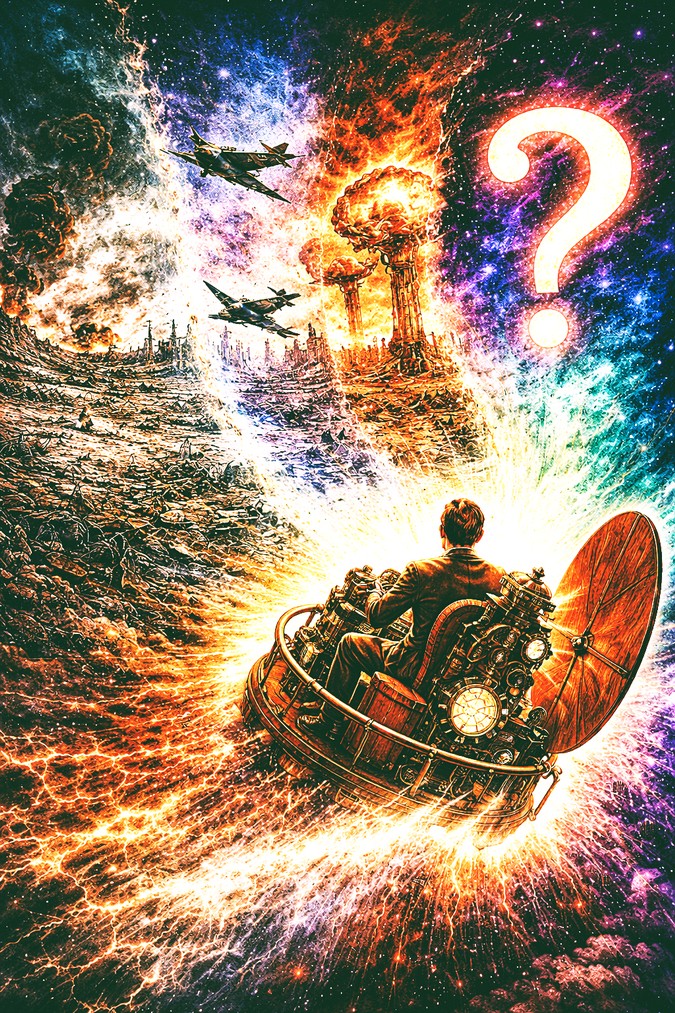
Image by Chatgpt
Part Three: Centuries And Eons Of Darkness
“In the year 8510
God is gonna shake His mighty head
He'll either say I'm pleased where man has been
Or tear it down, and start again”
(In the Year 2525 ‘Exordium & Terminus’
by Zager and Evans)
“Had man finally learned to control both the elements and
themselves?”
Before George and his machine can be engulfed by the flow of red hot lava, he pushes the lever forward to its furthest position. Amid the sound of high-pitched humming, the oncoming lava seems to leap forward and transform into a red haze that permeates the machine’s interior.
The machine’s speed through time saves George “from being roasted alive and encased in stone forever.” He cannot determine when he is as the dials are spinning too fast and the light is steadily diminishing. All George has is time – all he time left in the world before the wind and rain can erode the mountain that encloses him. For now all George can do is mark time and wait in darkness, “darkness for centuries” 70,000...80,000...90,000...100,000. Time enough to wonder “if there was still war being waged on the ground above ….. if man would still exist on earth.” Is this the natural and inevitable condition of human-kind: to endlessly wage war and commit acts of violence and destruction on others of its own species? Same as it ever was? Same as it ever was? Same - as – it – ever – was? And while he ponders waiting for the rock around him to wear down as the centuries roll by, George can only place his trust and faith in time.
“And how many years must a mountain exist
Before it is washed to the sea?”
(Blowin' In The Wind
by Bob Dylan)
Over the course of thousands of years, the rock eventually erodes and to his relief George once again finds himself free and out in the open. At first, he has the impression of a bleak and desolate landscape with no hint of humanity’s presence. He watches as trees “spring up like plumes of green smoke.” The unchanging colour of the landscape suggests that there are no longer changing seasons. Suddenly, George sees several new buildings being erected followed by the construction of a a dome and a tower which all too soon fall into ruin. Curious once again, George grabs hold of the machine’s lever…..
Part Four: 802701-Paradise Unattained
“In the year 9595
I'm kinda wonderin' if man is gonna be alive
He's taken everything this old earth can give
And he ain't put back nothing”
(In the Year 2525 ‘Exordium & Terminus’
by Zager and Evans)
“ I hoped to learn a great deal.
I hoped to take back the knowledge,
the advancement, mankind made.
Instead what do I find?”
Has George at last arrived at a point in time when “the earth stayed green” and there was no more winter or wars and when “man finally learned to control both the elements and themselves? With only one way to find out, he pulls hard on the lever and the humming sound diminishes. However, he stops too fast, and as a result the machine begins to spin around and fall over on its side. Feeling a bit rattled but otherwise unhurt, George man-handles the machine to its upright position before setting out to explore the future world of 802,701
It is as if George has materialised in some kind of Garden of Eden with trees and shrubs laden with strange blossoms and exotic fruits. Nearby there is a huge stone building on the top of which sits a large metal statue representing the bust of what could very well be interpreted as being a deity of some kind. Two large metal doors are set in one side of the structure. George knocks on the doors which produces a reverberating clanging sound. Receiving no response, he proceeds to explore his surroundings but before leaving the machine, he wisely detaches and pockets the lever.
The whole landscape seems to consist of one vast garden minus any weeds and more importantly for George, devoid of any human life. Does this ‘Paradise’ belong now only to George? If that is so, then it is definitely no Paradise at all. As George passes through the forest, he stumbles upon an immense domed structure. Although indicative of an advanced civilization, it is quite clearly in a neglected and ruined state. Vines have long since begun their destructive work on the weathered stonework, perhaps even centuries ago. Upon entering the building, it is apparent that it is still in use as the doors function, and there are low tables, chairs and plates evidently awaiting use by the currently absent inhabitants of this time period. Goerge picks up one of the plates and pounds a tabletop with it while calling out, “Anyone here?” The echos of the clanging sound produced by the plate and his own voice only serve to highlight the all pervasive and uncanny stillness of the vast structure.
George leaves the building and makes his way through the forest almost in a state of panic – panic at the cloying sense of stillness and the realization of his own possible isolation amid the absence human life. But how to account for what he saw in that great structure?
Continuing to walk through the forest with bewilderment and dread his only companions, George suddenly hears the sweet reassuring sound of human voices in the distance. In a clearing in the forest by a river, he spots a group of young rather slightly framed people enjoying a pool formed by the river. Their simple attire and blond-hair gives them an almost identical or uniform appearance. What is also striking about them is their carefree laughter and playful activity. So George, is this the future you hoped for, “to bask in the sunlight, bathe in the clear streams and eat the fruits of earth with all knowledge of work and hardship forgotten?” Paradise on earth? “ Well, and why not?” you think to yourself.
Suddenly a scream rips through George’s contemplation of this idyllic scene. It is coming from a young woman in distress who is caught by the river’s current and is in imminent danger of drowning. Even more shocking is the reaction of the onlookers who make no attempt to help her and merely continue to watch on as the woman screams out piteously. Spurred into action, George bursts into the clearing and urges the others present to take action, but to no avail. He then dives into the river and rescues the woman just before she is swept from the rock she had been desperately clinging to.
After setting the young woman safely on the ground nearby, George covers her with his jacket and asks her if she is alright. To his surprise, she simply rises and without uttering a word calmly walks away without any sign of fear or gratitude.
Adding to George’s confusion, the unconcerned gathering of young peopl , move off almost as one body from the area and walk past him as if he was a regular familiar feature of the landscape. As the sun begins to set, George follows them to the domed structure he had left earlier. He does not enter with this chattering sea of indifference but instead sits on the stairs. The young woman he saved comes back through the doors carrying his jacket and sits down next to George and talks with him. She is very beautiful, softly spoken and very childlike in her speech and demeanour.
Unlike the others, she shows curiosity to the extent that she has come back to see George and return his jacket as well as to ask him why he saved her. That in itself serves in some measure to set her apart from the others. However, she cannot understand why she ought to be curious as to who George is, where he comes from and why he is there. Added to George’ s meager store of knowledge is the fact that there appear to be no older people about and that everyone seems to be about the same as the woman. As to the reason? Before he can find that out, she tells him after a moment’s silence that her name is ‘Weena,’ (Don’t you start smirking!) and her people are called ‘Eloi.’ It is at this point that George makes another discovery: the people of this time period are illiterate. Instead of humanity as one might expect evolving and progressing with the passage of time, what we have is a case of devolution! (Possibly a process that has its beginnings in our own time?!) Suddenly with a look of concern born of instinct and experience, Weena springs to feet and urges George to come with her into the dome as it is getting dark…….
Inside the domed building young Eloi men and women are enjoying a communal meal not heading the entrance of George and Weena. Seated at a table, George tries to engage the others present in conversation but without success. George puts their lack of reaction down to the death of curiosity and even courtesy but he presses on regardless with his enquiries. He learns that the Eloi have no government or laws, and no one works. The food and their clothing simply seem to just magically appear. As far as the Eloi are concerned, the food apparently grows without the prerequisite processes of planting, cultivation and nurturing. George also puts this down to the Eloi having an economy that allows them devote all their time to study and experimentation. It is as if George has been naively attempting to graft on to this time period a kind of Utopian vision of the future, a feature of certain ideologies of his time he would have been familiar with. Unfortunately, with the passage of time come the realities of unforeseen consequences, the negative aspects of human nature and of false assumptions made about the course of human progress.
George is about to have his chance to learn all about this future civilization when he discovers that the Eloi have books. One of the young men leads George to where books are located. George discovers to his horror and bitter disappointment that the collective knowledge and heart and soul of human civilization lies moldering to dust stored on rotting shelves at the rear of a room. Culture and the foundations of civilization have been left to rot and reduced to powdery dust. This is part of Paradise? At what cost to all that would make life worthwhile?
Having learned all he needs to know about this civilization from the ever falling and swirling dust of the books, an appalled and disgusted George makes up his mind to return immediately to his own time. Back he intends to go through the “thousands of years of building and rebuilding, creating and re-creating. ……..a million yesterdays of sensitive men dying for their dreams” just so that these Eloi of the future “can swim and dance and play.” George would rather live and die among real men with their dreams and struggles despite his knowledge of the seeming futility of those dreams and struggles in the face of a “hopeless future.” And so the Eloi look on without emotion as George exits the domed building….except for Weena, this time no longer indifferent.
George returns to the stone structure where he and his machine first appeared. To his horror he discovers that the time machine is no longer there! The presence of grooves in the dirt leading to the metal doors of the building suggest that someone has dragged the machine inside. George in a panic picks up a rock and pounds on the doors, but they to no avail. While he walks around the building, George notices something moving in the bushes. When he lights a match, it quickly retreats. Suddenly, he spots another shape moving about, but discovers to his relief that it is Weena. She had followed him to persuade him to return to the domed building as it is dangerous to be out at night.
George asks Weena if there is a way to get inside the building where his machine is. Weena tells him that no one can get inside except the Morlocks. He learns from her that it is the Morlocks who provide the Eloi with their food and clothing while the Eloi are required to obey them. Instead of seeking the safety and shelter of the domed building, George is resolved to keep trying to get into the building containing his machine. He and Weena begin gathering wood for a fire to keep the dreaded darkness and whatever threats it contains at bay.
George tells Weena about the time period he came from. There is now rather ironically, a sense of nostalgia in his voice as he points out where the house, laboratory and library once stood in the area now occupied by the stone monument eight hundred thousand later. The nostalgia turns to grim disappointment as George explains how he “hoped to learn a great deal” and then “to take back the knowledge, the advancement, mankind made,” but instead found “the human race reduced to living vegetables!”
While he is talking, one of the indistinct figures that George saw earlier emerges from the bushes, reaches out and grabs Weena. George runs after Weena and rescues her from a creature called a Morlock. Settled near the fire, Weenag gazes into the flames with fascination then slowly she raises her hand and reaches out to grasp the flame. It turns out that she has never even seen fire before, the knowledge of which along with the wheel was “the first thing which separated man from the rest of the mammals.”
Despite so many of the distinctly human traits apparently having been lost, George realises that Weena, despite being safe within the domed building did decide to face the dangers of the night to warn him. By doing so, Weena displayed “the one characteristic which distinguished man from the animal kingdom…... the spirit of self sacrifice. “
It also seems that the Eloi merely live in an eternal sense of the present in that they have no concept of past and future. For George, it is as if he has landed in one of mankind’s Dark Ages and that all that is needed is for someone to show the Eloi the way out. If George is the one to kindle that hidden spark within even one of the Eloi then his coming to the future will have some meaning.
The next morning, unable to open the doors to the stone building, George discovers several holes resembling well entrances in an open area. These holes are not natural, they have been constructed. A pounding rhythmic mechanical noise can be discerned emanating from the darkness below. Weena is aware that the holes are an entrance to the subterranean world of the Morlocks. She learned this from some talking rings. George asks her to show him the rings that talk, and she obligingly leads him back to another area that once served as a museum, but like the books it has been left to atrophy and decay with the passage of time and from disuse.
George is soon subject to sensory overload as his natural curiosity is piqued by the various exhibits of long bygone eras, some of which can be recognised as belonging to the early part of the twentieth century, while others are obviously more advanced.
George and Weena finally arrive at a table upon which lie some rings. Weena demonstrates by spinning a ring on the tabletop. As the ring spins and glows underneath, a voice – perhaps the last recorded voice in human history - begins to speak.
It tells of a rime of war between the East and West, which after 326 years finally came to an end. With nothing left to fight with, so few left to fight and with the atmosphere depleted of oxygen and polluted with germs, the human race was doomed to extinction.
A second ring tells of a decision being made to divide humanity into two groups: those who chose to take refuge in great caverns far below the earth’s surface while the rest taking their chances on the surface. These set of events and the resultant decisions that were made have led to the creation of the world of the Eloi and Morlocks.
George reasons from what he has just heard that over the course of time “the Morlocks had become the masters and the Eloi their servants. The Morlocks fed and bred the Eloi like cattle and took them below when they reached maturity, which explains why there are no older people among them.
With Weena following, George returns to the open area with the holes and begins to climb down inside one of the well-like structures. It is his only means of finding a way of reaching his Time Machine and finding out what happened to those Eloi who have been taken below. Fearing that George will not come back, Weena in an act of child-like consideration and affection gives him a blossom which he places into his pocket.
As George begins his descent, a wailing sound of sirens begin to emanate from emerging pipe-like structures on top of the stone monument. The wailing sound is reminiscent of war-time air-raid sirens. As if acting on a hypnotic trigger, Weena appears to go into a trance and moves off. George climbs back out of the hole curious to see what is going on, and spots groups of Eloi walking as if in a trance out of the domed building and through the forest. It appears as if they are obeying a melancholy summons and are apparently converging toward a single point. Despite his desperate efforts, George cannot get a response from anyone. Unable to locate Weena, he eventually spots someone who he mistakes for her and grabs her, but she just looks blankly at him and continues walking. Filled with apprehension and confusion, George continues frantically calling out Weena’s name while moving with the herd of Eloi closer to the building with the wailing of the siren overpowering his senses. The Eloi file through the huge open doors into the stone building. And as George runs forward, the wail of the siren diminishes before finally ceasing. The metal doors then clang shut with finality trapping Weena within while keeping George without.
In a fit of despair, George turns to face a nearby group of Eloi who have stopped their advance and upon awaking from their trance begin to retreat back through the forest. He implores them not to just “stand there like “fatted cattle” but his accusatory and critical remarks have little validity as all the Eloi know is that when the sirens sound, it is time to make their way underground and that when the sirens cease it is a signal for "all clear." The Eloi are simply responding to conditioning inculcated into them from the a time in the past when there were wars, warning sirens, danger from the skies and all-clear signals. From George’s point of view the Eloi “are slaves of a dead past……..led to slaughter like sheep.”
Frustrated with the Eloi’s lack of concern for those who who enter the building and are never seen again, and determined to save Weena, George returns to the area with the holes and climbs down one of them. The Eloi on the surface approach, gather around the entrance in a semi-circle and look down as he makes his descent.