

Sci-Fi Film Fiesta, The Swingin' 60s - Volume 3: Freaky Future Shocks by Chris Christopoulos - HTML preview
Download the book in PDF, ePub, Kindle for a complete version.
Contents
Beyond The Time Barrier (1960)
The Man With The X-Ray Eyes (1963)
Introduction
In an age of accelerating discovery and boundless optimism, the 1960s stood at the crossroads of possibility and peril. Science promised to unlock the mysteries of the universe, cure disease, conquer space, and reshape human existence itself. Yet, lurking beneath this dazzling progress was a more unsettling truth: every leap forward carried with it the potential for unintended consequences. The future, it seemed, was as frightening as it was exhilarating.
Sci-Fi Film Fiesta: The Swingin’ 60s, Volume 3 – “Freaky Future Shocks” explores this tension through a remarkable collection of films that dared to question not just where humanity was headed, but whether it was wise to go there at all. These works reflect a growing cultural awareness that scientific advancement, left unchecked or unguided by ethical responsibility, could lead to outcomes far beyond our control.
From the haunting temporal dislocation of Beyond the Time Barrier (1960) and the cautionary vision of evolution and entropy in The Time Machine (1960), to the dangerous hubris of perception in The Man with the X-Ray Eyes (1963), these films probe the limits of human knowledge and the cost of overreaching ambition. They remind us that seeing more, knowing more, and doing more are not always synonymous with wisdom.
The dystopian nightmare of Fahrenheit 451 (1966) shifts the focus from scientific discovery to its social consequences, portraying a world where knowledge itself becomes the enemy. Meanwhile, Planet of the Apes (1968) delivers one of cinema’s most enduring cautionary tales, confronting audiences with the stark possibility that humanity’s greatest threat may be its own self-destructive tendencies. In a different but equally unsettling vein, The Power (1968) explores the fear of hidden abilities and the psychological toll of forces that cannot be easily understood or controlled.
Taken together, these films capture the anxieties of a decade defined by the Cold War, the Space Race, and rapid technological change. They reflect a world grappling with nuclear power, shifting social structures, and the dawning realisation that progress could just as easily lead to annihilation as to enlightenment.
Yet their relevance extends far beyond their own time. Today, as we stand on the brink of breakthroughs in artificial intelligence, genetic engineering, and other transformative technologies, the questions posed by these films feel more urgent than ever. What responsibilities accompany discovery? Who decides how new knowledge is used? And perhaps most importantly, can humanity learn to anticipate the consequences of its own ingenuity?
“Freaky Future Shocks” is not merely a journey through imaginative cinema—it is a reminder that the future is shaped by the choices we make today. The wonders we create may define us, but so too will the wisdom—or lack thereof—with which we wield them.
***********
Beyond the Time Barrier (1960)

Although a low-budget film, it is quite entertaining and engaging which is a tribute to
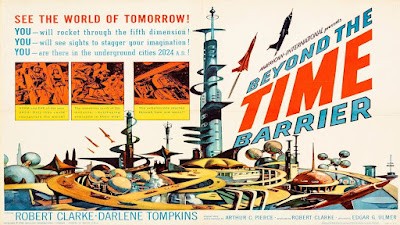
the director and the able performances of the cast.