Sci-Fi Film Fiesta, The Swingin' 60s - Volume 2 Far Out Battles Without and Within by Chris Christopoulos - HTML preview
Download the book in PDF, ePub, Kindle for a complete version.
Image by Chat GPT
Points of Interest
Atragon (海底軍艦, Kaitei Gunkan 'The Undersea Warship') is a 1963 Japanese tokusatsu (Japanese special FX ) science fiction film directed by Ishirō Honda, with special effects by Eiji Tsuburaya.
The American title of this movie "Atragon" is an abbreviation of the words "Atomic Dragon."
Produced and distributed by Toho, it is loosely based on The Undersea Warship: A Fantastic Tale of Island Adventure by Shunrō Oshikawa (1899) and The Undersea Kingdom (1954-1955) by Shigeru Komatsuzaki.
Augustus Le Plongeon (1825–1908) introduced the notion of “Mu” as being a mythical lost continent, the "Land of Mu" identified with, what else? - Atlantis. It was later identified with the hypothetical land of Lemuria by James Churchward (1851– 1936), who claimed that it was located in the Pacific Ocean before its destruction.
Five models of Gotengo, all at various scales, were built for the film with steel hulls for supporting their internal mechanisms. The largest was 4.5 meters (15 feet long), manufactured by a ship-building company for the price of 1,500,000 yen. It was fully operational with wings, fins, gun turrets, a bridge and the drill, all movable by remote radio control devices built into the hull. It was also large enough for a technician to lie inside the hull and manually operate some of the ship’s movable parts. The 30 cm model was used mainly in water tank shots to depict Gotengo cruising on the surface of the sea. A small mechanical arm was attached to the ship beneath the water line, providing the ship mobility. Moreover, Gotengo was just so damn cool!
Filming of Gotengo’s trial run made use of an indoor water tank with a miniature shore line placed in front of a huge curved backdrop painting with the scene being shot in three different cuts, each of which used a different scale miniature sub along with the use of an underwater crane, high speed photography, wires and air jets to create the illusion of mass and propulsion.
The scene where the American submarine Red Satan is crushed by water pressure was done by pumping air out of the model. A cool science experiment!
Toho’s Stage No. 11, the largest on the back-lot was used for the Mu ritual extravaganza. An elaborate backdrop measuring 30 feet high and 120 feet long was made for long shots of the Empress and her court overseeing the Mu ritual. The royal contingent observing the 600 male and female dancers was placed on a small platform with the pillars, balcony, and antechambers all painted in perspective on the backdrop.
The Ginza and Marunouchi areas reproduced in miniature at 1/20 scale were used for depiction of the destruction of the Tokyo business district. The model buildings were made of plaster, with some made with internal steel structures, ensuring that that they would partially survive the destruction. The buildings’ main supports were partially cut through and ropes were tied to each support beam with all the ropes being attached to the bumper of a truck. The intention was for the underground collapse to slowly ripple through the city, destroying it in a rolling wave. Needless to say it did not go according to plan as the truck driver panicked and drove off too quickly causing the entire model city to collapse at the same time. Recourse was made to some nifty editing later on.
An outdoor water tank on the Toho back-lot was used for shooting the attack by the Mu submarine on Tokyo Bay. Ten miniature tankers were constructed, each to a different scale and were distributed in the water tank to create a forced perspective thereby adding greater depth to the scene. Six automatic remote-control cameras shot the scene simultaneously as six miniature ships exploded in sequence. Conventional animation was used to integrate the Mu subs’ ray to the live action.
The underwater sequences were achieved through the use of camera filters and smoke machines.
The illusion of an immense wall of smoke and flames erupting from the explosion of the Mu power chamber was achieved by using a small water tank against which a camera was secured and positioned upside down beneath the water line. A sky backdrop was placed behind the water, and coloured paints pouring into the water, created the billowing clouds.
Instead of a dragon, Manda was originally envisioned as a giant rattlesnake. However, Manda’s design was changed to resemble a Chinese dragon with 1964 being the Year of the Dragon.
Manda was built up as being a frightening and awesomely powerful creature. Strangely enough, it couldn’t even give a decent account of itself in its battle with Atragon and only appeared briefly mainly in the second half of the film.
The strength of the film itself lies in the personal struggles of some of the characters such as the tortured Jinguji who is torn between his loyalty to Japan, his love for his daughter and the ultimate fate of the world as they face attack from and domination by the Mu Empire. It is also interesting to note that the threat to Earth is not by aliens from outer space but from beneath the ocean by a once thought of lost civilisation. The Muans are descendants of the lost continent of Mu who are also reminiscent of the lost continent of Atlantis, except that the Mu are located in the Pacific.
Atragon also raises some interesting questions concerning the way in which a nation and its people attempt to come to terms with its past and how it envisions its role in the future and its place in the world. When people find it hard to cope with change or when times are desperate, solutions are often sought by seeking out and clinging on to historical myths and idealised views of the past. Unfortunately the more unpalatable and forgotten aspects of this past often lie in wait below the surface ready to emerge and claim the hearts and minds of the susceptible…..
All in all, Honda has directed far better films than Atragon, but I recommend you watch it and try to enjoy it for what it is despite some of its short comings. Just don’t expect it to be on the same level as Japanese classics of superior quality such as The Mysterians, Battle Beyond Earth, Gojira or Rodan.
***************
Mutiny in Outer Space (1965)
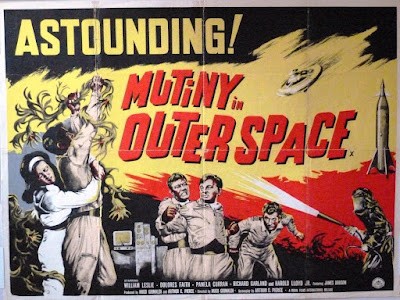
A well-paced and entertaining sci-fi film hampered by its low budget

Directed by Hugo Grimaldi, Arthur C. Pierce (uncredited) Written by Hugo Grimaldi, Arthur C. Pierce
Produced by Hugo Grimaldi, Arthur C. Pierce, Bernard Woolner, David Woolner, Lawrence Woolner
Cinematography: Archie R. Dalzell (as Archie Dalzell) Edited by George White
Music by Harry Eisen (Stock music editor)
Production company: Hugo Grimaldi Productions Distributed by Woolner Brothers Pictures
Running time: 82 minutes
Budget: $90,000 (estimate)
Cast
William Leslie as Maj. Gordon Towers
Dolores Faith as Dr. Faith Montaine
Pamela Curran as Lt. Connie Engstrom
Richard Garland as Col. Frank Cromwell
Harold Lloyd Jr. as Sgt. Andrews
James Dobson as Dr. Hoffman
Ron Stokes as Sgt. Sloan
Boyd Holister as Maj. Olsen (in credits as Robert Palmer)
Gabriel Curtiz as Dr. Stoddard
Glenn Langan as Gen. Knowland
H. Kay Stevens as Sgt. Engstrom
Francine York as Capt. Stevens
Joel Smith (unnamed character)
Carl Crow as Capt. Dan Webber
Robert Nash (unnamed character)
Astronauts on a trip back from the lunar ice caves contract a
deadly fungus.
They unwittingly contaminate a space station with the fungus.
Space Station X-7 is soon overrun by the unknown deadly
alien fungus.\
What’s more, not all is right with the X-7’s commander.
What must the crew do In order to save the space station,
along with Earth itself from destruction?
“Just when we think we have space under control…...”
In an imagined future of the 1990s, Maj. Gordon Towers and Capt. Dan Webber are returning to Space Station X-7 with geological samples and ice they collected from ice caves on the Moon.
Meanwhile on the space station, the crew on board are contending with space junk in the form of “another one those communication satellites” - a 30 year old t-type closing fast on their position.
Back on Earth Gen. Knowland discusses the cost and time savings involved in the construction of the lunar base phase two and the possibilities presented by the ice caves from which water could be obtained by means of solar power reflectors, along with construction materials being produced on site. The result it is hoped is that, “the savings in transporting raw materials will be tremendous.”
In a reflective mood the general states that it is the ‘human element’ that concerns him…..
On board probe ship number five all is pretty much routine with Maj. Gordon Towers and Capt. Dan Webber as they switch to automatic pilot with nothing to do but “just sit back and let the electronic skipper” take over. This leaves them time to engage in blokey talk concerning “heavenly bodies,” a “beautiful blond with a binary brain” and a civilian biochemist who is “supposed to really be something.”
And on and on rolls the teenage romantic banter and infatuations as on the space station we see that Lt. Connie Engstrom is smitten with Col. Frank Cromwell who doesn’t seem to notice her as he is so focused on his command responsibilities. This of course is concerning doctor Hoffman who insists that Cromwell gets some rest. This in turn brings to the fore a point of potential contention and conflict as Cromwell snaps at the doctor telling him, “don't ride me! I've had enough experience in space to know when I've had it!”
Anyway back to juvenile banter that makes one wonder if anyone in the whole universe would engage in such dialogue as Hoffman pays a visit to Dr. Faith Montaine and craps on about a lovely nymph living here, enchanted forests, farmer’s daughters and blah, blah, blah.
Well, in case we are too stupid to figure out that Faith is a “true scientist and not some adventurous hot rocketeer” she is thoughtfully and stereotypically attired in the usual white coat and huge unflattering spectacles just to reinforce that fact for us. Of course, there’s a romantic involvement between this hot civilian scientist and Maj. Towers. God, it’s like being in the eighth grade at school instead of on board a space station crewed by supposedly professional adults!
Every now and again we are provided with breadcrumbs concerning this imagined future that apparently still retains 1950s style surplus ex-military analogue equipment replete with big dials, knobs and switches. Bathtubs and water have been replaced by instant cleaning processes. Smoking cigarettes has been banned but at least people can still drink alcohol. Synthetic food is used on space missions (stand by for lab grown meat in the next few years) and by the way - there was apparently a third World War! (a disturbingly real prospect the way things are moving these days geo-politically)
As Towers and Webber leave lunar orbit and approach the space station, their facial expressions almost suggest that they are both passing enormous solid stools apparently due to g-forces when manoeuvring and accelerating their space craft. Judging by Towers and Webber’s arrival at the space station, it seems that in this future scenario there is no concept of space craft actually docking with a space station or of the crew gaining access via an airlock between space craft. Strangely enough the lack of gravity seems to force astronauts to move in slow motion and neither they nor their unattended helmets are in the least bit inclined to float. Go figure.
Not long after their arrival, Dan mysteriously collapses and is taken to the infirmary by Dr. Hoffman. Gordon is later ambushed in his quarters by his forceful and insatiable biochemist girlfriend, Dr. Faith Montaine, and instead of jumping her bones after his long absence, he tries to disentangle himself from her clutches! Never mind – saved by a summons requiring Faith’s presence in the infirmary.
Hoffman has been unsuccessful in diagnosing Dan’s condition. He states that “pressure changes have never brought on symptoms like this” and It can’t be due to "space raptures due to too much weightlessness" as they cause hallucinations but not the high fever that Dan is running.
Upon hearing of Hoffman’s inability to diagnose Dan’s condition, Cromwell begins to get all metaphysical and with a weird faraway look in his eyes declares that “there are things out there we may never understand….or live with” Well, derr! It would be a bloody boring and pointless universe if we understood everything! That’s why we….explore! It is obvious though that Cromwell’s mind is beginning to unravel.
Faith then notices that an initially small welt on Dan's leg has grown rapidly into a kind of large fungus twice (note, not two times!) the size it had been previously. She states that “it resembles a common bacteria” and could be of the kind of fungi that “are capable of killing living animal cells if they can enter the bloodstream.” Faith conjectures that the spores causing the fungus must have come from the Moon's ice caves.
In order to contain the spread of the fungus and conduct further investigation, Hoffman and Faith agree to put Dan into isolation and not say anything to anybody about this until they are more certain about the fungus and any potential risk it could pose. But is this the right decision? Wouldn’t it be their responsibility to inform their commander and the rest of the crew as to any potential risk to their safety? Perhaps there’s the question of Cromwell’s apparent growing mental and emotional instability to consider. Just saying.
“He's on the brink of space rapture”
Of course we have the mandatory swarm of meteors approaching the space station on a collision course. Interestingly enough, Cromwell designates the oncoming meteors as “the enemy” but is unable to give the order to take evasive action until coaxed to do so by the communications officer, Lt. Connie Engstrom.
Hoffman reports that Captain Webber is dead and that it was more than a virus fever that caused it. Cromwell is told that “ Weber was infected with some unknown kind of fungus” that’s “literally eating him up.” Cromwell tells Hoffman and Faith that they should have told him and under normal circumstances that seems to be reasonable. However, Cromwell in addition to being concerned that all their lives have been placed in jeopardy, is also worried that “a thing like this could put us in quarantine.”
Cromwell wants to see Webber’s body for himself but Hoffman warns him that “he's a pretty terrible sight.” After briefly viewing the body through a small observation window, he bizarrely states, “now I am convinced there's nothing unusual.” He then warns the others not to mention what has happened to anyone else and that he wont have the station “panic-stricken.”
When informed that it is his duty to report what has taken place to Gen. Knowland at Earth Control Center at once. Cromwell refuses to and insists that Webber's death was the result of "pressure shock" despite how unlikely that would be.
The other crew-members present are gob-smacked that Cromwell doesn’t seem to “realise what could happen if that fungus gets started and starts spreading.” They conclude that he is “a very sick man” who’s “on the brink of space rapture” and should be grounded.
Back at Earth Control Centre, General Knowland and Captain Stevens are considering a coded message just received from the space station informing them of Webber’s death and stating the cause as being “death shock due to sudden pressure changes while entering parallel orbit with this space station.” This surprises the General as Webber had been in excellent condition. The message goes on to relate that Cromwell considers that Major Tower’s attitude since arriving at the space station is not in the best interest of his command nor the US Space Agency. Both General Knowland and Captain Stevens find the contents of this message to be very unusual indeed.
On the Space station a return message has been received in the form of a communique from General Noland who wishes to know what the…...(cleaned up by Connie) if Comwell could clarify his last report.
Cromwell, however is off with the fairies once again as he contemplates the certainty of the existence of other worlds with beings like them as “the probability law states the conditions for life as we know it should exist on at least one hundred thousand planets here in our own galaxy.” As for locating the existence of such life, Cromwell despondently states that “we'll never make it in my lifetime.” He goes on to add, “no, this is the end of…..” He never finishes that statement but we can guess what he was going to say which would be a window into his present state of mind.
When Connie leaves Cromwell, she is accosted by Towers and Hoffman who question her about the report. Connie, however remains loyal to Cromwell as both a crew member and on the basis of her feelings for the commander and tells them that he is command of the station and she’ll “not be a part of any conspiracy against him.”
In the meantime, Faith has finished with her analysis of the fungus but finds herself trapped by it in the infirmary. Towers and Hoffman realise something is wrong when they unsuccessfully try to contact her on the station’s intercom. While Faith hops from side to side and to and fro in a lame portrayal of terror, Towers bursts into the infirmary sweaty armpits and all. He then proceeds to monkey-bar over to where Faith is and orders her to cling on to his back. As he monkey-bars himself and Faith back through the sluggish fungus, it appears that Towers is really walking them through it rather than making like Tarzan.
“ We must be ready to annihilate Space Station X-7”
With adrenaline pumping and testosterone surging, Cromwell stomps about issuing orders for spraying the station, sealing up the laboratory and contacting General Knowland in view of the supply ship that is supposed to arrive the nest day.
As Towers is informed that such transmissions can only be made withthe proper authority if it is deemed to be an emergency, Cromwell appears and asks him, “since when are you giving orders aboard the station?”
The following facts that constitute such an emergency are presented to Cromwell:
1. “There's a monstrous thing aboard the station.” 2. “We may all be contaminated.”
3. “We've got to stop all ships from coming here.” 4. “We've got to inform General Knowland and we'll need his help.” 5. What’s growing in the laboratory is “spreading like Hellfire.”
Cromwell portrays Towers to the other crew members present as suffering from hallucinations due to space rapture and that “he can become dangerous.” Towers, Faith and Hoffman point out that considering Cromwell’s actions and state of mind, it is he who is the one who is placing them all in danger and therefore they must relieve him of his command. Cromwell cuts them short by ordering the three mutineers locked up.
After the three are taken away, a somewhat conflicted Connie enters and offers to take a look at the infirmary herself, but is prevented by Cromwell who wants her to send a report to the general on what has taken place and to have him ensure that the transport ship is launched at once with replacements for the detained personnel and as well as a report on how Towers attempted to take away Cromwell’s command at gunpoint, before he was overpowered. The accompanying music once again underscores the mental carnival playing out through Cromwell’s psyche.
The intended report amounts to an accusation of mutiny against Towers. Cromwell insists that Connie had witnessed whole incident when in fact she hadn’t and that he can count on her loyalty and respect, qualities he expects from his crew.
From a rather obvious clue in what Crowell had told her, Connie decides to placate the clearly disturbed commander by telling him that he can trust her and that she’ll give the general a full report, as no doubt she now will.
Unknown to Cromwell, Connie he has palmed an audio recording of his last order. She transmits the recording to Knowland, who is aware that “Cromwell knows better than anyone that all weapons were ruled out of space as far back as 1970.” Orders have been given to have Towers released while Connie’s report makes mention of the fact that the entire space station is being overrun by some kind of fungus and that all ships must be stopped from coming to the space station.
Meanwhile aboard the Space station, a search for Cromwell is being conducted but he is proving to be quite elusive. In addition, it seems that Hoffman is succumbing to the virus and he enlists Faith’s assistance to get him quietly and unobtrusively to the infirmary.
Major Towers has established contact with General Knowland where he forcefully states,
“Do not program any other flights to this station at this time. Second, we have a
very dangerous alien growth….I'm sure it is from the lunar ice caves. According to
Dr. Hoffman and Faith Montaine it is a type of fungi that grows at a tremendous rate.
Under certain conditions it can be deadly and destroys living cells.”
Towers concludes by pointedly stating that the space station must be quarantined.
When a request is made for Dr Hoffman’s knowledge in the matter of the fungus, the good doctor’s absence is discovered. What’s more, when Knowland tries to reply to Space Station X-7, he gets no response. Suddenly there is a flurry of activity involving establishing contact with West Coast space bases, getting the Chiefs of Staff on Knowland’s private line, contacting Strategic Command Headquarters, going on alert - hell, just be seen to be doing a bunch of stuff.
The horrifying possibility is put to the general that the Space Station could go out of control and plunge toward Earth carrying that deadly fungus with it. It might burn up when it hits the atmosphere but “suppose one tiny fragment didn't: that might be enough to start this thing off spreading it all around the world.”
If that is the case, there can be in Knowland’s strategy saturated militaristic mind only one option: “Gentlemen, we must be ready to annihilate Space Station X-7!”

Image by ChatGPT
Space Station X-7 Danger In Orbit
US Space Station Threat To World!
Killer Fungus Threatens Earth
Invasion From The Moon
Although Hoffman has contracted the fungal infection and is very ill, he is able to tell Faith and Towers that the fungus can be killed by cold. He reminds them how in the lab it rapidly grew when it reached the lighted area but that it isn't the light the fungus thrives on, instead it's the heat. This was confirmed when they placed Webber in the decompression chamber where there was no light. It is also pointed out that the fungus originated from “the frozen wall of the lunar ice caves; until it reached a warm environment, it was dormant.” Hoffman appeals to Towers and Faith to place him into the refrigeration chamber to lower his body temperature to maximum.
Another attempt to take control of Space station X-7 will need to be made but added to the danger posed by the fungus, Cromwell is once again on the rampage being fully afflicted by space rapture. Having escaped confinement to his quarters, Cromwell dons his cap and attempts to sabotage the station’s systems. With his carousel consciousness careening out of control, Cromwell is placing the station in grave danger with a sulphuric acid bomb and threatening to activate a gravitation control switch along with the station’s control jets which could bounce the Space Station right out of orbit.
Fortunately, Cromwell is subdued and presents a pathetic sight as he is being restrained while telling Connie to contact the general to inform him that the mutiny has been put down. All Connie can do is reassure Cromwell as if he were a child that he can trust her to tell the general everything. Cromwell is then taken away to be tied down but at least made comfortable seeing he is the commander and was not responsible for his actions.
Space Station X-7 Doomed
US Space Station A Growing Danger
With communications down, the possibility of the crew losing control of the Space Station and the X-7 possibly crashing to earth, Faith is beginning to lose…..faith, along with her grip on reality. When Towers tries to reassure her that at least they are still alive, she intones in a dreamily spaced-out manner, “we're not really alive anymore….. we're nothing more than an event about to become history…... the bad dreams I have with my eyes closed are still there when I open them.”
In order to snap Faith out of her malaise and hysteria, Towers resorts to the cinematic tried and true method of slapping her in the face. It appears that physical assault is part of the repertoire of “the amazing powers of Major Towers.” At least we’re more enlightened in the 21st century in that we tolerate and approve guys on screen being kicked or kneed in the nuts as well as being slapped in the face if they do or say anything untoward.
With Faith restored to her senses, it is discovered that there is a food shortage aboard the station. Faith told the others that they had enough food to last another week but that was a lie as she didn’t want to worry them. All of the synthetics are contaminated.
The last hope of saving X-7 appears to be to lower its interior temperature to below zero degrees while the crew are protected by their survival suits. The plan proves to be successful as the fungus inside X-7 dies off. However, it is now growing on the outside of the space station and spreading! Bur why?
Meanwhile, a workaround to the communications problem has been put into effect involving shutting down the station’s reactor which will be registered by terrestrial radar tracking stations in the form of Morse code consisting of a signal created by breaking the circuits on the nuclear generator thereby producing a simple static signal.
The received message outlines the situation so far:
• The fungus is destroyed by freezing temperature.
• The interior of the space station is now below zero.
• The fungus cannot be similarly destroyed on the station’s exterior.
• The food supply is exhausted.
• Oxygen supply is low.
• Help is needed.
Back on earth Knowland appears to be bound to “a decision of the heads of states around the world” whereby if “there's any sign of Space Station X-7 falling out of orbit, they'll have to be destroyed.” However, one of Knowland's officers suggests that the fungal growth on the station’s exterior may be due to the "high temperatures generated by the unshielded blazing sun" beating down on X-7. This gives Knowland the idea of creating a screen in the form of “a cloud of sub-zero particles” launched in a rocket that will explode creating a huge cloud of ice crystals that will engulf Space Station as it passes through.
The plan works as the fungus on the exterior of X-7 is killed. (Who would have thought that fungus can scream as it dies off in the void of space?) While the crew aboard the station await the arrival of a relief ship in the next three hours, Knowland tells them "Don't lose your faith" (Get it? Faith! Oh God!) With the end of their travails, Faith and Towers gaze at each other and signal with a saccharin smile that all is now and will be well. Cue space station spinning optimistically away into a shiny hopeful future.
Points Of Interest
Mutiny in Outer Space was filmed in six days at Producers Studio in Hollywood, on a budget of approximately $90,000. Space Station X and Invasion from the Moon were the film's working titles. Although it was filmed in the US, the film is an Italian-American co-production. In the US, Mutiny in Outer Space was theatrically released as the second film of a double feature with The Human Duplicators, another such co-production.
Although the film is obviously quite cheaply made, I found that I could best appreciate it by listening to its audio content only. Due to my steadily deteriorating eye-sight, I often listen to audio only and audio-described versions of films and let my imagination flll in the blanks in terms of visual cues based on what I hear. It was in this manner that I recently revisited Mutiny in Outer Space. The dialogue reflected the film’s quite zippy pace and it was easy to imagine everything that was taking place. It was almost a disappointment when I viewed the film as per normal again. Mutiny in Outer Space would work very well as a dramatised radio play.
Speaking of the film’s visual aspects, it has the feel of being a throw-back to the science fiction films of the previous decade. However, some of the ideas presented are really quite interesting, while others are fairly naive and embarrassing even for the time. Among these are:
In relation to the scene in which the old communications satellite is on a collision course with Space Station X-7, we are reminded of the presence of space junk being an ever growing hazard to satellites and space craft in low orbit in our own time!. It seems that as we humans continue to spread throughout and infest the rest of the cosmos, our refuse will similarly follow in our wake.
Ice Caves on the moon: Recently we have detected the presence of water ice on the polar regions of the moon and within craters that are permanently in shadow. This also presents us with the possibility of obtaining both water and fuel for future lunar bases and missions to other planets.
Probe Ship Number Five and its “electronic skipper:” So much of space travel in our own era in terms of guidance, navigation, rendezvous and docking procedures is becoming more and more routine and automated. One hopes that this over-reliance on technology and artificial intelligence doesn’t allow complacency to take over thereby resulting in tragic consequences.
The fungus and its survival in outer space: The Apollo 12 mission to the moon brought back to earth a camera from a Surveyor craft that was accidentally contaminated prior to launch with a common type of bacterium, Streptococcus mitis. The bacteria had apparently survived dormant in the harsh lunar environment for two and a half years. It begs the question as to what else could survive the extreme conditions of outer space and what kind of potential threat would be posed to life on earth? Have previous pandemics been the result of micro-organisms entering the earth from outer space? Or perhaps have microbes migrated to our planet via asteroids and comets and kick-started the process of life here as part of a process called panspermia? We already know of the existence of extremophiles or microbes that can survive in extreme conditions on earth. Is it possible that global warming and the resulting melting of the permafrost could release long dormant pathogens that wind up causing diseases against which we may have little defence?
Finally, there is the question of the “human element” that General Knowland was so worried about in relation to our presence in outer space. No doubt great thought and effort has gone into the emotional and psychological suitability and compatibility of those who are and will be selected for space missions. But will tis continue to be the case as we expand further into space and increase our presence there whether it be for exploration, recreation, to take up residence and undertake employment on orbital space stations and in colonies on the surfaces of other planets? Who is to say what kind of toll an environment for which evolution has not adequately equipped us may have on our physiological and psychological state. If nor “space raptures,” then what else?
***************
Battle Beneath The Earth (1967)
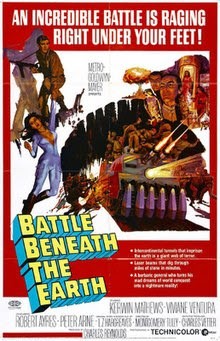
A diverting and quirky 60s sci-fi film with an unrealised ambitious concept

Directed by Montgomery Tully
Written by Charles F. Vetter
Produced by Charles Reynolds, Charles F. Vetter Cinematography: Kenneth Talbot
Edited by Sidney Stone
Music by Ken Jones
Distributed by Metro-Goldwyn-Mayer
Running time: 91 minutes
Budget: £156,307
Cast
Kerwin Mathews as Cmdr. Jonathan Shaw
Viviane Ventura as Tila Yung
Robert Ayres as Adm. Felix Hillebrand
Peter Arne as Arnold Kramer
Al Mulock as Sgt. Marvin Mulberry
Martin Benson as Gen. Chan Lu
Peter Elliott as Dr. Kengh Lee
Earl Cameron as Sgt. Seth Hawkins
John Brandon as Maj. Frank Cannon
Ed Bishop as Lt. Cmdr. Vance Cassidy
Carl Jaffe as Dr. Galissi
Garrick Hobson as Professor Blackthorne
Sarah Brackett as Meg Webson
Bee Duffell as Matron's friend
Chela Matthison as nurse
Burnell Tucker as Jack Ambridge
Advanced burrowing machines?
Tunnels dug from China to the United States?
Atomic bombs under major cities?
A dastardly plan to conquer the U.S.?
An expected war with a projected 100 million causalities?
All this kept secret for years!
But now at last
Someone who knows..
Someone who was there….
Will explain…..
Feature Article
I am former (ret) Naval Commander, John Shore. As I sit here penning this article in this last decade of the 20th century, I remember that back in the ‘60s our attitudes toward the People's Republic of China were pretty much shaped by Cold War dynamics and our ideological opposition to communism, not to mention strategic jockeying in Asia.
Our government in the US refused to recognise the PRC as the legitimate government of China, so we instead supported the Republic of China (ROC) government in Taiwan as the official representative of China. That’s going to be a definite potential sore-point in international relations for many a year to come, I’ll bet.
From the point of view of ‘our side,’ the PRC was an aggressive communist power aligned with the Soviet Union, despite growing Sino-Soviet tensions. God knows what China thought of us! But for us in the West, China was viewed as being a major player in spreading communism throughout Asia, especially evident by its support for North Vietnam in the Vietnam War. A climate of fear of communist expansion developed over what we in the West saw as China being a key supplier of arms and support to North Vietnam We believed that it was up to us to pursue a policy of containing China’s influence in Asia through alliances like the moribund SEATO (Southeast Asia Treaty Organization) as well as by maintaining a military presence in Taiwan, South Korea, and Vietnam. The US also imposed economic sanctions and trade embargoes on China, isolating it from much of the Western world.
Back then the "Domino Theory" prevailed in which it was contended that if Vietnam fell to communism, other nations in the region would follow, falling one-by-one like a line of dominoes. Well, so much for that bright idea!
It wasn’t until the end of the ‘60s and the beginning of the 1970s that there was a shift of attitudes leading to a kind of détente and the eventual opening of relations culminating in President Nixon’s historic visit to Beijing in 1972.
Since those days, I have lived long enough to witness the fall of the Berlin Wall, German re-unification and the beginning of the dissolution of our former foe, the Soviet Union. Due to a combination of age and illness, I don’t have much time left on this earth and can only give an educated guess as to what the next century has in store.
I can see a time when the United States may no longer be the sole preeminent global super-power. Yes, even in its likely decline with ‘barbarians’ nibbling at the edges, the US will still be seen as an awesomely bristling military juggernaut. Meanwhile, whoever leads Russia into the next century will no doubt hark back wistfully to the time of Peter the Great or Stalin and in Napoleon-like fashion wind up tripping over his own ego. This could leave the way open for powerful renegade warlord or oligarch taking over the reigns of power with dire consequences for the world. China’s level of economic and military development, on the other hand may very well enable it to rival and perhaps even surpass that of the US. This will inevitably lead to a heightened level of tension in the relationship between China and the West. Are we about to witness the inevitable rise of China as a global economic and military super-power, with Russia becoming a shadow of its former Soviet entity, and the US coming to the realisation that (no matter how much it may try to bluster, cajhole, threaten, wheel-and-deal and bully its way around the globe) it is no longer the single dominant global super power of the 21st Century? Will we then see a return to a similar kind of geo-political hostility and paranoia that characterised the time period that provided the context of a battle that I was personally involved in, a…..Battle Beneath the Earth?
As you read this article, and having read today’s sensational headlines, you are probably aware of the Freedom of Information release of official documents pertaining to a highly classified incident involving rogue elements of the communist Chinese Army headed by fanatic General Chan Lu. The account that follows is from one of those people who was involved in the events that occurred literally beneath our feet…..
THE CRAWLING ANTS INCIDENT
AKA “OPERATION PEST CONTROL’
By John Shore, former US Naval Commander (ret)
“A listening disturbance”
It was a typical night in Sin City where bright colourful shiny things and the revving, pinging, honking cacophony of sounds assail and distract the senses of hopeful visitors intent on forgetting about their mundane humdrum lives and the reality in which those lives are forced to traverse. It was also that night in 1967 when Las Vegas police received an unusual report that a scientist and my friend, Dr. Arnold Kramer was lying prone on a sidewalk at South Vine and Main with his ear to the ground and alerting passers-by to movement or suspicious sounds underneath which he claimed he could hear. Of course, the police in attendance soon assessed him as being mentally disturbed and with Arnold being so obviously emotionally and mentally distraught rendering him almost incoherent, they restrained him, took him to the station and arranged for him to be committed to an asylum.
What’s pertinent to this account is what the on-lookers and the two policemen reported Arnold as saying. He was reported to have said, “Just like ants. They're crawling under us, I tell you. Just like ants…..They're all down there. Crawling about like ants. If you listen closely, you can hear them…... they're right beneath us. Listen. Listen.”
As Arnold was being led away, he appealed to the policemen to get in contact with me as he felt that I would understand.
My part in this incident began at the Office of Naval Research (ONR – WEST) Deep Submerged Systems Program at San Diego, California. I was there on account of my role in an undersea lab project called, Sealab VII. I headed this project which unfortunately ended in disaster due to a mysterious underwater earthquake. Twenty-seven men died when it collapsed under tons of rock from the earthquake. Sure, I was off the hook so to speak but not not completely cleared as the record still stood and the verdict cited the collapse as having been due to “causes unknown." As for an earthquake? It was determined that “there were no traces of any tremors or quake reports.”
There would be no more diving assignments for me. I found myself ‘reassigned’ to a test lab where I spent my days as a glorified plumber tapping pipes with a rubber mallet. One day my fascinating work routine was interrupted by the arrival of an assistant who appeared to be distracted and stressed over some matter. It turned out that she was Arnold’s’ sister, and me being an old family friend she asked if could visit her brother in the state psychiatric hospital on account of Arnold asking for me. It seems I was the only one he would listen to.
“They're crawling in under us right now.
Who knows when they will strike?”
I soon visited Arnold at the Psychiatric hospital, where Dr. Galissi informed me that he had “failed miserably” in that he could not get through to Arnold. When I saw Arnold, I tried to get him to recall why he had been brought to the hospital. All he could talk about was ants and how we couldn’t stop them. The sudden appearance of an ant on the padded wall of his room sent Arnold into a frenzy of destruction upon the six-legged little beast. He then looked at me and declared that “they're crawling in under us right now” and “who knows when they will strike.” I wasn’t certain as to the “who” Arnold was referring to.
Suddenly, in a flurry of over-excitement and nervous energy, Arnold produced from under the mattress of his bed some seismographic drawings he had made of tunnels. As he explained about his “latest detection techniques,” I tried my best to placate him by feigning interest in and agreement with his warnings about “that's where they're coming in South of San Diego….and there along the Oregon coast” and that “they're bound to reveal themselves” and “there'll be an accident somewheres.” Arnold was no fool. He could see that I like everyone else was merely attempting to placate him as one would to a mentally deranged patient.
Just before I left, Arnold blurted out in anguish and frustration, “they've got tunnelling machines. They're coming in under us…..They're going to wipe us out. They're gonna wipe us right off the map!”
“We've got the entire world bugged”
Well, there was nothing for it but to visit a bar and down double scotches while a young lovely oriental dish at the bar kept on giving me the eye. A cowboys and Indians western movie was playing on the TV with the usual expected goodies and baddies, as if that was how the world was supposed to work. My attention was somewhat diverted by a TV special bulletin news broadcast that abruptly interrupted the program. It featured a report of a sudden coal-mine disaster in the small coastal backwater town of Placer, Oregon. While the bulletin continued, I kept hearing Arnold’s voice in my mind calling out in anguish, “They're going to wipe us out. They're gonna wipe us right off the map.” I then left the bar vaguely conscious of that gorgeous Asian woman’s keen interest in me but unfortunately I had more pressing matters on my mind.
I later made my way to the Los Alamos (Underground) Atomic Detection Center to pay a visit to my pal, Lieutenant Commander Vance Cassidy. It’s a global listening facility where they proudly proclaim they’ve got “the entire world bugged.” Never one to exaggerate, Cassidy tells anyone who wants to listen that if “a champagne cork pops in the Kremlin”, they hear it.
I found out that there were no warning tremors recorded before the accident which begged the question, “why would the mine collapse so suddenly?” Possible explanations ranged from a mistake in engineering to faulty timbers. The investigation of the accident concluded that there was “no suspicion of sabotage... or other external causes exist." In short there seemed to be “no basis for Kramer's story.” It was put down to being “just another accident….like Sealab VII” Yeah, right!
My next stop was at the Placer mine cave-in disaster site. After almost being clobbered by falling debris in a shaft of the lower section of the mine, my guide and I came across another section that had never been dug through. And yet it had “perfectly cut sides.”
I then high-tailed it back to the Detection Centre armed with tunnel samples from the mine site where they were analysed. They were found to be a “mixture of rock and soil typical of the Placer area and fused under extremely high temperatures” possibly “by some kind of tunnelling machine.” The problem with that last suggestion is that such a machine requiring a vast amount of heat was believed to have been “beyond our scientific knowledge” at that time. Added to the whole mystery was the inexplicable discovery of a strange medallion located at the mine.
“That's about the wildest yarn I've ever heard”
Our speculative ruminations were cut short by the arrival of Arnold accompanied by Dr. Galissi and a hefty orderly. After the latter two individuals departed, Arnold set about explaining to those present more detail about his research.
Arnold delivered his explanation in his usual abrupt and abrasive unconventional manner. He informed his audience that seven years of his life had been devoted to realising humanity’s dream “to understand and predict earthquakes and volcanic eruptions..to prevent needless death and wanton tragedies.” Without government and scientific support he had been forced to work alone building and designing “extremely advanced and sensitive equipment. Six months previously while studying “that arch-villain of Japanese volcanoes, Asamayama” Arnold “began to detect strange patterns of movement beneath the Earth's surface.” On a chart of the Pacific he indicated the pattern and direction of what he described as “mysterious underwater sounds….creeping along beneath the ocean moving towards our coastline in a steady methodical manner unlike any natural force.”
Unfortunately for Arno0ld, all evidence of his claims had been “burnt to ashes” when Assamayama erupted. The reaction of his listeners left no doubt as to their attitude toward this so-called “experienced seismologist” and his wild tale. To his audience, Arnold was a few tremors away from a full scale mental eruption! As if on cue, a message was delivered informing us of a “severe landslide above San Francisco” that had occurred a few minutes previously. Nothing had been recorded on the Centre’s equipment. There was nothing for it but for myself together with a team to “get back in that mine” and “find out what's at the end of that tunnel.” As I left I was given a piece of parting advice that is applicable in all situations – to “be prepared for anything.”
“Chinese…..With atom bombs”
In command of a small team of soldiers, I returned to return to the mine and descended with them into the bowels of the earth. As we entered further into the tunnel, the sound of something monstrous and mechanical steadily approached our position. From concealed positions we witnessed to our surprise the unexpected sight of a large yellow vehicle bearing the same dragon insignia as the medallion that had been found earlier on the first entry into the mine site. This was some kind of drilling or boring machine that appeared to be carving a tunnel through the rock using some kind of high intensity lasers mounted on the front.
As soon as the laser tank passed by, our team followed it until it led us to an underground chamber containing of a number of Chinese lab technicians and soldiers. Even more disturbing was the sight of an arranged assemblage of atomic bomb devices. A decision had to be made quickly and a risky one it was!
On the assumption that the devices were not triggered, I ordered the team to fan out and get into position before we moved in and eliminated the personnel in the chamber. After that was successfully accomplished, I ordered for the disposal team to move in and had a barricade set up a hundred yards back up the tunnel.
The Chinese bombs were identical to the Mark III and not surprisingly were “copied lock, stock and imploding pin.” We then quickly set about disarming the bombs and all went smoothly until the last one. It was a tense few moments with time running out and the yellow laser tank making its way inexorably back toward out position.
The disarming process was finally completed but we now had no choice but to tangle with the tank. Bullets were not much use against it and the lasers were cutting up my team to pieces. Our only option was to use grenades on the tank’s treads and get the hell out there pronto, which we did.
We didn’t know it at the time, but the Chinese personnel in the underground chamber were commanded by a rogue Chines officer by the name of General Chan Lu. Having seized control of his country’s plutonium stores and holding his cowed and impotent government virtually hostage, he embarked on a plan to construct a global spanning system of tunnels to annihilate the U.S. with atomic bombs. The General was aided in his nefarious scheme by a brilliant scientist called, Dr. Kengh Lee.
At the time we just did not know how prepared for a long struggle our enemy was; how powerless the Chinese Communist Party was to interfere with the General’s plans (if they indeed they were so inclined) and just how potentially exposed we were to defeat and ruin!
“Now is the time for something completely and uniquely
illogical”
Back at the Detection Centre, a section of the yellow boring tank we had managed to retrieve was confirmed to be a laser drill consisting of a multiple drilling head that could “cut through steel, concrete, rock, anything, just like that.” We were suddenly stunned by the realisation that while we' had been wasting billions up there on space exploration, the Chinese had been busily “working down there where it counts.”
While work was to commence (in a twist of irony) on constructing a duplicate of the laser, I was ordered to reactivate my combat team and re-enter the tunnel and “fight, hold out, sabotage and do anything” to delay the enemy until we were ready.
In addition to our efforts to reproduce the enemy’s technology, answers to various questions needed to be determined. For instance, hows were the Chinese able to provide oxygen and provisions for their personnel over such long distances underground? For how long? The logistics for continuing and maintaining production must have been mind boggling. How could such a monumental project be adequately financed?
I can’t help thinking about poor Arnold and the kind of pressure he must have been under to work miracles getting our version of the boring machine up and running.
He must have thought to himself how ironically funny it seemed that for years he had been ignored by the scientific and political establishment and then all of a sudden they expected the impossible from him.
Some good news eventually came our way in the form of a working noise detection device based on Arnold’s work. The problem was that even though we had the means to pick up any sound, we overlooked the fact that there is a “fantastic amount of activity that goes on in this country” in the form of “heavy construction, mining, digging, dynamiting, all around us, 24 hours a day.”
Even the Centre’s poor old computer had a nervous breakdown being unable to perform its mission of accurately detecting and discerning sound with all the global hullabaloo that was taking place. After all, “Kramer's original research took place in unpopulated areas – a factor we didn't consider.”
While all this was being sorted out on the surface, we were having our own subterranean hullabaloo in the form of an ambush. Our team had made its way to what we thought was a chamber containing atomic bombs only to discoverer that they were dummies and that in the centre of the chamber a source of radiation was emanating from a container of radioactive waste. It was a trap and before we barely had time to move clear, the waste was detonated. Our every move had been anticipated and we allowed ourselves to be manoeuvred into an ambush and the results were not at all pretty for our team.
“Condition Silent now in force”
When we tried to establish contact with the Centre and appraise them of our dire situation, our message was subject to interference from the background noise in their control room. This resulted in a rather radical idea involving the cessation of all noise-producing activity! A kind of Day the Earth Stood Still scenario in which such things as all mining operations and plane flights ceasing at a particular time while the noise detection device was put to work. Imagine trying to coordinate something like that while having to provide plausible cover stories for the population as to the need for such an activity!
It wasn’t long before underground noise was detected indicating direction of movement and speed of what could have been “tunnel borers or a bomb trailer moving through.” This activity was plotted on the Centre’s electronic wall-map. Even more alarming was the depiction on the map of the apparent extent of the underground tunnel network.
“They've completely undercut
our military power”
“Yes, and created a stalemate”
We could see that the enemy had constructed “three separate tunnel complexes. The first, running into Texas under our space centre and the big aircraft plants. Second, cutting through our population centres, and the third, snaking north under our missile sites and the big Air Defense Command Centre. All they had to do was simply sit there “waiting to press the button.” If we didn’t find an answer we knew we could “write off the entire country.”
Still, our side had at least one ace up its sleeve and that was the enemy’s “lifeline: one long slender thread under the Pacific.” That was a mistake on their part which we could exploit to our advantage. News received from Hawaii indicated the existence of a deep inactive volcano. The insertion of an expeditionary force could “cut their jugular.” We could reach that point by means of our own our tunnel borer thanks to Kramer’s miracle working. Our borer may not have been as sophisticated as the enemy’s machine but it worked damned well.
When we arrived in Hawaii we were introduced to Miss Tila Yung from the University of Hawaii who was assigned to assist the expeditionary force. She also later became my wife but that is another story for another time. Tila was an “expert potholer or spelunker, if you wish” in addition to being “a top authority on volcanic passages.” She had been exploring caves for about 11 years and worked as a geologist at the university.
We soon began our descent into the volcanic passage and began putting our borer to work using its lasers to to cut a way into the passage that would lead us up against the Chinese tunnel. Once we achieved our objective, our mission was to destroy the tunnel using a 10 megaton atom bomb. Yep, that’s what we were lugging around with us. Looking back, it sounds pretty crazy! The 1960s. They were crazy times!
When we located the passage that was to lead us to the Chinese tunnel, we brought up the borer. We increased the power to phase seven but came up against petrified silica and had to switch the machine off. We couldn’t switch location and with time running out, we could only try again. We slowly brought the borer up to phase nine and then phase ten but at that point it suddenly burnt out. There was no chance of repairing it.
Let’s take a pause here and recall that medallion we found earlier. An investigation top-side of its origins and significance provided additional information about the nature of the enemy we were up against. It was determined that the medallion was “an ancient emblem of the Lu warlords, going back as far as the Ming Dynasty.” General Chan Lu apparently was a direct descendant. We initially believed General Lu had been purged by the Chinese Communist Party but to the contrary, this veteran of the Long March had in fact broken away from the central government and organised a private army which he used to take over the plutonium plants he was supposed to be guarding. It was also a fair bet that the general had a couple of bombs sitting under Peking right at that moment. Under the circumstances there was not much anyone could do to stop him.
Back at the passage there was nothing for it but to put our backs into it and dig our way out of our passage and into the enemy’s tunnel. Kramer felt pretty bad about what had happened to his little baby, the borer and and believed that he was responsible for our dilemma. Suddenly, Arnold had a hunch that we may have missed something further back in the cavern we passed through that would prove to be an alternate direct route to the Chinese tunnel.
Considering how long it would take us to dig our way through by hand, it was decided that a scouting party would be formed consisting of Arnold and two others from our team. Perhaps they would be lucky enough to find another route to our objective.
“Within 48 hours, your country will be a desolate wilderness”
Unknown to us at the time, Kramer and the two soldiers accompanying him were ambushed by General Lu’s men. It seems that the general tried convince Arnold to switch sides and work for him considering his considerable talents. Arnold may have come across as being a bit eccentric but he was no traitor. When Arnold refused the offer that was too good to refuse, the general employed brainwashing techniques to get him to see things his way. From that point and as yet unknown to our team, Arnold was not his own man operating with free will.
Later, Arnold returned minus the two soldiers claiming that he had located a narrow passage that led away at first but bent back right into the enemy’s tunnel. Supposedly, the two soldiers were waiting to guide the way. Well, the upshot of it was we managed to fall into a trap and I had the ‘pleasure’ of being General Lu’s esteemed guest. He tried to flatter me by praising my “courage and ingenuity” even though I had caused him a great deal of trouble. He was under the misapprehension that in his words, “victor and vanquished will join hands to rebuild the devastations of war.” According to the general, in only 48 hours the U.S. would become a “desolate wilderness” with an estimated hundred million deaths at least. With the inevitable task of rebuilding, the general felt that men like myself were needed to take command and guide the survivors into what he termed “the paths of peaceful reconstruction.” He must have had rocks in his head if he thought I would become his puppet!
Arnold, Tila, Sergeant Mariv Mulberry and I were locked in a cell awaiting our fate. Poor old Arnold felt bad about being responsible for our predicament but he couldn’t have helped it. Besides, he soon enough redeemed himself when he contrived to immobilise our sentry by faking an accidental injury thereby allowing us to obtain the keys to unlock our cell and effect out escape from confinement.
As we fled along the passage, we soon realised we were boxed in by General Lu’s pursuing troops and the approaching bomb train. Our only means of concealment was an elevated ledge. Suddenly Arnold performed a very foolhardy but amazingly selfless and courageous act. My friend gave his life by drawing the attention and gunfire of the pursuing troops.
While the bomb train halted until the tunnel could be cleared and the clearance to proceed was obtained from General Lu, we made our move and managed to commandeer the bomb train. Tila saved my life in the process by using a knife to prevent my opponent from killing me. The effect on her was more than I could stand and it’s not something I want to see ever again.
A change of uniform, the waiving of official priority orders and a great deal of front on our part manged to get us through a check point and further back up the tunnel. I had the unenviable task of hanging off the side of one of the bomb carriages feeling like the proverbial granny’s tooth.
Time was running out and we had come to the end of the line. We could not leave to get help and leave the bombs to Chan Lu? With little time to spare I used dynamite to rig together a makeshift bomb imploder as the original one could not be located. Hopefully that together with the percussion caps would have been sufficient to trigger the bomb.
With barely ten minutes to spare we had left General Lu with a nasty little surprise present that would deliver a big bang. When they had realised that all was not in order as it at first appeared to be and that the bomb had been armed and was about to explode, would the General’s loyal cohort have been prepared to take his orders and attempt to dismantle the bomb? Or would they have cursed him for his stupidity and for having brought about their defeat and destruction?
“Tunnel Area Able 7: Response negative. Activity zero”
As Tila, Sgt. Mulberry and I watched the ever rising and spreading mushroom cloud back at the Centre, the computer's verified that Chan Lu's entire network had collapsed and was flooded. There would have been next to no chance of any enemy survivors.
It’s sad to think that none of this would have been possible without the persistence and self-sacrifice of my buddy Arnold Kramer to whose memory this feature article is dedicated, along with those who lost their lives in defence of our country during this long buried battle beneath the earth.
We are a country that has always been in need of an enemy of some description. Often that enemy once identified eventually winds up becoming a friend or an ally. Similarly, what were once considered to be our friends or allies over time wind up being viewed with suspicion and hostility. What we sometimes fail to realise is that the enemy may be closer to home than one might think. The enemy, if such exists may very well be right under our noses…...or perhaps under our very feet! Ssshh! Quiet! And listen……

Image generated by Chatgpt
Points Of Interest
Battle Beneath the Earth is basically a British production masquerading as an American one and therefore one might be forgiven thinking that the Brits were just exercising their sense of humour in a send up of many things American!
Upon first viewing, Battle Beneath the Earth might be dismissed by some as being little more than a juvenile sci-fi adventure featuring goodies and baddies, laser weapons, nuclear bombs and stereotypical evil Oriental villains hell bent on world domination.
This is definitely not a film to be taken seriously. It exists mainly for pure entertainment and fun and is barely a notch or two away from the old classics like Rocky Jones and Flash Gordon with earnest heroes performing superhuman feats and over the top villains full of…..evilosity ! Battle Beneath the Earth in fact has the feel of a typical 1960s series such as Batman where you know the heroes will be up against it in their quest to stamp out evil but will eventually triumph in the end. It is the action and pace that is of importance in such films and not weighty moral and philosophical matters or touchy-feeely interpersonal considerations. Sometimes it is just plain good that this is the case as such escapism gives the mind and spirit a break from the daily crap that surrounds us.
In our modern 21st Century technologically advanced era it seems to get harder to actually get in touch with a real human being in order to get things done. The film, however provides us with a pleasant ‘What if?’ or ‘Wouldn’t it be nice if?’ moment. For example, in Operation Silence, all it took to get the entire nation to switch off were a series of commands issued via a corded phone. Momentous things actually getting done in remarkable time! Try getting a pot-hole on the road filled and repaired these days!
OK, now I know there’ll be some heads exploding over the fact that most of the non-speaking Chinese roles in the film were played by actual Chinese / Asians, while the the prominent speaking roles featuring Chan Lu and Kengh Lee are played by veteran British actors, Martin Benson and Peter Elliott. Well, so what? That’s the way it was done back in the day for better or worse. Instead of tut-tutting, it makes more sense if the viewer treats it like a snap-shot of a particular era in time portraying the kind of attitudes towards ‘race’ that were displayed all within the context of the Cold War years. Don’t forget that in ancient times in the theatre, female roles were played by male boys. Once again, so what?
While we’re on the subject of actors and the characters they portray, one of the cast members in Battle Beneath the Earth, Peter Arne is worthy of note. In such a film it is the one-dimensional characters that seem to predominate. The character of Armold Kramer, however comes across as being far more complex and three-dimensional and as a consequence for more interesting. He is a very conflicted character both resentful of his treatment by the military, scientific and political establishment, while fully determined to perform his duty when called upon despite the mental and emotional stresses he has undergone.
There is no doubt that Battle Beneath the Earth is hampered by it low-budget constraints with the result that what transpires on the screen falls somewhat short of what is implied by the film’s title. For instance, the subterranean ‘battle’ between the opposing U.S. and Chinese forces really involve somewhat less than a squad or platoon! Not that the rather small sets could accommodate many more.
Then there is the allegedly Hi-tech U.S. Atomic Detection Center which looks anything but hi-tech despite the flashing lights and wall maps. On the other side, we have the “yellow” (get it? Yellow!) tunnel borer and the bomb train both of which have a toy-like appearance as if they were 1960s made in Japan gadgets we used to play with when we were kids.
Yes, in many ways,
those were the days!
*******************
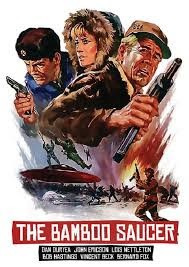
The Bamboo Saucer (1968)