

Sci-Fi Film Fiesta, The Swingin' 60s - Volume 2 Far Out Battles Without and Within by Chris Christopoulos - HTML preview
Download the book in PDF, ePub, Kindle for a complete version.
Contents
Battle Beneath The Earth (1967)
Introduction
SCI-FI FILM FIESTA
The Swingin’ 60s
Volume 2
Far Out Battles Without and Within
The 1960s did not merely reach for the stars — it challenged them!
As rockets thundered skyward and Cold War tensions simmered beneath the surface of everyday life, science fiction cinema became a battlefield of imagination. The optimism of space exploration collided head-on with anxiety about invasion, espionage and annihilation. On screen, oceans concealed super-weapons, the Moon became a contested frontier, and Mars loomed as both promise and peril.
In this second volume of Sci-Fi Film Fiesta: The Swingin’ 60s, we plunge headlong into the era’s most explosive confrontations — stories where humanity stands defiant against threats from beneath the sea, below the Earth’s crust, and far beyond our atmosphere.
Atragon (1963)
From the imaginative studios of Japan comes a spectacular clash of civilisations. A lost undersea empire rises to reclaim the surface world, and only a futuristic super-submarine — bristling with audacious invention — stands in its path. Monumental, colourful and unapologetically bold, Atragon embodies the grand scale and moral drama of mid-century sci-fi adventure.
Mutiny in Outer Space (1965)
When a lunar mission goes horribly wrong, terror follows the astronauts back to Earth orbit. Isolation, suspicion and creeping dread define this taut space-bound thriller. Beneath its modest production beats the unmistakable pulse of Cold War paranoia — where the enemy may not only be alien… but already aboard.
Battle Beneath the Earth (1967)
The threat does not always descend from the heavens. Sometimes, it tunnels upward. In this subterranean shocker, enemy forces burrow beneath American soil in preparation for nuclear devastation. The film captures a decade haunted by infiltration and sudden strike — a war imagined not above the clouds, but under our very feet!
The Bamboo Saucer (1968)
East meets West in a race to secure alien technology. Shot partly in Hong Kong, this unusual entry blends espionage, UFO lore and international intrigue. As global superpowers compete for extraterrestrial secrets, the Space Race becomes something far stranger — and far more cosmic.
Mission Mars (1968)
Mars beckons — but not with open arms. This late-decade curiosity ventures into interplanetary mystery, blending speculative science with metaphysical overtones. The Red Planet here is not merely a destination; it is a test of humanity’s courage and comprehension in the face of the unknown.
These films may vary in budget, tone and ambition, yet together they capture something electrifying about the Swingin’ 60s. This was an age of confrontation — ideological, technological and cosmic. The enemy could be an ancient civilisation, an alien contagion, a foreign infiltrator, or the vast silence of space itself.
In Far Out Battles Without and Within we celebrate these vivid, sometimes wild but always fascinating visions of conflict on a grand scale. They remind us that long before CGI armadas filled our screens, filmmakers dared to imagine the ultimate showdown: humanity versus the abyss.
So strap in and…..
prepare for the ride of your life!!!
Atragon (1963)
( 海底軍艦, Kaitei Gunkan )
'The Undersea Warship'
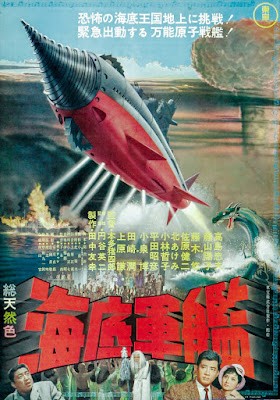
A fairly entertaining Japanese science fiction film with impressive-looking sets and

battle sequences together with a rousing music score. However, this is probably
one of Toho’s and Ishiro Honda’s lesser efforts
Directed by Ishirō Honda
Screenplay by Shinichi Sekizawa[1]
Based on The Undersea Warship: A Fantastic Tale of Island Adventure by Shunrō Oshikawa, The Undersea Kingdom by Shigeru Komatsuzaki Produced by Tomoyuki Tanaka
Cinematography: Hajime Koizumi
Edited by Ryohei Fujii
Music by Akira Ifukube
Production company: Toho
Distributed by Toho
Release date: December 22, 1963 (Japan)
Running time: 94 minutes[2]
Box office: ¥175 million
Cast
Jun Tazaki as Captain Hachiro Jinguji
Tadao Takashima as Susumu Hatanaka
Yōko Fujiyama as Makoto Jinguji
Ken Uehara as Rear Admiral Kusumi
Yū Fujiki as Yoshito Nishibe
Kenji Sahara as Umino
Hiroshi Koizumi as Detective Ito
Akihiko Hirata as Mu Agent #23
Hideyo Amamoto as High Priest of Mu
Tetsuko Kobayashi as Empress of Mu
Strange occurrences are taking place all over the world,
including disappearances and kidnappings.
The legendary empire of the lost continent of Mu which
disappeared 12,000 years earlier has reappeared.
The Muans and their giant snakelike guardian, Manda are set
to reclaim their supposed colonies and threaten the surface
world with domination.
The world’s countries unite to resist.
Embittered World War ll Captain Jinguji has created the
greatest warship ever seen, that may be the surface world’s
only defence.
Despite appeals for assistance from the rest of the world and
even from his own daughter, Jinguji is reluctant to help.
But why?
What will it take for Jinguji (still bitter about Japan’s defeat in
World War II) to decide to help save civilization?
MYSTERIOUS MU-CHINATIONS
Just 20 years previously, well within people’s living memory, a nation had been embroiled in a world war. This nation and its Imperial militaristic leadership had embarked on building an Empire and followed the long-standing practice of certain powerful western nations of forcibly acquiring colonies and exploiting their people and their resources. In the end though, it all came to naught when two cities of this nation and thousands of their citizens were obliterated by atomic weapons and the nation was forced to accept the unacceptable – unconditional surrender!
Now we find the minds of people of this nation preoccupied with more trivial and less violent pursuits as exemplified by the film’s opening involving a night-time ‘summer by the sea’ magazine photo shoot featuring a shapely bikini-clad model. As they work on getting the right shot, photographers Susumu and Yoshito suddenly witness a car flash by them before plunging into the ocean.
The next day at the scene, a detective investigates the case and learns that a chauffeur who was waiting for Mr. Shindo at the Towa Construction Company was choked and had passed out. Further questioning of the reporters who witnessed the incident involving the stolen car indicated that they were taking PR pictures at 12.20am when a man suddenly came out of the sea. They went on to tell the dubious detective that it appeared the man seemed to be made of vapor or steam. The diminutive chauffeur confirmed that the hands that chocked him were indeed very hot. Although the car had been retrieved by the authorities, no bodies were discovered.
Shortly afterwards, Susumu and Yoshito spot Makoto Jinguji, daughter of deceased Imperial Captain Jinguji. Their interest in her is that she would make a fine model but before they can catch up with her she is obviously keen to avoid them and is quickly driven away but not before she and the car are photographed. And who is that suspicious-looking character who appears to be observing and following Makoto?
Our dynamic duo are now presented with a bit of a problem: how to find Makoto in a city with 1o million people, half of whom are women? Why, by means of the licence plate number (SO 72-95), of course.
During another round of questioning involving the detective and our intrepid duo, it is learned that an engineer was kidnapped at a dam site making him the second one since the previous night. The detective is still not convinced about the vapor-man story as there’s no real evidence to support it. All that can be stated with certainty is that the two kidnapped men were civil engineers and cave-in experts. Suddenly, an earthquake (not a rare occurrence in Japan) shakes things up just a bit for good measure. Coincidence?
Yet another odd character has emerged from the car retrieval crime scene and has come to confront retired Rear Admiral Kusumi who is now a shipping company president but had been Captain Jinguji’s former superior. This strange character looks like a refugee from the Beat generation and seems to be suffering from the cold being firmly swaddled in a coat despite the obviously mild weather. He goes by the name of Umino and claims that he’s a True Story Magazine reporter. Umino gets right to the point and claims that Captain Jinguji is alive and is working on a new submarine project. Lending substance to his claims, Umino makes reference to a submarine that sailed on the night the war ended...the A- 403.
While Susumu and Yoshito now have a lead on on Makoto’s whereabouts, she and Kusumi discuss her father. Makoto learns that the night before he left for an attack he came to Kusumi and asked him to look after her. She was 3 years old at the time. This is hard for Makoto to understand being part of a younger generation who have little or no memory or war-time Japan and the kind of ethos that prevailed. During her father’s time the old Samurai principles or code of Bushido prevailed in the then militaristic-led Japan. Loyalty, honour, courage, self-sacrifice and patriotism were qualities that were emphasized whereby one’s country came before personal feelings and even one’s life. Death before dishonour was considered to be paramount. Kusumi regards the commitment he made to Jinguji as being a mark of personal honour as failure to fulfil it would mean he could never face Jinguji or indeed himself.
While in a taxi, Makoto informs Kusumi that a strange man has been following and watching her when she goes out or when she’s near her apartment. Suddenly, they realize they are on the wrong road. They are in fact being abducted by the taxi driver who is taking them straight to the sea side.
The taxi-driver is Mu Agent No.23 from the Mu Empire – the supposedly mythical empire that sank into the Pacific Ocean thousands of years ago. While training his gun on the now expanded party of captives with the inclusion of our two paparazzi boys, Mu Agent No.23 demonstrates his special energy powers: generating tremendous heat through his hands.
Why are they all standing on the beach? Well, a submarine (yep that one over yonder) is supposed to pick them all up where the captives will work as slaves for the Mu Empire. Suddenly, Agent 23’s brief period of gloating is interrupted by a badly choreographed punch-up involving him and one of the wannabe sleuths which ends up with the gun winding up in the hands of Kusumi. Not afraid of being shot and killed knowing that other agents will come to get Kusumi and Makoto, Agent 23 dashes off into the sea amidst a burst of gunfire after declaring to the others that they'll meet again.
AN ULTI-MU-TUM
During another session with Detective Ito, this time at the Metropolitan Police Dept. there is a discussion about the episode involving the Mu agent and the Mu Empire. Suddenly a package from the agent and inscribed with "MU" arrives for Admiral Kusumi. Thinking at first that it may be a bomb, it is discovered to instead contain a spool of film.
The film reveals the existence of an undersea continent powered by a geothermal "sun." Those viewing the film are informed by the film’s narrator that 12,000 years ago, the Mu Empire existed in the Pacific Ocean and that the entire world was ruled over by that empire. Fate, however seemed to have intervened and the Mu continent sank to the bottom of the sea in one night. The descendants who survived now live at the bottom of the sea and have made a sun using terrestrial heat as well as using buried resources. The Mu civilisation far surpasses the civilisation of those who dwell on the surface of the earth.
At one point in the film, the Admiral’s attention is drawn to the sight of the A-403 submarine, the Japanese Navy's pride, it being the best and largest submarine commanded by none other than Capt. Jinguji.
When the submarine was taken by the ‘Muans,’ Captain Jinguji and his crew were not on board. Reports indicate that Jinguji is building a more powerful and efficient submarine - ATRAGON - an undersea battleship named GOTENGO!
Admiral Kusumi and all in attendance are instructed to stop the construction of Atragon immediately and return the world to the Mu Empire, so that the people of Mu can inhabit the earth again. Failure to capitulate will result in the Mu people’s curse together with their deity’s messenger, MANDA falling on the heads of the surface dwellers.
After initial scepticism concerning the film’s authenticity, it is decided that the ultimatum constitutes a case of blackmail and it is beyond the capabilities of the police to deal with it.
After the mysterious destruction of a vessel at sea, newspaper headlines proclaim global shock, panic, death and destruction:
MU DECLARATION SHOCKS WORLD!
VENICE DESTROYED!
HONG KONG IN RUINS!
In response to all the evil-doings, orders are sent to the world's newest atomic submarine - the Red Satan. With a name like that one would think it was a sub crewed with evil communist devil worshippers. Nevertheless, whatever occult powers it might have possessed, the world’s best submarine was crushed by water pressure when it tried to pursue the Mu vessel.
With a sense of impending hopelessness, thoughts turn to desperate measures such as the use of the H-bomb. A very touchy proposition considering Japan’s wartime history of being the target of the world’s only deliberate and aggressive use of atomic weapons on cities and their citizens. Not to mention the insane amount of nuclear bomb testing that blew the hell out of Pacific islands and atolls and their inhabitants being used as guinea pigs to test the effects of radiation and fallout.
With doubts about the H-bomb’s power in high pressure water and the limitations on its use due to moral principles, thoughts now veer towards ATRAGON which it is felt must have something which the boffins of Mu are scared of. The UN definitely concurs with adopting this course of action.
In order to achieve this goal it will be necessary for the Admiral to contact Captain Jinguji at once. Not only did the Captain serve under Kusumi, but he had also disobeyed his orders. The Admiral kept silent for the Captain’s sake when he left. The question is, where is the Captain now?
Remember the ugly craggy-faced man who earlier had been following Makoto? Well, he seems to have gotten himself arrested. It turns out that he was a naval officer who had served under Captain Jinguji. In answer to previous questioning this man identified as Warrant Officer Amano stated the number 8561, a Japanese Navy tag number.
Amano’s training and discipline comes to the fore in the presence of (former) Rear Admiral Kusumi as he promptly stands to attention and answers the questions put to him. The others learn from Amano that Captain Jinguji is still alive but he is under orders not to say where he is.
Suddenly another earthquake is felt followed by a broadcast message from our old slippery friend, Mu Agent 23. This is designed to underscore his demands that the world must obey the Mu Empire and become its colony. In addition, the Admiral is instructed to order Captain Jinguji to stop building Atragon otherwise the world will be annihilated. (Damn their eyes, the fiends!)
Remember Beatnik boy who earlier confronted the Admiral? Well, he’s somehow turned up again and passing himself off as a reporter just as the Admiral is asking Amano the present whereabouts of Captain Jinguji. Amano’s sense of loyalty to his captain prevents him from telling the others where he is but he instead offers to lead them to Jinguji's base.
SUB-MU-RINE GOTENGO!
After several days of travelling by plane and boat, the party reach an isolated tropical island. Met by a contact party consisting of representatives of Jinguji's forces, they travel by land rover across what appears to be a volcanic plain on the way to Captain Jinguji’s base.
Meanwhile within the Mu territory, the inhabitants await news as to the location of Jinguji’s base. Suddenly, their undersea realm is rocked by an earthquake followed by a cave-in at Power room 57. Prayers are then offered up to the Mu God seeking help with the rebuilding of their glorious Mu Empire on earth again and passing on their hardships to the slaves on the surface of the earth.
Kusumi and the others are facing their own hardships at the moment as they find themselves and their vehicle stuck in the loose soil. As they get out and push to free the land rover, Beat Boy reporter turns into an instant mineral detector and observes that the land around them contains iron pyrites, bauxite, manganese – all untapped resources.
Eventually the party arrives at the Goten Kinbu Corps where the admiral and Captain Jinguji come face-to-face for the first time in 20 years. More importantly it is the first time that Jinguji has seen his own daughter Makoto in all that time. However, the brief flicker of emotion in the father’s eyes is replaced by an expression set hard with steely determination to get down to business. One can only imagine the disappointment felt by his daughter.
Jinguji is informed by the others that the world urgently needs Atragon. Jinguji flatly refuses Kusumi’s appeal stating that Gotengo is for Japan alone. He built Gotengo for the sole purpose of restoring the Empire of Japan after its defeat in World War II. Even though the war has been over for 20years, his company had not surrendered.
Suddenly Makoto runs off in anger and bewilderment. Susumu angrily confronts Jinguji, slams him for his coldness in not even having a kind word for his own daughter and accuses him of being “war crazy.” Susumu then heads after Makoto to comfort her.
Later on the party is summoned to a vast underground facility to witness a test run of Gotengo which proves to be a success. Like something from the pages of Jules Verne’s Master of the World, the heavily armoured submarine rises out of the water and ascends into the sky to fly about the island. It is even equipped with a cold air cannon that can instantly freeze whatever it hits at the temperature of absolute zero.
Some of the history behind the building of the Atragon is also been revealed along with the reason that the Muans now possess the A-403 submarine. When the captain and his forces were searching for a place for a base, an unidentified submarine attacked them. All of the planning would have failed if they died, so they used A-403 as a decoy to escape. When it was captured by the Muans, they found it to be empty. However, the blue print of Atragon was left behind. The Muans had knowledge of what was afoot but lacked the details.
The rift or gulf between two worlds - the old and new Japan – is evident when Kusumi tells Jinguji to stop addressing him as Admiral as he touches an (literal and symbolic) old scar. Jinguji stands before his old commander like some isolated Japanese soldier who has just emerged from the jungle after 20 years not knowing or accepting that the war is over and still filled with a sense of duty and patriotism. Kusumi informs him that the new Constitution has renounced war and that with the passage of time thinking has changed. The world together with Japan is in danger and needs Atragon and that Japan is now a part of the world.
Jinguji is intent on making Japan great again and continues to refuse Kusumi’s appeal, stating that he built Atragon for their nation’s navy and that he has devoted his whole life to his country. If times have changed then he’ll turn back the clock and change it again with Atragon.
The exchange between father and daughter also serve to highlight the generational divide or rift between the old and new ways of seeing the world. Makoto is far happier holding on to an idealised version of her father rather than being confronted with the reality of him and what he represents: a way of thinking that is indistinguishable from that of the people of Mu. For that, Jinguji’s daughter hates him.
After the harsh exchange of words between father and daughter and Makoto’s departure, Susumu approaches Jinguji and reproaches him for his selfishness by refusing to come to the world's assistance in its time of crisis. He accuses the Captain of being a ghost wearing rusty armour named patriotism.
Before he leaves, Jinguji gives Susumu a photo of himself and his young daughter stating that he had kept it close to him for 20 years. He finally requests that Susumu take care of Makoto. He has never stopped loving his daughter and has held on to her memory for 20 years. It is almost as if he expects never to see her again much as a Kamikaze pilot may never expect to see his country or loved one’s again after he performs what he sees as his ultimate duty for his emperor and nation.
MORE MU-NOEUVRINGS
Shortly afterwards, Makoto and Susumu are kidnapped by the beardy beatnik reporter who had earlier set a bomb on the base’s dock which has now detonated, crippling the base.
During a great choreographed shin-dig back at the Mu Empire, the prisoners are brought before the Empress who declares that they are to be sacrificed to Manda!
Conceding that he had indeed been wearing rusty armour, Jinguji now appears to have changed his attitude and consents to Kusumi's request to employ the Gotengo for war against Mu Empire.
The Mu Empire issues a warning to the entire world to destroy the Atragon and return the Empire’s colonies immediately! The extent of the threat from the Mu Empire can be gauged from shots of (miniaturised models) New York skyscrapers and other landmarks from around the world.
Meanwhile in downtown Tokyo, the tension and feelings of anticipation among the military stationed throughout the downtown area is broken when the Mu Empire launches a devastating subterranean attack with the ground seeming to give way under the buildings causing them to crumple into the earth.
While the Gotengo appears and proceeds to pursue a Mu submarine to the Empire's entrance, Susumu, Makotot and two other prisoners escape their cell and manage to kidnap the Empress of Mu. After donning Mu aqualung and wet suits, they are pursued by Manda, but are soon rescued by the Gotengo. A battle then ensues between the submarine and Manda with the serpent grabbing a firm hold on the sub’s hull. A surge of electricity through the hull soon loosens Manda’s hold and the “Absolute Zero Cannon" is employed to freeze the Mu beastie.
TER-MU-NATION
Jinguji offers the Empress peace terms, but she refuses somewhat similar to the situation faced by wartime Japan when called upon to surrender. With little choice left, Jinguji directs Gotengo into the heart of the Empire’s power room - the Empire’s heart located six miles below the palace where terrestrial heat is used for Mu energy. The vessel’s cannon is then used to freeze all of the geothermal machinery.
Upon surfacing successfully, the crew of Gotengo witness a cataclysmic explosion signalling the end of the Mu Empire. Jinguji can well appreciate the Mu Empress’ desire to share her Empire’s fate in the undersea conflagration when he allows her to escape and leap from the Gotengo’s deck into the roiling sea.