

Sci-Fi Film Fiesta, The Swingin' 60s - Volume 1 Eve of Destruction by Chris Christopoulos - HTML preview
Download the book in PDF, ePub, Kindle for a complete version.
working with all possible speed before conditions of heat make
assembly uncontrollable. No one, and I repeat, no one, can tell us
exactly what this massive
explosion will effect. One thing is certain, however. Without it, we are a
doomed planet.
With it, we can only place ourselves in the hands of the Almighty.”
“We're makin' a great clean end, man. Real cool, clean finish”
As the situation worsens with increasing panic and disorder, Stenning tries to make his way to Jeannie's flat in Chelsea, where it apparently has always been “pretty bad down there.” Stenning soon finds out just how bad it is as he attempts to inch his car through a throng of wild Beat generation youngsters playing jazz music and hurling water at each other.
As his car comes to a halt and is soon overturned by the out-of-control crowd, Stenning is confronted by a scene which seems to depict a nihilistic generation without hope abandoning itself to anarchy and an excessive outpouring of emotion charged with sexual abandon and violence. The constraints of the old repressive order are being quickly cast aside for whatever can help them cope with the inevitability of the coming doomsday, clearly showing that “they’d rather it was all over...”
After extricating himself from between the grip of a frenzied girl’s thighs wrapped around his waist, Stenning makes his way into Jeannie's flat where he finds himself in the midst of a mob of youths trying “to give the dirty little cow a bath." Whatever turmoil had been brewing in the dark pit of Stenning’s psyche, now finds a violent outlet as he engages in a fist fight in an attempt to get the youths away from Jeannie and out of the flat. In the process, one of the youths loses his footing and grip and plummets down the lift-shaft.
As the time approaches for the “big bang” scheduled for Wednesday, 11:00 a.m. we are now back in the office of the Daily Express. Stenning, a man now reformed by a woman and an Earth about to catch on fire, still has his old biting sarcastic wit to comment upon the dying embers of civilisation.
When it is learned that “there's five cases of typhus in North London, and they're expecting more” due to “ black market water, mostly,” Stenning quips, “four a gallon. Typhus, no extra charge.”
With the prospect of typhus and the use of nuclear devices (ironically, the same technology that got the world into the current predicament) to save the world, Stenning observes, “at least we have a choice now….Typhus or leukemia.”
Feeling that he has nothing more to contribute at the office, Stenning tells the editor that he’s “done enough work for one lifetime” and is going home. When told that he needs an inoculation injection, he remarks, “against what? The end of the world?”
“The time is now 10:41.
19 minutes before countdown.
19 minutes.
The time is now 10:46.
14 minutes before countdown.
14 minutes.
14 minutes before countdown.
You are advised to stay inside.
The time is now 10:47.
The time is now 10:51.
Nine minutes before countdown.
Nine minutes.
The time is now 10:52.
Eight minutes before countdown.”
McGuire, Stenning and Jeannie await the final outcome that will decide the fate of the world in the local pub. As they toast the survival of the human race, the countdown proceeds inexorably…….while as the tension mounts, Bill appears visibly and uncharacteristically shaken by the unknown outcome.
After ‘Zero’ is mercifully reached, the only indication of the massive detonations is a sprinkling of dust drifting and wafting down from the ceiling of the pub.
Stenning the journalist ends his report which forms the closing narration and is devoid of cynicism and sarcasm. It is probably his finest bit of reporting he has ever done:
“So man has sown the wind and reaped the whirlwind. Perhaps, in the next few hours, there will be no remembrance of the past and no hope for the future that might have been. All the works of man will be consumed in the great fire out of which he was created. But perhaps at the heart of the burning light into which he has thrust his world, there is a heart that cares more for him than he has ever cared for himself. And if there is a future for man, insensitive as he is, proud and defiant in his pursuit of power, let him resolve to live it lovingly, for he knows well how to do so. Then he may say once more, truly the light is sweet, and what a pleasant thing it is for the eyes to see the sun.”
"World Saved" or "World Doomed?"
As Stenning’s narration proceeds, the film concludes ambiguously with the presentation of two possible futures in the form of two different front pages of the Daily Express: one proclaiming the success of the detonation, the other, “H-Bomb Blasts Fail. Now Nation Prays.” This is followed by a panoramic view of some of London’s sites and ending with a close up shot of the cross atop St-Paul’s cathedral then fading to black……. with no credits.
What of the future? Do we merely travel along a path that inevitably leads to our annihilation with no means or will to change our fate? Or, as in the background of the Daily Express newsroom in the film, is the ‘EXIT’ sign always there for us to see pointing to a way out for us? Is there always a way out of predicaments of our own making if only we are prepared to take a different path toward a better future?
(ChatGPT Image)
Points Of Interest
The Day the World Caught Fire was partly made on location in London and Brighton, and featured the actual Daily Express, using the paper's headquarters, the Daily Express Building in Fleet Street, London.
Arthur Christiansen appeared as the Express editor, a version of himself - the real life Express editor which served to lend a realistic and an urgent credibility to the newsroom briefings featured in the film.
The film itself was shot in black and white but in some prints, the opening and closing sequences are tinted orange-yellow to suggest the scorching heat of the sun. The film was shot in anamorphic widescreen using the French Dyaliscope process.
Some of the simple but very effective techniques employed by Val Guest include the clever incorporation of stock footage to depict floods and various global disasters, all very seamlessly accomplished.
The role of the news media is presented from the standpoint of the traditional printed press and its decades old technology, a world away from the various news media formats and technologies available in the 21st Century. Just as far removed from our modern era is the political landscape which in the film is defined through the perspective of the Cold War. The issues raised by both however, still seem to have relevance for audiences sixty years later. For instance, the tension between the notion of a free press and the obstacles to achieving this erected by governments and the effects of social media and its dissemination of misinformation and rumour
In The Day The World Caught Fire, Jeannie’s arrest shows the price that is often paid by whistle-blowers who attempt to reveal the misdeeds and hidden agendas of those in authority in whom we place our trust. Modern audiences will be aware of what happens to those who try to disclose the truth: from journalists thrown into Egyptian jails; the disgraceful US vendetta against Julian Asange; the Chinese authorities’ treatment of the doctor who initially tried to make known the extent of the danger posed by the Covid-19 virus; police and security raids on Australia’s national broadcaster, the ABC and on a journalist’s Canberra residence; pressures to reveal journalist’s sources, through to the efforts of totalitarian regimes around the world who try to prevent the truth from being known.
Instead of Nuremberg-style rallies and forming Facebook flocks of dyslexic fools waving bits of cardboard and bleating Trumpian phrases like “Fake NEEEEWWWWWSSSSS!” we should do everything in our power to encourage a free and diverse and independent media and strengthen the role of investigative journalism.
Despite the ending of the Cold War, the possibility of global destruction through nuclear war still exists as a real possibility. Since 1961, the nuclear club has gained more members than just two superpowers. Notice toward the end of the film the clocks gradually showing the time edging closer and closer to 12.00 just like the Doomsday clock! I wonder just how far away we are from 12.00 – closer than we think?
The film suggests that the times were definitely a-changin’ with distrust being shown toward traditional upper-class and Establishment attitudes and values. The government no longer appears to be working in the interests of the governed and consists of “stupid, crazy, irresponsible bastards” who merely spout platitudes at us.
In our own era there’s a considerable amount of distrust around the world toward governing ruling elites. Take for instance, the lame and dishonest pronouncements and actions of officialdom in modern day China or an organisation like the World Health Organization who have been reported as having resorted to misinformation, deception and deliberate falsehoods in the face of the Covid worldwide pandemic.
It is also just as lame and dishonest when an authority figure like the US President initially attempts to dismiss the threat being posed by a global pandemic that is killing thousands of his own citizens as being exaggerated or even a hoax that will be over quite soon with things getting back to normal in no time. Not to mention offering advice that an injection of disinfectant and a dose of UV rays will fix everything up! This despite the available evidence and the weight of the prevalent expert advice and opinion. When it looks like it’s not back to business as usual, dishonest deflection is resorted to with blame being sheeted home to the Chinese, the various states and governors and the World Health Organisation. Get the picture? Like a virus, official dishonesty, cover-up, and misinformation itself spreads and infects society with mistrust and division and needs to be vaccinated against, no matter where it occurs.
The global crisis depicted in the film and humanity's attempts to deal with it conveys the notion of how science no longer can be relied on to provide answers to all of the world’s problems. In fact, it is often the source of those problems. The Day The World Caught Fire in a way illustrates the kind of problem we’re having in our own era when it comes to the science of climate change and talk of global warming. Not being an exact science built on absolute certainty in possession of all the answers, any scientific pronouncements on the subject can just as easily leave itself open to the charge from detractors and deniers as being little more than “guesswork” or “science fiction.” But science built on observation, the examination of available evidence, the testing of hypotheses is all that we have to help us explain why things happen and what do about them if they present us with a problem. Unfortunately, it is this kind of advice that is based on science that is too easily ignored or overlooked for political reasons by many of those in authority. An awkward but important question that is raised by the film concerns the strength and endurance of modern civilisation in the face of extreme threats to its very survival. To what extent might we have "gone soft" thereby undermining social cohesion and replacing it with hysteria, panic and self-interest? What happens when all the old certainties are removed, when one is a single pay-packet away from destitution, when one’s personal security and liberties are taken way and all is left is an empty stomach and no hope for the future? Our sense of community is fragile at the best of times and can become very fragmented in the face of disaster.
In our own recent pandemic crisis, we have seem most people sensibly abiding by the restrictive measures designed to combat the spread of the virus. However, there have been some instances of people fighting over items in supermarkets and abusing checkout staff. There have also been those who are more concerned with the need to have a round of golf rather than show some measure of self-control in the interests of the greater good. And of course there are those mad militia far right contrarian peanuts in some US states and in Europe who claim to be libertarians or think that the’ south is gonna rise again, ya’ hear!’ who think that the Pandemic lock-down measures are part of some grand evil conspiracy and therefore refused to accept the ‘mark of the beast!’ Yep, desperate times bring ‘em all out of the woodwork!
It is amazing how in just about any era there occurs a feeling of concern and even fear about society’s youth. In The Day The World Caught Fire, there is a definite anxiety about the youth of London at the time as being dangerously, unpredictable, and reckless at a time of national and global crisis. In our own era, young people are unfairly labelled as being self-absorbed snow-flakes who are addicted to technology. Hello? Anybody recall the Climate action protests when many young people got up of their backsides and took to the streets and social media when everyone else stood about tut-tutting about them not being in school and needing to remain out of sight.
With the current concern over the effects of a warming world, the film’s disturbing scenario has relevance to modern audiences considering the recent heat waves experienced world wide along with wild fires in Australia, Europe and California. All such occurrences have tended to leave us believing that they are unprecedented – a word that has had considerable (over) use throughout the current Covid-19 crisis.
Often it is a lack of knowledge or appreciation of history that makes us think that what happens in the here and now is completely ‘unprecedented.’ The Black Death was ‘unprecedented’ for those living in the medieval era when more than a third of the world’s population died from the Bubonic plague; The Spanish Flu was ‘unprecedented’ for those in 1918 & 1919 in which over 600.000 Americans (50 million globally!) perished with a third of today’s population!; The Great Depression was ‘unprecedented’ for those who lost their livelihoods after the Stock Market Crash of 1929; The First and Second World Wars were ‘unprecedented’ for those who lived and fought at the time and in which millions died as a result.
It goes to show that there is nothing intrinsically special about any particular era of human civilisation nor indeed of the human race itself. Somewhere out there there is probably a hunk of space rock, a gamma ray burst, a solar flare, a virus, a bacteria, an extra-terrestrial species, a super volcano or even a present or future human course of action that will determine our final fate. And if the end did come for our species, would the universe care or even notice our passing? Yet, still we’ll grimly struggle on trying to find a way to survive as life always tries to find a way…..
At the time of the Covid pandemic, the ambiguous ending of the film made me think of what might happen once the pandemic subsides and the world is free of its grip on the human, social and economic life of the planet. Will things simply go back to what they were despite the glaring spotlight that the pandemic shone on our way of life: governmental deceit and mismanagement; political imperatives taking precedence over citizens’ health and well-being; influence exercised by powerful vested interests; social and economic inequality; diminishing rights to privacy and increasing monitoring and surveillance; the cult of consumerism and endless growth; obsolescence and waste; fragmentation and tribalism; rising political populism; environmental degradation? Or, will another path be found to travel that leads humanity to a future that is a negation of all those destructive forces that currently bedevil the world?
*************
This Is Not a Test (1962)
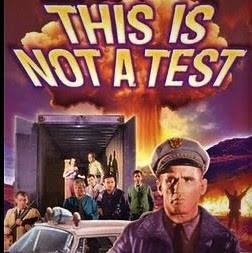

A low-budget minimalist, effective and suspenseful Cold War film with decent
performances by a largely unknown cast.
Directed by Fredric Gadette
Produced by Murray De Atley, Fredric Gadette
Written by Peter Abenheim, Fredric Gadette, Betty Lasky Music by Greig McRitchie
Cinematography: Brick Marquard
Edited by Hal Dennis
Distributed by Allied Artists
Release date 1962
Running time: 73 minutes
Cast
Seamon Glass: Deputy Sheriff Dan Colter
Thayer Roberts: Jacob Elliot Saunders
Aubrey Martin: Juney
Mary Morlas: Cheryl Hudson
Michael Greene: Joe Baragi
Alan Austin: Al Weston
Carole Kent: Karen Barnes
Norman Winston: Sam Barnes
Ron Starr: Clint Delany
Don Spruance: Peter
James George Jnr; Norman Bishop; Ralph Manza; Jay Della; William Flaherty: as the Looters
It’s 4.00am on a lonely stretch of mountain highway.
A policeman sets up a road block.
Several cars and a truck are stopped……..
And the nightmare begins!!!
“Code 1305 proceed to point seven at once…….you're on your
own Colter”
Dead-pan, implacable and unimaginative symbol of authority, Deputy Sheriff Colter is given the task of setting up a roadblock on a lonely stretch of mountain highway somewhere in California. In answer to the questions posed to him by those he stops is his repeated order to “pull over to the side of the road”and “turn out your lights.” Without information, the people under his charge can only speculate that there’s “probably something up ahead,” perhaps an accident. Despite this and Colter’s rude and brusque manner, the detained assembly comply with his directives, resigned to the fact that “there’s nothing to do but wait” and that for the time being they’ll have to “do like the man says.”
Those who have so far been stopped form an interesting cross-section of society, with all of the expected human frailties and faults. There’s;
➢ Gramps or Jacob Elliot Saunders, a kindly chicken farmer and his lovely
“Pollyanna” granddaughter, Juney.
➢ Al Weston, a down to earth truck driver on his way to “a date with a beautiful
redhead in Sacramento.”
➢ Al’s mysterious hitch-hiking passenger named Clint Delany who Al picked up
earlier in Reno.
➢ Cheryl Hudson from San Francisco, an intoxicated attractive broad with a hip
gambler boyfriend Joe Baraji “North Beach crazy,” a cat who just made a killing of $175.000, dig?
➢ And shortly to pull in, there’s the conventional and wimpish Sam Barnes and
his obviously dissatisfied wife, Karen from Tahoe, along with their cute mutt named Timmy.
All of their individual and collective lives, destinies and fates seem to be in the hands of a public official whose talents extend to barking orders and punishing minor transgressions of the letter of the law. In the eyes of some of the detained, Deputy Sheriff Dan Colter is little more than a “mickey mouse cop” and a “badge happy cat” who’s intent on preventing them from going about their business.
In reality Colter is just a functionary who only knows how to follow orders and his orders in this case are “no cars are to proceed beyond this point in either direction.” As to how long? Well, that depends on when he is instructed to remove the roadblock. In the absence of such qualities as initiative and creative thinking, such types as Colter often compensate by relishing the opportunity to exercise their perceived authority over others.
“All units. Confirming 1305. It's a button-up”
June observes that up until this point Colter hasn’t told them anything. When Gramps tries to reassure her that everything is going to be alright, she asks him, “Gramps, are you ever gonna stop treating me like a child?” June understands the reason behind this. But what of Colter’s treatment of this particular group of adults? In a way he is treating them as if they were children by not being frank with them and providing them with information as soon as he becomes aware of anything.
Something immediate is about to happen for which Colter’s personality and character is perhaps best suited for: pursuit, arrest and exercise of lethal force against offenders and law-breakers. It turns out that Al’s passenger, Clint is an escaped psychotic murderer who takes off when Colter tries to talk to him and calls him by his name.
It seems that six months previously, Delaney stabbed a girl to death. In addition to other killings he may have committed, Delaney wrote to his dying father not to die until he got to him in hospital “because he wants to watch him suffer. ”Yes, there are potential dangers to life and limb posed to innocent people from crazed individuals and in this case that was what “the road block was set up for”- to remove the threat posed to society by someone like our insane Clint Delaney.
As Kool cat Joe points out to Colter, “you goofed it, so now you’re running around playing Wyatt Earp.” So what’s their sterling leader to do now? In the face of perceived incompetence and ineptitude, authority needs to find a way to redeem and reassert itself and establish relevance. As if on cue, an urgent message crackles over the police radio;
“All units. All units.
Situation 1310! Situation 1310!
THIS IS NOT A TEST
Condition yellow.
Air raid. Air raid.
Extreme emergency!
All officers take charge.
Operation Eager. 1310.
Yellow alert!”
A potential danger to life and limb has now become an all too real threat of global annihilation due to crazed and remote Geo-political forces and factors way beyond the control of individuals and those in leadership. The individual and collective fate of our little isolated band of humanity is pretty much determined now. The question is: How will they respond as the count down begins toward their inevitable destiny?
In a very real sense this situation IS a test – a test of each individual in the face of the inevitable.
From our own point of view, it would also be interesting to see if there are any parallels between the actions and attitudes of the characters in the film and what we have noticed during the course of our own global crisis involving the Covid-19 Pandemic.
Initially, we can see there is the very human need for self-preservation as a panicked Sam blurts out, “we've got to get to the nearest shelter! There must be one in the city.”
There is also the pressing need for information as to what is going on which Colter’s captives are unable to do due to “no regular radio reception in these mountains.” They are then expected to be satisfied and placated with the assurance that “they'll (the authorities) tell us as soon as they know.”
Colter’s one-dimensional thinking only allows him to resort to the exercise of power, authority and force. As far as he’s concerned “nobody's going anywhere.” This is backed up by a blast from his gun and the command to “get out of those cars and bring your keys – now!”
As if to underscore this development, another message erupts from the police car’s radio;
“All units. All units.
Situation 1310. Condition red.
Evacuation. Evacuation.
Operation Scatter.
THIS IS NOT A TEST.
1310. Situation red.
All highways out of population centres to be cleared for
evacuation.
Operation Scatter.
All officers have full authority to deal with local problems.”
Any crisis can only be magnified and made worse if the quality of leadership and authority is defective or lacking. For instance, in the film there is definitely something psychologically wrong with Colter and he should not be given full authority to deal with local problems in the face of such a crisis. He is caught in a mental loop which only allows him open to one course of action: to detain the others where they are.
Another expected reaction to extreme crisis situations is of course, panic. Our small party realise that the evacuation will mean that “every road from every population centre is gonna be jammed with thousands of automobiles” as people rush to save themselves. It seems though that Colter is using this scenario to justify his intended course of action and is merely adapting it to fit the circumstances. He informs the others that in order to “stop you from adding to the congestion, my orders are to keep you here.” Well now, they can look to him with confidence as he obviously knows what he’s doing, yes-siree! Colter can now redeem himself for letting that nut job Delaney slip through his fingers.
It’s amazing what people choose to worry about when faced with calamitous situations. For instance, Sam’s main concern is not getting to Mexico City. However, as Al points out to him, it “won't be very long before there'll be things flying around a little bit more important than a plane to Mexico City.” As we’ve seen with the current Covid-19 Pandemic, some people do indeed find it hard to put things into perspective or prioritise what’s important.
Then there are those who seem to be in a state of denial. When faced with the grim reality of their situation, June quite innocently and understandably declares that she “just can't believe it.” Of course, we are aware of certain individuals and groups who for political and other reasons would purposefully choose not to believe the facts that are staring them in the face, whether it be climate change, a global pandemic or indeed “the end of the world!”
Panic and denial are sometimes joined by outright distrust of and hostility toward those entrusted with leadership and authority. When Colter informs the others that they’re going to “take it easy and proceed according to plans,” Joe sarcastically observes, “you got it all worked out, pop…..you got it worked out for a situation like this - eight people on a mountain.” Joe then asks Colter, “what do you got in the back of your heap man, a collapsible bomb shelter?”
“Attention all control points.
All military all civil defence units,
Operation Scatter must not slow down.
Traffic stoppages on river freeway must be cleared.
Execute severest measures to control hysteria and keep
traffic flowing.
Martial law!”
The severity of the situation is by now quite evident whereby “the whole country could be destroyed in the next few hours.” Despite the clear impending danger and probably because of the sheer enormity of the crisis, Joe is all for carrying on as normal and extracting whatever diversion and pleasure he can obtain from whatever life is left to him. He’s more concerned about whether “the cats are still rolling dice up the state line” rather than worrying over things he can do nothing about.
The futility of their situation is brought home to the group by Al who has determined the relative positions of the city, Western Air Defense Command Headquarters, the missile fuel refinery and their own location. It is concluded that they are situated in a “prime target area” and are therefore “sitting ducks on ground zero…... sitting on the target right smack in the bull zone.”
Despite the chaos in the world beyond the highway and the inevitability of their extinction, Colter is determined to preserve his little oasis of control and order and will use force if he has to in order to keep the others where they are. It is not surprising that faced with such absurdity and futility, Joe would opt to try to exercise his assumed freedom of movement and right to choose to spend what time he has left “standing in front of a bar” with his chick and that to do so is no one else’s business.
Colter’s answer to a perceived act of defiance is to knock Joe out and handcuff him to a car. The final word of authority: use of force to ensure compliance. Unfortunately, reason, humanity and compassion have taken a back seat as implied by one of the party observing that Colter and everyone else “ought to take it easy. Who knows how much time we have left. Seems a shame to waste it getting mad with each other.” Sensible advice for any era!
The reality of Cold War madness and the justification for fear is laid bare with the following observation;
“That first action will be to knock out the country's ability to resist. First thing will
be a white light that'll blind us, then a hot flame that'll burn…...Even the air you
breathe will be deadly. Everything you touch will give off radiation - ever hear of
Hiroshima - and you won't hear it happen. Suddenly there'll be no warning…….”
Added to the deadly litany of the effects of nuclear war is the awareness of “the area of destruction from the explosion of one hydrogen bomb.” Colter’s answer is to declare that “people survived Hiroshima” and that therefore they too can survive.
As the countdown to the missile attack proceeds, Colter issues orders to convert Al’s truck into a bomb shelter. With their car keys and therefore their means of escape having been confiscated, the hostages to madness proceed to empty the truck of its contents.
Fear can often have the effect of luring people into focusing their concerns on matters other than what they ought be scared about. In Juney’s case, she is terrified of having to comply with Colter’s directive to make the truck their shelter for two weeks and (as many these days feel about lock-downs) she “can't stand the thought of being all locked up.” Gramps tries to comfort and ease his granddaughter’s mind and voices the majority view which tends to be cooperative and compliant in times of crisis. He believes that they “have to do what the man says” and “learn to accept things as they come” if they are to have any chance of surviving.
In a very child-like way, Juney rushes off in panic away from this madness straight into another kind of madness in the form of Clint Delaney. Juney, however handles this frightening situation quite well by not reacting in fear. Her explanations to Clint about what is going on cannot penetrate his demented psyche as all he can focus on is retrieving his suitcase, the contents of which we can only guess at. In any crisis situation you find deranged psychopathic and sociopathic groups and individuals whose only thought is to cling on to their ‘precious’ obsessions and who have no comprehension of human society’s values and norms.
The truck that is presently being unloaded to be converted to a shelter for two weeks has “Discount World” advertised on its side. And yet its contents consists of imported caviar, diamond tiaras, fur coats and bourbon. It must be a pretty up-market discount store! Still, with everything about to come to an end, what do such things matter? It’s all up for grabs and all that’s important is what will be useful to survival. At least Cheryl can pretend that everything will be OK if she wears a fur coat and downs a bottle or two of booze, while Al can pretend he’s showering a “princess” he’s keen on with the kind of gifts she deserves.
In contrast, there’s Karen’s husband, Sam who is concerned about the “valuable merchandise in this truck.” This fine upright, uptight and largely useless individual while clinging to his conventional view of reality, doesn’t even realize that he’s losing his wife to someone else who can offer her what she really wants and needs right now with “no strings attached….anything but a tomorrow.”
A late-comer to the captive group pulls up riding a Vespa. His name is Peter and he seems to offer a bit of an outsider’s perspective of what’s transpiring. It is apparent that he is quite well-educated and informed considering his knowledge about matters pertaining to nuclear war.
Peter and Juney engage in a rather grim and ironic consideration of the sad state of affairs in the world symbolised by the Christmas bauble (“incongruous…. symbol of the joyous celebration of the Savior”) and the toy rocket representing for Peter a missile that can be “launched from any place on earth (and) can strike a target with pinpoint accuracy in just 75 minutes.” Juney points out that they got the first warning 20 minutes previously! Tick-tock…..
We tend to feel compelled to point the finger at those we feel are being uncooperative or totally oblivious to the seriousness of a particular situation. We may wonder at their thoughtlessness at wishing to go on with life as if nothing has happened. Take Joe who admits that he’s “scared about that jazz” but the $175.000 he’s clutching in his hand represents for him “independence, not more scamming and hustling….a free ride any place we want to go.” Also, despite Cheryl’s party-girl carrying-on, she admits that she’s scared and doesn’t want to die. People hide their fears in all sorts of ways and have nothing else to cling to except hope, even if it’s false hope. Joe holds out hope to Cheryl that they are going to get out of this situation and that even though the odds are longer, he has a “good feeling everything's gonna be all right.”
It is this very situation though that has reached a stage where absolute absurdity is reigning supreme:
Colter is obsessing with alcohol prohibition and introducing his own local version of martial law after Crazy Delaney conducts a covert raid on some of their supplies. Al is instructed to shoot him on sight if he is spotted.
Off-screen, law and order seems to have broken down in the city as can be gauged from the police car radio message:
“All fire units. All fire units.
Officers, shoot all looters!
Shoot all looters!”
Sam still cannot get his mind around what is going to happen shortly and probably believes everything will go back to normal if he just tidies up around the place and correctly and responsibly disposes of litter! Must keep up appearances. All he succeeds in doing though is getting in the way.
Cheryl has purloined another bottle of booze and she and Joe are set on having a great old time – anything if it just makes things a little easier for them. Cheryl is little more than a frightened girl who drinks to make things feel better for herself. Joe is scared to and disguises the fact by acting like a “hood most of the time.”
The impotence and lunacy of the official plan of action instituted by our crazy stalwart symbol of authority, Colter is highlighted by his belief that there were survivors of the bombing of Hiroshima. However, it is apparent that he is aware of the implications of a nuclear strike, that there would be no hope for anyone who is “within 200 miles of ground zero” and that instead of “an old-fashioned atomic bomb” it is more likely that a hydrogen warhead would be employed. “In that case it's over: no truck, no mountain, no nothing.”
Failing any further rational argument or accurate information, Coulter can only appeal to his sense of duty and position of authority. He states bluntly that, “as long as I wear this badge it's my duty to protect the lives of the citizens.” He could have sent them to a reception area but he didn’t even give them that choice as he believed they would not have made it. In his mind, it is up to him, that they must depend on him and by golly he’s going to do his duty even if it kills everyone. He doesn't exactly instill a lot confidence, does he? We’re just waiting for his left eye to start twitching and for the little metal balls to appear in his right hand.
A time of extreme crisis and stress can also result in an upending of social mores and norms along with our sense of morality and ethics, especially if they are seen to serve no useful purpose. For instance, Al and Karen can only think of being together with time running out and don’t give a damn who knows including Karen’s husband, Sam.
Sam for his part, cannot even dredge up enough passion and feeling to fight for his wife and can only stand impotently with the rifle feeling futile and defeated as a man and husband. No-one would blame him if he started to rage and wave the gun around in fury. The last binding link and tenuous hold Sam had with his wife is symbolically broken when Coulter directs the group to get in the vehicles and follow him to another spot, a “quarter of a mile up the road.” Sam tries to take Karen by the arm and have her accompany him as is his custom, but Karen stops short, looks at him disdainfully and breaks away to join Al as a passenger on the road to some kind of hope where for however long she’ll be appreciated for who she is. She even went to the trouble to pointedly take the little pooch with her! Having less value to his wife than a little mutt, very ounce of self-respect and self-worth has been drained from Sam who has to face the end of his ordered and conventional world without even hope to sustain him. Depending on one’s point of view, Sam’s final act will be one of cowardice, of desperation borne of a lack of hope, or his one and only act of courage.
1320 Repeat,1320.
Missile! Missile!
Condition red! Condition
red!
Missile! Missile!
The lunacy of Colter’s plan is apparent when it is suggested that mud will have to be placed on the vent screens of the truck to help prevent too much radiation being admitted. However, there’s the small matter of the necessity of being able to breathe!
Added to this is the almost certain fact that “on ground zero everything from miles around will be burnt beyond recognition.” And how has the group’s dilemma and having to go “through all these survival motions” come about in the face of this crisis? As Peter points out, “because Mr Laws ordered us too.” Their predicament stands as a microcosm and a consequence of the larger forces at work in the world whereby people place their trust or are forced to trust and obey those in positions of power and authority who are concerned with exercising their power over others and often prove to be corrupt and incompetent.
Attention! Attention!
All medical personnel, proceed to shelter immediately.
Missile! Missile!
Missile’s time of arrival, approximately five…..”
Peter, Juney and her grandfather decide to take off rather than enter the truck. It almost begs the question as to why they and the others didn’t take off earlier as there had been many opportunities to? Colter couldn’t have rounded them all up or shot them all for trying to abscond. Even more puzzling is the fact that Gramps suddenly remembers that there’s a cave or abandoned mine nearby where shelter could be obtained deep inside the mountain. He thinks of this now! Well, the script writers must have thought it a good idea to slip it in at this point.
Anyway, Gramps obviously decided that he’s lived enough of life and would prefer to look whatever is coming in the eye. He thinks that if there’s any hope for the future, it lies with young people like his granddaughter and Peter if they manage to survive the cataclysm deep in the abandoned mine.
“Seattle, come in. Come in Seattle. Seattle come in.
WRLRP calling WMQR San Francisco.
Come in Tom, do you read me?”
It seems as if the world beyond the little flimsy makeshift highway shelter has gone to hell in a hand-basket. It also seems as if the world within the truck is beginning to stew in a hell of its own. Even Joe loses his cool and tells Cheryl to just shut up as she’s flapping her jaws incessantly due to her fear.
Even Colter is looking quite forlorn by now with little active bossing around to do. But wait a second! Is that Al contemplating lighting up a cigarette? The twisted circuits in Colter’s brain start firing up again and he issues another edict: “You can't smoke in here!” Yes, for a second he has purpose in his life once again!
Purpose borne of idiocy just like Colter’s entire plan based on a belief of being able to withstand a nuclear strike and possibly survive for two weeks In a flimsy truck with the air vents clogged with mud and having to endure heat and claustrophobic conditions while being surrounded by massive amounts of radiation.
Meanwhile, Cheryl’s all hot and sweaty and asks if anybody would mind if she strips off some of her clothing. None of the males in the truck or the audience I’m sure would mind a bit. Take off as much as you like! It could be a long couple of weeks in that truck after all.
Coulter’s deranged mind is obsessed with other matters and his intent gaze in the direction of Timmy is beginning to make the little dog decidedly nervous. To Colter’s way of thinking the “dog's gotta go” as they’ll “need every bit of air to breathe.” This despite the fact that they have already lost several members of their group. In a savage act of cruelty, Colter kills the little dog. This begs the question as to what would happen if they all were in the truck and no-one had left or had died? Would Colter have summarily executed someone if their air supply was insufficient?
In a somewhat Trumpian mode of thinking, Colter is convinced that his act of stupid cruelty will cause the others to see him as a savior and that they’ll be thanking him that they don’t have that extra pair of lungs when they’re laying there gasping for breath.
Speaking of cruelty to animals, there’s a rather disturbing scene involving our crazy friend Clint Delaney, who has by now retrieved his suitcase, his ‘precious’ and is feverishly trying to find a car to start but to no avail as he can’t find any car keys. Suddenly, he runs amok and grabs hold of crates containing live chickens from the back of grandpa’s truck and hurls them about. The hapless chooks are flung about hither and thither by Clint who finally collapses defeated amid the petrified poultry. Try doing something like that in a film these days and you’ll have the animal welfare organizations descending upon you like the Valkyries!
Finally, an act of desperate defiance by the scantily clad Cheryl leads to the door of the truck being flung open and an unexpected meeting of two equally deranged and insane worlds: the world inside the truck and the outside world.
Coulter’s group stand face-to-face with a handful of men, “the first out from the city” from whom they learn “there ain't no city no more” as “everybody there's going nuts” and where there “ain't no law” and “it's everybody for himself.”
Their presence has a definite sinister air about it and Colter’s declaration of himself being the local authority seems absurd. Even though the new-comers say they only want gas “about 10 gallons to get on the other side of the mountains,” it is obvious that they’ll do anything at all to get what they want.
Despite the men’s demeanor and suspect intentions, an offer is made for them to join the original group in truck. This act of humanity and compassion is abruptly put to the test with the next final message over the police car radio…..
All units. All units.
Take shelter. Take shelter.
Missiles coming in!
Missiles three minutes away!
Missiles…...”
Suddenly all pandemonium breaks loose with Colter being jumped for the car keys, his patrol car taken along with Karen being carried off by the outsiders.
Colter now finds himself locked out of the truck and catches sight of Clint who has come on to the scene and has presumably witnessed what has gone on. Colter now says to the man he had earlier wanted to shoot, “don't run! Come on Clint, get in the truck. You can't get away Come on, get in the truck!”
Clint stares in utter confusion and bewilderment at Colter as the deputy sheriff seems to utterly lose it in his desperation to gain entry into the locked truck – his oasis of law and order. It is as if there is a confusion as to who or what exactly is crazy – Clint, Colter and the world he created or the entire world for having let such things come to pass?
The answer comes in the blinding white flash of the nuclear blast at the the end…….
This was not a test….but in so many ways, it was!
Points of Interest
Early in the film, Sam wonders out loud that maybe "CONELRAD knows what's going on," and some of the group rush over to their cars to tune in their radios. Al mentions tuning into “640. During the Cold War period, between 1951 and 1963, CONELRAD (Control of Electromagnetic Radiation) served as an emergency broadcast system set up to inform American citizens in the event of enemy attack. If such an event took place, all US television and FM radio stations were required to stop broadcasting. Most AM medium-wave Broadcast stations would shut down while the stations that stayed on the air would transmit emergency information at either AM 640 or AM 1240. In 1963, CONELRAD was replaced by EBS (Emergency Broadcast System), and in 1997, EBS was replaced by EAS (Emergency Alert System).
1962, the year in which the film was made also saw the Cuban Missile Crisis. A case of fiction almost meeting reality in which the world came close to a nuclear confrontation between the US and USSR. It is hard for modern audiences to appreciate what it must have been like to experience air raid drills, "duck and cover" exercises and advertisements for home fallout shelters, all designed to assure a nervous citizenry that they could actually survive a nuclear missile strike.
This low budget film gives us an excellent insight into the kind of fear and terror of a nuclear war that many people at the time felt and forms the framework of the story in which everyday people find that their lives have been overtaken by events they cannot control. The important point is how each of the characters choose to react in face of such events and their inevitable fate or destiny. Even more to the point is how would we react?
(ChatGPT Image)
Panic in Year Zero! (1962)
(a.k.a. End of the World)
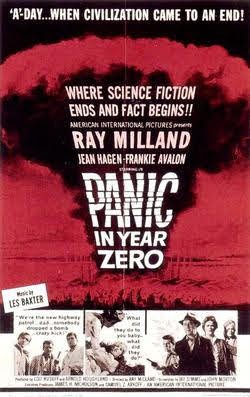
Oscar-winner actor Ray Milland’s sole directorial effort stands a simple but brutal

sci-fi film that exposes the ugly aspects of human nature during the struggle for
survival in a post-apocalyptic nuclear nightmare.
Directed by Ray Milland
Produced by Arnold Houghland, Lou Rusoff
Screenplay by John Morton, Jay Simms
Story by Jay Simms
Music by Les Baxter
Cinematography: Gilbert Warrenton
Edited by William Austin
Distributed by American International Pictures
Running time: 93 minutes
Budget: $225,000
Cast
Ray Milland as Harry Baldwin
Jean Hagen as Ann Baldwin
Frankie Avalon as Rick Baldwin, son
Mary Mitchel as Karen Baldwin, daughter
Joan Freeman as Marilyn Hayes
Richard Bakalyan as Carl
Rex Holman as Mickey
Richard Garland as Ed Johnson, hardware store owner Willis Bouchey as Dr. Powell Strong
Neil Nephew as Andy
O.Z. Whitehead as Hogan, grocery store owner
Russ Bender as Harkness
Shary Marshall as Bobbie Johnson
Byron Morrow as Evacuee from Newhall
Hugh Sanders as Evacuee from Chatsworth
What if?……..
…..it all went horribly wrong on that fateful day in 1962?
Los Angeles 1962….
A family leaves for a camping trip...
A nuclear attack destroys the city...
Chaos begins to reign supreme...
Old values and ideals crumble...
A father fights to keep his family alive….
“This is civilisation’s jungle after the jackals of society have
ruthlessly ravaged it, ending the world of decency!”
As the missiles close in, on a lonely stretch of mountain highway somewhere in California, a deputy sheriff forcibly assumes control of a small disparate group of motorists and sets about converting a large truck into a makeshift fallout shelter. They are among the first to discover that the events that are about to transpire are indeed NOT A TEST!
As the missiles approach, elsewhere in California Harry Baldwin, his wife Ann, their son Rick, and daughter Karen prepare early to leave Los Angeles on a camping trip in the Sierra Nevada Mountains. A typical suburban family one might say: the father optimistically looking forward to casting his line in a pristine lake, his wife supremely and sufferingly supportive and the teenagers complaining reluctance to traipse off into the wilderness at such an ungodly hour just to catch some stupid fish.
It is now 6:15 am and the Baldwins have been on the road for two hours when they suddenly notice unusually bright flashes of light coming from a great distance behind them. Initially, it is thought that the flashes might be lightning but Harry soon joins the dots in his mind and begins to voice the terrible realisation that “the only thing…”
What is left unsaid is soon given the form of fact and truth by a succession of events and clues. First is the overwhelming evidence of the explosions having occurred in the direction of Los Angeles over which a gigantic mushroom cloud has formed. Secondly, “none of the LA stations are on…. not even CONELRAD.” Thirdly, when Harry tries to contact Los Angeles by payphone, a frustratingly polite, implacable and impersonal operator's voice informs him, “I'm sorry, sir, the lines to Los Angeles are temporarily out of order.” When he inquires as to what has happened, the nasally voice responds unhelpfully with, “I do not have that information, sir.”
Unknown to the Baldwins, the deputy sheriff on that lonely stretch of mountain highway found himself locked out of his truck shelter. The deputy sheriff together with the remaining survivors of the group he detained were instantly vaporized when the missiles struck.
A lack of information is a sure guarantee of the spread of panic and that is precisely what is being experienced by the Baldwins and fleeing citizenry of Los Angeles at this moment.
It is the kind of panic that has its roots embedded in a life with fear as a constant backdrop. It is the kind of life that Harry’s kids and others like them have only known. Rick asks his dad, “We've had it, Dad, haven't we?” almost implying that there’s an expectation of the inevitability of nuclear annihilation. His sister, Sarah’s incomplete statement, “I thought when it happened, we'd all be…” suggests that the consequences of nuclear war have been drilled into the minds of the population, especially young people.
The family decide to attempt to return to rescue Ann's mother back at their home, but they soon find that they are swimming against the tide of panicked citizens fleeing the city in their cars, trying to get away from the fallout and destruction from multiple nuclear explosions.
Soon there is an announcement on the radio:
“This is the Emergency Broadcasting Network.
All normal forms of communications appear to have broken
down.
Although there has been no official statement,
the light flashes and the resulting cloud formations
would indicate that Los Angeles and surrounding areas
have been attacked by nuclear bombs or missiles.
I repeat, this is not an official statement.
In order to conserve power on battery-operated radios,
bulletins will be broadcast at two-hour intervals.
Next broadcast at 9:00.
Stay tuned to 640 or 1240”
With a crisis comes desperation and distrust along with the possibility of chaos and a breakdown in law, order and authority. Take for instance the unassuming-looking man the Baldwins come across at a gas station who witnessed “LA being torn apart and watched it being tossed into the air.” He also witnessed his wife being cut to pieces miles from the blast when a bedroom picture window blew in.
Such a desperate man with no money is not about to worry about the niceties of transacting business and is prepared to back up his intentions with violence. The price of necessities is about to rise as people try to exploit the crisis for personal gain and only the color of one’s money is to be trusted.
Inject enough fear into people’s lives, rob them of a sense of personal safety and security and present them with the prospect of empty bellies, no shelter and the absence of leadership and you’ll find that the veneer of civilization is very thin indeed.
Harry seems to have arrived at such a conclusion and decides that it’s not worth heading back home to check on his mother-in-law as they cannot help her, that there’ll be looting and worse in the city and that there probably isn’t any authority left. To Harry’s way of thinking there’s only “Us. We're still alive, and others like us.”
Stopping at a diner for a bite to eat, Harry learns more about the extent of the missile attack which has also taken in San Pedro, Long Beach Harbor, San Diego and San-Francisco. Harry is also advised “skip the next couple of towns” as “people are pouring out of LA like lava out of a volcano” as if it were “the second Exodus.”
The diner becomes like a microcosm of what is quickly developing throughout society at this time: impending shortages, lack of civility, profiteering and every man for himself (all genders implied).
[We all remember during the early part of the Covid-19 pandemic, when toilet paper and everything else went flying off the shelves. In my own state of Victoria in Australia, there were reports of organised groups venturing out of the city into rural towns to grab what they could from supermarkets. It got to the stage that rural townspeople felt hostile towards these city folks who they viewed as being like vultures or vermin.]
Realising what is happening to society, Harry decides that his family must find refuge at their secluded vacation spot. In fact, Harry goes into survivalist or ‘Prepper’ mode. When his wife confides to him that she’s frightened, Harry replies, “that's a safe way to be” since right now “two and two doesn't make four anymore. At the moment, it adds up to exactly nothing. For the next few weeks, survival's going to have to be on an individual basis. At the moment, we have to have food, a way to protect it, and a way to get more when it's gone.”
Harry’s wife desperately wants to hold on to hope in civilization rather than merely “write off the rest of the world.” Harry replies that “when civilization gets civilized again, I'll rejoin” but in the meantime “watch it unwind to a small hard core. Then someone is going to start putting it back together. I want that someone to be us.” He then asks his wife “Is that wrong? Is that immoral?”
I guess the answer will depend on what will happen to them in the process of ensuring their survival – their sense of humanity, what constitutes their being civilized, what they may eventually end up losing?
The Baldwins next pull into a small town off the main road which has not experienced an influx of fleeing city people and may not be aware yet of what has happened.
Despite it being too early for trading, Harry manages to obtain a grocery store owner’s cooperation by playing on his ignorance, greed and readiness for making a deal. His selection of supplies suggests the need for stockpiling necessities that will keep long term without the conveniences of modern living. As to why? The proprietor can only guess. However, Harry does give him an enigmatic hint in form of advice: “Lock up the store, take all the merchandise you can carry and hide it.”
Next stop, Ed’s hardware store. Despite the reports of a possible nuclear attack, Ed optimistically believes the official version that it is unconfirmed and that they are a long way from Los Angeles. After all, it’s easier to deny reality than it is to believe that the worst has happened.
Harry begins the process of buying tools and guns from Ed Johnson. Harry informs him that he can only pay $220 in cash out of the total bill of $420 and that he will cover the remaining amount with checks. Ed tells Harry that he will have to withhold the guns in accordance with state law. When Harry pulls a gun on Ed, a struggle ensues and with Rick's help, Harry makes off with the weapons after informing Johnson that he will return sometime later to pay for them in full.
The interesting feature of this scene is the lesson being conveyed to Harry’s son, Rick whom he has made an accomplice to armed robbery. Harry even tells Rick that if Johnson “makes one stupid move, shoot him.” Yes, desperation has indeed made Harry into what Ed referred to him as being – “just a thug.”
Even Ann can no longer recognise the man she is married to and says to him, “after all these years, I thought I knew you, but you turn out to be a stranger, robbing and mauling people like some kind of a cheap hoodlum.” Ann is not ready to turn her back on the rest of the world, civilisation and human decency.
Harry looks at things in a totally pragmatic way that is in accord with the changed circumstances in which the primary thought has to be: "No matter what, I'm going to live." The physical survival of his family will take precedence over moral and ethical considerations – the hallmark of a civilisation – at least until the time when “the law will come back.”
Harry as a father, a husband and as a man has a solemn purpose: to ensure the well-being and survival of his family. A sense of purpose and meaning is important and an almost ingrained part of a man’s psyche, one which is slowly being chipped away in modern times. It is too bad that it has taken something as drastic as a nuclear catastrophe and the desperation and fear it has generated to trigger this in our protagonist. The danger in this case is just what Harry will end up losing in the process and as a result of the stress and pressure that is being piled on his shoulders as he has taken upon himself most of the decision-making and organising.
Adding more fuel to the pressure and stress is the announcement on the car radio revealing more about the extent of the nuclear attacks;
“Here are the 11:00 bulletins. Partial communication has now
been restored. Among the targets of this devastating attack
were New York, Chicago, Philadelphia, San Francisco, and Los
Angeles. Damages and casualties are extremely heavy.
London, Paris, and Rome have suffered almost total
destruction, it was learned.
We have retaliated in kind. Key targets of our counterattack
have not yet been announced.
Those of you who have shelters are urged to stay in them.
There are reports of looting. Proceed with caution.
The organisation of military and law enforcement is
underway, but will take time.
We will return with more bulletins in two hours.”
At a gas station further along the road the law of supply and demand combined with greed has already kicked in. Harry is about to be charged $3.00 a gallon gas instead of the advertised 34¢ a gallon. Not having the $90.00 total and not being willing to be further ripped off, Harry biffs the gas station attendant. Yet another lesson for his son who looks on approvingly and says, “Dad, that was quite a belt.”
It doesn’t take long for people to hive themselves off into fearful communities and tribes determined to keep the outside world at bay. On their way to their destination, the Baldwins encounter a road blockade set up by the good citizens of a town who are set on “not letting any of you people from LA into our town.” So much for all of us being in this together and being one nation united in the face of adversity! And why are they doing this? Because the good city folk came into their town, said they were just passing through and instead “busted up our drugstore and damn near killed the owner.”
[Even during the Covid pandemic, the various states in my country, Australia set up
boarder blockades to prevent people from affected areas in other states from
entering their territory lest they bring the virus in with them. A certain degree of fear
and hostility manifested itself with such boarder closures]
Needless to say, Harry doesn’t take no for an answer and with Rick riding shot-gun chooses to crash through or crash, shook up women-folk notwithstanding.
Their next stop puts the Baldwins in contact with the kind of people you will always find in both times of peace and during any crisis. These are the sort of people who have no redeemable qualities whatsoever. They exist as human cockroaches who are solely intent on taking from others in order to satisfy their own selfish wants and desires. There is no reason for these scumbags being born and existing as they serve no useful purpose to society and constitute nothing but a drain on everything and everyone. And yet, here they are in our midst and civilisation has to find a way to deal with them!
Three such mouth-breathing sociopaths pull up near the Baldwins’ parked trailer. They soon make it known that they are “in business” for money, “extra gasoline” and anything or anyone that may be in the trailer. Now that “somebody dropped a bomb, dad” they have elected themselves as “the new highway patrol.”
With his own life and the safety of his family at risk, Harry gives Rick the signal to fire his gun at the young hoodlums. Having retrieved his gun, Harry seems on the verge of unloading his weapon but stops short due mainly to his wife who seems to act as some kind of a moral brake on him.
In fact, it was Ann who pushed Rick’s gun away to prevent him from killing one of the hoodlums. This sets Harry off and he quite savagely rebukes his wife telling her “that boy, as you call him, was going to kill me. Then he was coming after you and Karen. Would that have suited you better? ….Would you rather see one of us lying dead at your feet?”
Who exactly is Harry really mad at? His wife and her naivete? Himself and what he feels he has to do? The situation they find themselves in that has forced them to make such decisions and has warped their values and sense of morality?
Almost as if in answer, Rick marvels aloud, “I could have blown that guy's head off.” His father then realises that his son liked the feeling of that and tells him, “then you're as wrong as they are. This is no deer hunt. I want you to use that gun if you have to, but I want you to hate it.”
Harry wants to save what’s left of civilisation as much as his wife does. The difference lies in the ways and means of achieving this. One way may lead to their own extinction while the other way may rob them of their humanity irrecoverably.
The tide of civilisation’s remnants sweeps inexorably along the highway to nowhere only stopping, not to help - but to push anyone needing help out of the way. The Baldwins cannot ford this raging automotive river of panic and so Harry comes up with a plan to “make a stop sign” consisting of petrol being sloshed across the road and igniting it. This task he and Rick successfully manage to accomplish causing the traffic to screech to a halt and setting at least one car on fire. But what if the plan had resulted in the deaths of other motorists who are only intent on escaping with their lives? Well, there are no women to remind Harry about this as they are shut in the trailer and will be let out when they get to the road.
Shibes Meadow, the Baldwins’ destination stands as a kind of Prepper’s oasis, a haven or shelter until order is restored. On that basis, access points need to be denied to those who may also wish to make it their base and pose a potential threat to Harry and his family. Harry and Rick set about pulling down a bridge in order to cut off “one avenue of attack.”
A cave that Rick knows about is selected as their living quarters on the basis that it is sizable, secure and defensible. After all, the trailer would be “about as safe as a silk nightgown” in face of any potential fallout. Too bad no-one told deputy sheriff Colter who along with his truck shelter and party of detainees were earlier vaporised on that lonely mountain road.
While civilization may be crumbling around them, and despite the irony of having wound up in a cave like their stone-age ancestors, Harry believes that it is important to maintain important aspects of its rituals, habits and values. We see therefore, harry offering up a prayer before their meal asking “our heavenly Father” to “lighten our darkness” and “save us from the perils and dangers of this night.”
The rationale for maintaining “these concessions of civilisation” is to maintain the family’s morale by providing them with “links with reality” thereby helping them to be less afraid. And Harry does admit to his wife just how afraid he is.
From right out of the Preppers’ playbook, Harry instructs his family about the necessity of having a series of buried food stores should their shelter be overrun and as means of buying their way to freedom with the promise of food.
Ann has a role that was more or less expected of women in that era and seems to spend a lot of her time making enigmatic and pertinent comments before wandering off screen. Karen has the role of the whining and whingeing teenage girl who is not allowed to join the men folk when they head off on manly business. She’s of course expected to help out her mother and be protected.
A source information about conditions in the outside world is a necessity and so the voice on the radio brings grim tidings of the current situation;
“...states and Canada have been attacked. Casualties are
extremely heavy, but no statistics are as yet available.
Successful counterattacks have been made on European and
Asian objectives.
At a reorganisation meeting of the United Nations, a
resolution was introduced whereby these darkest days in the
history of civilisation will henceforth be designated as The
Year Zero.
Continued reports of looting are coming in. Such acts are
regarded as treason against the United States and those
guilty face the death penalty.