

Flash! Fiction 4 by Peter McMillan - HTML preview
Download the book in PDF, ePub, Kindle for a complete version.
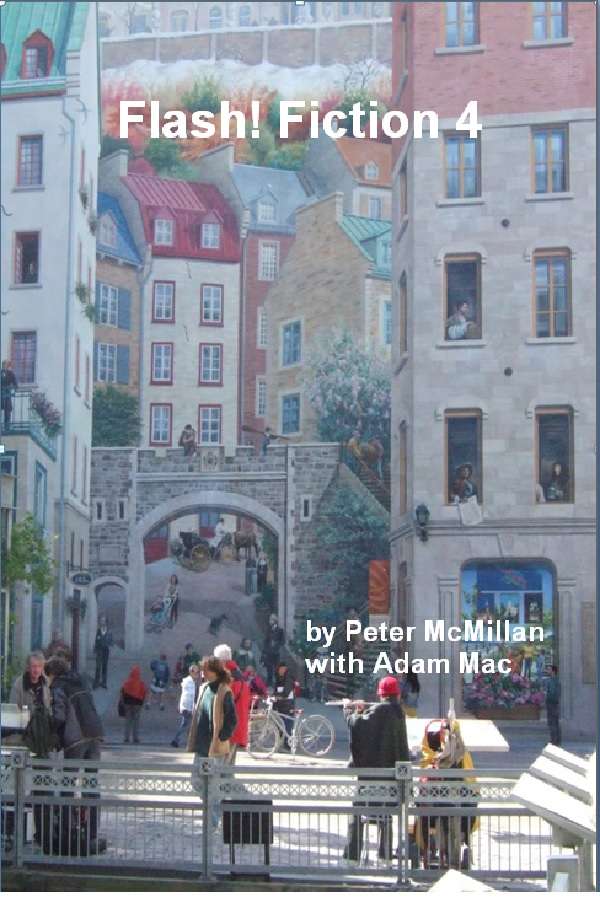
i
by Peter McMillan
with Adam Mac
ii

Copyright
The 27 stories contained in this eclectic collection are reprints of authors' flash fiction that has been published on the Internet.
This book is a work of fiction. All names, characters, places, and incidents are the product of the authors' imagination or are used fictionally.
This anthology of short fiction by Peter McMillan and Adam Mac is licensed under a Creative Commons Attribution-NonCommercial-NoDerivatives 4.0 International License.
For more information about the license, visit
<https://creativecommons.org/licenses/by-nc-nd/4.0/> First published: 2015 (out of print)
Reprinted: 2023
Cover photograph: Place Royale, Québec, 2011, P. McMillan iii
For Mr. Greengrass
iv
First Impressions ............................................................................. 1
The Audition .................................................................................... 3
Scooter's Legacy............................................................................. 5
A Sense of Justice .......................................................................... 8
Riding the Train ............................................................................. 12
Virtual Sacrifice ............................................................................. 16
Without a Doubt ............................................................................ 19
The Market for English .................................................................. 21
The ESL Test ................................................................................ 23
A Word in Edgewise ...................................................................... 30
Mr. Greengrass ............................................................................. 34
Centre of the Universe .................................................................. 36
Chain Reaction ............................................................................. 37
Pac-Man Dialectic ......................................................................... 39
The Park ....................................................................................... 41
The Optimist .................................................................................. 45
On Certainty .................................................................................. 49
The Talent Scouts ......................................................................... 51
Speakers' Corner: The Invasion .................................................... 53
Stories by Adam Mac .................................................................... 60
In the Vat....................................................................................... 61
The Stringer .................................................................................. 65
The Double Cross ......................................................................... 72
Last Stand ..................................................................................... 75
What Brains in the Vat Do in Their Free Time............................... 77
The Accidental Death of a Landlord .............................................. 80
v
Brains in the Vat in Therapy .......................................................... 82
Schmerdloff’s Proposal ................................................................. 87
vi
Cecil was wheeled into the rec room where all the residents were passing the time ‘til the evening meal.
His room was too small. Much smaller than what he was used to. At least it had cable. He just needed a TV. The nurse said one might be coming available.
This was the first time he’d seen any of his new neighbours. It was a lot to take in. Some were dressed to the nines. Others were singing showtunes while a woman wearing a cancer turban played the piano.
“Who’s the old bird facing the corner?” he asked.
“One of our long-termers, Miss Annie. She prefers it that way, sometimes,” answered the nurse.
“Kinda ruins the atmosphere, doesn’t it?”
“Well, Mr. Snow, this isn’t rehab.”
“Don’t I know it. My boy made that pretty clear. ‘Here Dad, your new home,’ he said. ‘Nice,’ his new girlfriend said.”
“She doesn’t have anybody—just us.”
“No family?”
“Moved away soon after she came.”
“What did she—”
“Real estate. Thirty years. Pretty successful I heard.”
“Ironic.”
“Lots of irony here, Mr. Snow. Would you like to take a tour of the gardens?”
1
“No thanks, saw it through the window in my room.”
“Alright then. I’ll leave you to mingle. By the way, those boxes—the boxes your son mentioned—need to be unpacked when they arrive.
Boxes left in residents’ rooms will be removed after two days. Policy. Health and safety, you understand.”
First published in Apocrypha and Abstractions April 23, 2015.
2
She'd been in bed for three days — the entire weekend, so it had to be serious. It was a bad flu season, though the old family doctor, still making the occasional house call, said it was nerves most likely.
Stella had just turned 14, but she'd already shown signs of being like her Aunt Audrey. Both were actresses, in theory — high-strung and self-absorbed. Stella's mother recognized the resemblance most keenly, having shared a room with her younger sister Audrey when they were growing up.
Now, Stella was auditioning — just a school play, but for the time and place it was the biggest part of her life. The play had been adapted from an O. Henry story, and Stella knew, she just knew, she had to have the main role. It was only two days away.
They didn't let on but her parents thought it might be the best thing
... for everybody ... if she didn't win. Tony, her little brother, felt otherwise. He worshiped his big sister, even though she made him fetch and carry and come and go as she pleased.
From her upstairs bedroom, propped up on two big down pillows, Stella could see the side of the old vacant house next door. It was a large, old-fashioned house — a tear-down her parents said. The garage was nearest her view, and it was unobstructed by maple leaves this time of year. Past the skeletal branches of the maple, it was an almost blank canvas of brick with a single waist-high window that didn't appear to have seen a paintbrush in more years than she'd lived.
3
Later in the day, shortly after school let out, she was rehearsing her lines before her parents came home. Only Tony was in the room with her, but she knew he'd never betray her. He was busy watching the heavy equipment being unloaded next door, when suddenly he spun around and asked what was so important about a leaf anyway. She explained that it was the difference between getting the part and failure. She was cryptic that way, so it sometimes took him awhile to figure out what she meant.
The next morning before school it was a mix of drizzle and snow flurries, but that didn't stop Tony or them. He found a big red maple leaf on the ground — bigger and prettier than all the rest — then crawled through the construction fence and taped it to the garage window. Standing back to admire his work, he turned to see if Stella was there. She was — her surprised face pressed against the second-story window. He beamed at her just as a giant orange claw descended from the sky and tore into the wall, pulling it down behind him.
First published in Beyond Imagination Digital Literary Magazine, January 2015.
4
Scooter hated his name, but he loved it, too. Traffic for him was a cinch though he'd had some close calls. He worked at the Reading Fair which was a Speaker's Corner-cum-virtual reality venue with computer-generated guest speakers from far away times and places. All presentations were fictional; however, character authenticity was crucial for audience recognition.
Scooter was a fact-check — obsessive-compulsive, green, control freak-certified — and his job was to make sure that the presenters'
holograms were consistent with their body of work. He was indis-pensable. For example, he discovered the anomaly in Albert Einstein's military-style crew cut and prevented it from going live.
He also intervened to can Lincoln's "I Have a Dream" speech. Perhaps, most memorably he fixed the glitch that erroneously programmed Neil Armstrong to utter the immortal words, "And now for something completely different," as he became the first man on the moon.
Scooter didn't actually scoot around in libraries or archives. After all, in the digital age, information came to you if you knew how to call it, and Scooter did ... very effectively. He had a knack for scoot-ing in and out of places — just a crack was all he needed — and coming back with a trove of data, which he organized with the dex-terity of an eight-armed conductor.
Unfortunately, most of what he managed was easily replicated by the technicians in Bangalore. Management seized an opportunity to save costs by eliminating equipment and personnel redundancies, like Scooter along with half the technicians who were absolutely incredulous on getting their notices.
5
Scooter and his doomed colleagues were kept on for two additional weeks owing to the big show the impresario had scored with the national museum. She had committed to a gallery of 25 personag-es, ignoring staff counsel that only 19 were fit for the occasion.
Six more had to be created. Moreover, they had to represent the fields of medicine, pop art, entertainment, business, literature, and Ancient Egypt. Scooter and his buddies set to work not the least intimidated by the ambitious timetable, all the more aggressive because two holograms had to be created for each one in the exhibit: one to pass internal inspection and the other to be triggered by a duplicate remote.
For Freud, they put in Jung Frankenstein. In place of Campbell's soup, they produced avant-garde art using Bush's baked beans.
Instead of an exclusive tour of the Tutankhamen exhibit in Cairo, an effigy of King Tut was to be regaled by Steve Martin. Henry Ford's cameo was ousted by "Neutron Jack" Welsh, the brilliance of GE, who was to explain how he came to love the bomb. The world's greatest-ever footballer, Edson Arantes do Nascimento, had to step aside for Barry Bonds who was asked how he juggled being the home run king and a negative role model. The only two-time winner of the Nobel Prize for Literature refused to disclose his/her identities, so Adam Mac was added at the last minute to face the perennial literary question: how does a writer endure oblivion?
Scooter never got to know how the exhibit went off. The day before his last day at work, he was run over by a bus. Nuts and bolts, cir-cuit boards, and shredded metal lay scattered all over the roadway.
The bus, through the bike rack mounted on the front, seemed to smile.
6
They managed without him. The exhibition was a rollicking success, though regrettably not with the right people. Scooter would have been pleased.
First published in Beyond Science Fiction, February 2015.
7
He wouldn’t need this stuff anymore, though he’d hoped to take away something. USBs, like-new 3.5" diskettes, and everything in between, had to stay. If it was confidential, proprietary, copyrighted, trademarked, patented, or otherwise of importance or interest to the company, he had to turn it over. He knew that. What was a surprise was that it didn’t matter that the USB was his and that it had his daughter’s photography portfolio on it. Personal or not, his escorts confiscated all electronic media—even the mouse. That cut deep. It was his first.
Calendars—desk calendars and one-a-day calendars—annotated with idiosyncratically-coded messages, innocuous except to a trained eye. They relented only after he’d embarrassed himself by pleading that he be left with something to show for the years he’d worked for the company. Years of servitude, he wished he’d said.
Five were returned to him, but they were so thoroughly redacted they would likely serve as a very different kind of memento.
Scraps of paper and post-it notes—he was a hoarder—bore the names of his colleagues and the places and times for getting together, usually after work. Shorney’s, game 7 of the World Series; Toby’s for the midday England-Germany match, Brattigan’s, Stanley Cup Finals; a weekend matinee of The Nutcracker in hon-our of Penelope’s daughter who landed the role of a sheep; the Phantom they forced themselves to see, because they had won tickets; and of course, Reilly’s where they’d spent many evenings speculating about the company’s latest restructuring, government investigation, or class action lawsuit.
The artificial plants, the inspirational pictures, as well as office supplies valued in excess of $5 were tagged with asset numbers and had to be scanned back into inventory. What was left filled less 8
than half of a banker’s box, and that he had to empty into a five-cent plastic bag when he got down to the information and security desk at ground level. Boxes they reused, he was informed.
#
Despite the way he had been treated, particularly at the end, a sub-conscious dependency lingered. For the entire next week, he awoke to false starts, a couple of times getting showered and shaved and out the front door with briefcase in hand. The worst was when he actually got to work and rode the elevator up with Penelope and Roger and Maurice. It was awkward for them, too.
They promised to call. Said they were sorry and everything. That humiliation was the kick he needed, and the memory stayed raw for days, reinforcing his redundancy like nothing else could.
At home, he’d never really been interested in looking out the front window—hadn’t spent much time in the apartment. In fact, his blinds were closed most of the time. But with nothing on TV and nothing worth reading, and no work to go to, he took to peering through, just to get some ideas from watching how other people passed the day, he told himself. Little by little, the blinds were raised.
He realized he’d stumbled onto something. Here was a world just outside his window—so near yet so distant and unknown. Having spent so much time at the office and after hours with his office friends, he’d never taken the time to see and consider what was served up daily on the streets and sidewalks below. The blinds stayed open night and day.
During the daytime, especially at rush hours and lunch, traffic was nonstop busy with people and cars and bicycles and skateboards and dogs. But for all the activity, it wasn’t really inviting or entertain-9
ing. It was chaotic and disorderly, disturbing—not at all like the structured world of his office. Worksickness? Really?
Right there on the sidewalk, dogs did their business. Cars jostled other cars to wedge into tight parking spaces or double-parked up to half an hour at a time. Bicyclists on the sidewalk yelled at pedes-trians. The produce market down the street tossed its organic waste on the sidewalk to simmer in the sun or puddle in the rain.
Young teenage girls from St. Joseph’s—his daughter, Yvonne, would have been about their age—flirted with scruffy-looking twenty-somethings to get cigarettes from the convenience store.
Everyday there was something new—some gross or indecent or stupid act you wouldn’t believe could happen here.
A lot of the same scripts played out every day—like television re-runs. The only difference was this was happening right outside his window. In HIS world, and it wasn’t right. How could they infringe his right to enjoy peace and order? How could they think— Who did they think— Obviously, they didn’t ... think. And what they did without thinking caused him enormous stress and anxiety. Hadn’t they been socialized, normalized—just plain taught respect? Wasn’t that the point of school?
He debated. Should he call the city about the smelly garbage from the fruit and vegetable market—make a public health complaint?
And there had to be a number to call to report people selling cigarettes to minors.
But what would a bunch of bureaucrats downtown do? File a report, bury it, and at the end of the day, collect a pension.
Wouldn’t it be better to carry a walking stick and, next time he saw a bicyclist parting the crowd on the sidewalk, shove it in the spokes of the front wheel? And if that little princess in the Lexus SUV dou-10
ble-parked again, maybe he should take down the plate number and anonymously report a hit-and-run.
The phone interrupted his plotting. He let the machine answer.
“Hey Donny! It’s Roger. We’re taking in a doubleheader tonight. Interested? We’re gonna grab something to eat at the ballpark. Meet us around 5:30? Our usual seats down by third base. Cheers.”
He replayed the message.
What the hell was he thinking?
First published in Down in the Dirt, Volume 128, March/April 2015.
11
B: Kayla! Over here!
K: Brandon?
B: Hey, what’s up? Whew, it’s crowded in here. Last time I saw you was—Christopher's house party back in grade 12. Whatcha you been up to?
K: Thought I recognized you back in the parking lot. That your MX-5?
B: Yeah. My parents bought it for graduation. Not bad though.
God, is it stale in here! No air in here yesterday either. Hey, still into the Blues? Me and Matthew Tornquist—you remember him—
are driving to Chicago for the long weekend. We're gonna take in some clubs and do some sailing. His old man keeps a boat there for clients. Why are we stopping? Oh, sorry, let me move that for you. You’re welcome. So rude, huh? Anyway, Saturday night there's a party at the Hancock Tower, and a lot of Blues and jazz musicians are gonna be there. You interested?
K: No way! That would be awesome! Like you know I love Chicago Blues, and Buddy Guy, maybe I can meet him. That would totally rock! Better get your ticket out. Conductor’s coming. Matthew? Don’t think I've met him, but didn’t he have a sister, who, like, went crazy or something and ended up in a psycho hospital in New York?
B: Yeah, that's Nicole, but he doesn't like to talk about her, so I wouldn't go there.
12
K: Whatever! Everybody's got something, like, weird they don't wanna talk about. But that'd be awesome—I mean the trip. Were you taking your car?
B: No, gotta take it in. It's burning oil like crazy. Looks like we’re moving again. But Matthew's got his Mom's 7-series. A little buttoned-down, but it's a ride, and it’s got plenty of room, so, yeah, c’mon! Here’s my number. Gimme a call.
K: Cool!
B: Great! So, what have you been up to?
K: Like, you know, school and stuff. I got into Queen’s, but it was, like, suffocating there. I finished a year, then came home and Daddy helped me get a job until I find something else. I'm looking at McGill. Brandon, over there! A couple of empty seats. Move, quick! Yeah, I need a big city, more life, more people, more excitement, you know. Wanna spend more time on the slopes even though I can’t compete anymore, and God, my French is horrible, and I’m going to Paris next summer. How about you? You’re doing Philosophy, or Anthro-, er, Andrology, or something like that?
B: Philosophy. Definitely not Anthropology, if that’s what you mean. Looks like we’re stopping again. This is unbelievable. I usually take a later train. It’s not as crowded and nowhere near the delays.
K: This is nothing. I’m usually standing the whole way, morning and afternoon.
B: Anyway, you know I’m still planning to go to law school. May even join the old man's firm, but that’s down the road. For now, I'm just hanging out and reading Philosophy. May go to grad school 13
later on. Mind-bending stuff, Philosophy. I mean really mind-bending. Now I see why so many Philosophy students end up as lawyers.
K: Wow! I'm impressed. You always did have it together. I'm still not sure. So many possibilities. I just can't, I mean, don’t want to choose. Not yet anyway.
B: There’s no pressure though, right? We're still young, and if we make a mistake, so what. Hey, I think Union’s the next stop.
About time! Besides, how can we explore if we don't experiment?
It's like in this course I'm taking. You know, most people just live on the surface. They don't like to think—really think—about living.
They just live, like the people on this train—on the train at 7:00 a.m.
and off the train every day at 6:30 p.m., if they’re lucky. How many of them do you think really think about Philosophy and language and how much it shapes their little everyday lives? Just think what happens when we get lazy, or busy, some people like to say, and we let our language get sloppy and say things we don't mean or that aren’t true, like, "how are you?" or "have a good day" or "everything’s fine." It's really just so hypocritical, you know, and meaningless. Words don’t mean what they should, and our thoughts become shallow—
K: Hmmm. Sounds interesting. I think I see what you're saying, but, like, isn't there something missing. I mean, if I say "how are you?" to someone, won’t he be polite back? OK, he may not care, and same for me, but at least we'll be polite, don’t you think?
Maybe it's dishonest and super-, er, shallow, but isn't it, like, better than, uh, rudeness and getting in your face? And as long as the ride is smooth and you get where you’re going, who cares, right?
Conductor (shouting over the PA system): Union Station, this stop.
Union Station. This is the final stop for this train. Again, we would 14
like to apologize for the delays and any inconvenience they may have caused. Have a nice day—and please watch your step.
First published in Down in the Dirt, Volume 129, May/June 2015.
15
"You got nothing to worry about," the man said. "He's gotta chew off my arm to get away."
The screen was grayish-white, and the intro music faded. It was dead quiet in the theater.
Nothing happened right away, so naturally I started imagining what was going on, what was coming next.
My first thought was that the guy with the speaking part had a muz-zled dog on a biker harness—it was that kind of voice—and was taking it for a walk in the park. But that was boring.
Then, I pictured two men locked into a single set of handcuffs. It wasn't clear which had spoken or why. Maybe they were in a diner, ordering at the counter? Better, but hardly original.
Recalling a recent story I'd read that may or may not have been in
theNewerYork, I conjured up a geeky little git with a Disney watch knock-off that featured holograms for sociopaths or sociopath-groupies. Now, that WAS different.
The last one came alive, and as I was inching back in my seat to avoid the watch hologram's grasping hand tentacles, a woman laughed heartily. That's twisted, I thought. Behind me two voices gasped—in horror, excitement, I really couldn't tell, though it seemed more appropriate. In front there was sobbing, muffled—a bit premature I felt—and on my left two young children were squeal-ing precociously. I was shocked and repulsed by these reactions, but frankly I was a bit preoccupied with keeping this monster's fangs or claws or whatever they were from ripping me out of my seat.
16
Shrinking as far back in my seat as I could I banged heads with the person behind me who must have been trying to help but didn't. I collapsed, fell forward, and when I came to the monster had disappeared. My visor was on the floor. The screen was still empty and the audience was getting impatient. In the back of the theater it started—the stamping of feet and the chanting—and like a huge wave it rolled to the front.
I was just about to leave, having had my fill of this absurd theater, but I was promptly stopped by a beefy couple standing between me and the aisle.
“You can't leave now,” said the woman as her partner twisted my arms in their sockets.
“But—“
“It's you it wants, and it's coming back,” she said, picking up my visor and handing it to me.
“This is ridiculous. What are you talking about? There's no movie.
There's nothing. Just a blank screen.”
“It's not the screen everybody's watching,” she added. “It's you.
You're 'the sacrifice.' Kind of ironic, don't you think?”
“I'm not getting any irony, just a bad headache and sore shoulders from Vince, here.”
“Surely, you had some idea what you were getting into here? It can't be advertised and marketed because it's the underground.
You must've heard though—and this is the thrill that keeps people coming back—that for every crowd that comes in one person doesn't come out—quite the same.”
17
“Besides,” the guy who looked like a Vince added, “yours is the best yet, and everybody's dying, so to speak, to see how it ends.”
First published in Farther Stars Than These, February 19, 2015.
18
I'll have the fish and chips. Hmm— Could you change that to a chicken steak sandwich with extra onions and fries on the side? No, better make that a salad. Or coleslaw, but vinegar, not mayonnaise.
The sweet potato fries look good. Yes, cancel the coleslaw. To drink? Let's see. Sweetened iced tea? Don't have any? How about Coke? I'll have Diet Pepsi, then. Is it caffeine-free? On second thought, water's fine. If you've got one of those fruit-flavored waters
— yeah, strawberry-kiwi sounds good. I think that'll do it. Oh, wait.
You know what. I could really go for some red meat. Would you mind changing the sandwich to a rib-eye steak? Rare. No, medium rare. No, make that well done. I hate to do this, but I think I'll have the fish and chips after all. Halibut though, not cod. The chips, are they thick fries? If you've got fresh catfish, I'll have that instead, and can I substitute potato salad — German style, of course — for the chips? You know, I think I'd like to try the blackberry-pomegranate flavored water. Sorry for taking so long. I see you're busy. Won't keep you, but could you leave a dessert menu? Don't have one?
No problem. How's the pecan pie? Never mind, I'll have a piece of blueberry cheesecake and a cup of coffee, black. Better make that a decaf ... with one cream and one sugar. That's it. Well, maybe an extra napkin if it's not too much trouble. Thank you for your patience. Really, you've been terrific. Absolument!
#
Excuse me? Would I mind sharing my table? Uh ... no, I guess not.
You mean with the giant in the tattoos and black leather who's headed this way? Boyfriend? And a handsome gentleman he is, but I don't think — I mean, isn't there a free, er, more private table —
over by the rest—
19
Good day, sir! Your timing is impeccable. I was just leaving. The table is all yours. I'm sorry about the order, Miss. I just remembered I have a ... oh, yeah, I'm having some tests run down at the hospital
— colon-something or other — and I'm pretty sure they said no food or drink. Memory's like a sieve, you know.
Ah, well, since you both insist, maybe I'll have a small bite to eat.
They always exaggerate this fasting business. You're absolutely right, sir, I SHOULD change my order. Carpe diem! You can say that again. Surf-n-turf with baked potato and all the fixins and a pitcher of draft beer? Splendid choice. Same for you? And Miss, I'll pick up the check. My pleasure, sir. No doubt about it. But maybe I should phone the hospital. There's a pay phone just outside. No, you're right as rain. That would be rude. What was I thinking? You have a favor to ask? Go right ahead. You name it. Whatever you want.
OH MY!
I take your point, and I promise, or better still, as all these people are my witnesses, I won't say another—
First published in Flash Fiction Magazine, October 18, 2014.
20
Once upon a time© in English, a groundbreaking innovation© hit the market — buying and selling© phrases. Tens of thousands of phrases were acquired and licensed©. Everyday speech© was transformed as were the business letter© and the student essay©.
There was a surge in copyright infringements©. Leveraging human nature©, peer policing© worked remarkably well©, because viola-tors lost standing© at work or school opening the door© for others.
An ad agency© went public© with an IPO, cornered the market on licensing and saw its stocks soar© to stratospheric levels©.
Licensing was expensive, though there were different packages available depending on use and affordabili ty©. There was the plati-num package© of 10,000 phrases for C-level executives© and university professors©, and at the other end there was the economy package© of 500 phrases, which was often awarded with scholarships and for exemplary performance reviews©. Most people had to settle for special dictionaries of uncopyrighted English, and a subscription was required for quarterly updates©, as phrases were copyrighted daily and removed from free public discourse©.
Dictionaries published overseas were the cheapest, but their rephrasings were awkward at best© and unintelligible at worst©.
In a celebrated case© of copyright infringement© that reached the nation's top court©, a g raduate student© published a thesis that was later found to have violated the company's copyright©, alt-hough the student, without any support from the university or the thesis supervisor©, argued that the thesis' publication date© pre-ceded the copyright date© by a few hours. However, the student's case was lost on the company's discovery that a second essay, with the copyrighted material© stricken and replaced©, had been published simultaneously© with a different publisher.
21
Company lawyers© convinced the panel of judges© that the student's prior knowledge© was thereby demonstrated© and had warranted a more cautious© move to publication. In addition©, a second line of attack© by the plaintiff's lawyers© showed that the acceptance of the new copyrighted phrases© had been given the previous day by an official with the Copyright Office©, 18 hours ahead of the student's publication.
The court found against© the student, ordered that the publication be nullified and that the university and the thesis professor© be du-ly reprimanded©, notwithstanding their heroic efforts© to distance themsel ves© from the case. The student was quietly expelled©, but he became a vocal opponent© of copyrighted language© and a champion of© free non-copyrighted speech.
A lot of changes have been made since then. For example, there are now fair use© dictionaries that include copyrighted phrases©
that can be used at no charge© provided it can be proven that each has been used in 100,000 documented instances©, which works out to© one written instance or verbal utterance by .01 percent of the global English-speaking population©. Incidentally, many of the copyrighted phrases© that appear in this text are forecast to be re-assimilated into the public domain© in the next decade© or so©.
This text has been registered for licensed use© only. Any unli-censed use© of the material may be punishable by fine and/or imprisonment©. Copyright Office©.
First published in theNewerYork, November 16, 2014.
22
Submission REJECTED!
The following submission to the ESL Test Development Committee is insulting to 2nd language learners. Some of our students have direct or indirect experience with even more insidious forms of government and corporate intimidation, but we would be irrespon-sible to play on this and knowingly embed intensely controversial political commentary in our program.
If the author's intention is to critique the Government's wartime secret policing activities, then s/he should try something a little more creative and subtle and more fitting to the circumstances. This kind of suggestive editorializing through aggressively realistic fiction is inappropriate for an ESL class, which is, in a sense, a captive audience. To miss this point is to be dim. To ignore it is to abuse freedom of thought.
In addition, having seen these questions before, when I worked for another ESL contractor to the Government, I suspect that the author may be guilty of committing the Osberg variation, i.e., attempting to publish the same material multiple times as different works with only slight changes.
The author would be well advised to try something new or to submit his/her political opinions to the op-ed section of a newspaper or magazine.
Reviewed by:
PM
23
Submitted to the Test Development Committee Special Instructions and Test Answers
marked by ► for ESL Staff
►The following questions (1-13) have been designed to conform to standards adopted by the Department of Immigrant Control and Education (ICE) for its prototype immigration ESL test. In addition to the standard reading comprehension and grammar questions, there are three unmarked questions, which have been incorporated in accordance with the new Alien Loyalty Act. Although the ICE pro-tocol dictates that the unmarked questions must be answered completely and truthfully before a student can pass the ESL course and receive a certificate of language competence, this requirement will be waived pending ICE's formal release of its ESL testing standards.