

INGRID DOWS - AN ALTERNATE STORY PART 3 - THE SPACE AGE by Michel Poulin - HTML preview
Download the book in PDF, ePub, Kindle for a complete version.
CHAPTER 7 – TROUBLE IN THE EAST CHINA SEA
15:03 (Central Pacific Time)
Friday, April 06, 1951 ‘C’
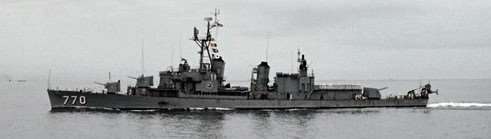
Bridge of the American destroyer U.S.S. LOWRY (DD 770)
Sailing westward towards the Philippines, Central Pacific
‘’Sir, classified message from Pearl Harbor, priority ‘Critic’.’’
‘’Thank you!’’ said Lieutenant-Commander Arthur C. Jackson, who was sitting in his bridge command chair, while taking the message clipboard offered by the sailor who had brought it up from the radio room. That sailor stayed close to his chair as he quickly read the message clipped to the board, so that he could return it to the radio log of the ship after his captain would have read the message. The content of that message, classified ‘Secret’, made Jackson frown. However, he didn’t comment out loud on it and gave it back to the sailor, then got up from his command chair and went to the charts table at the back of the bridge, in order to consult the chart of the Pacific laid on it. After a quick look at it, Jackson spoke up, giving an order to the helmsman of his modified ALLEN M. SUMNER-Class destroyer, which had recently completed a major refit in Pearl Harbor.
‘’Helmsman, change course and steer to Heading 312 degrees. Increase speed to thirty knots.’’
‘’Changing to Heading 312 degrees and increasing speed to thirty knots, aye sir!’’ Next, Jackson left the bridge and went down to the combat information center, or C.I.C. in short, of his ship, which centralized the data and information from the various sensors of the destroyer and where its armament was directed. There, he found his operations officer, Lieutenant (Navy) Robert Kelsee, standing next to the tactical plot table. Once next to Kelsee, Jackson pointed at their location on the tactical plot.
‘’I just ordered a change in heading to the Northwest, towards the Strait of Luzon and Taiwan. We just got a ‘Critic’ message from Pac Fleet ordering us to join at best speed the MISSOURI Battle Group and to then patrol the Taiwan Strait. Pac Fleet Headquarters has some intelligence about a possible Chinese Communist attack in preparation against the Chinese Nationalists in Taiwan. The MISSOURI Battle Group will have the mission of deterring or, if need be, repel any communist attack against Taiwan.’’
Kelsee, who was still relatively young but whom Jackson appreciated for his intelligence and quick thinking, asked him a question at once.
‘’Can we count on some air support once there, Captain? We will be quite vulnerable to air attacks in that narrow passage, which is a hundred nautical miles wide at the most.’’
‘’That was not mentioned in the message but I suspect that Rear Admiral Fisher, on the MISSOURI, will be asking Pearl about that. On the other hand, this may be a golden occasion for us to try our new missile systems in actual combat.’’
‘’Hopefully, they will prove their worth then, Captain: these Hughes VLS launchers and their missiles are brand new to the Navy. In fact, we were the first destroyer in the Pacific to be refitted with them and with one Hughes LINEBACKER Ship Point Defense System.’’
‘’True but Hughes has a reputation for producing some really good shit. I am confident that we will be able to face about anything the Chinese will throw at us. While we sail towards Taiwan, I will go have a short nap. Call me if anything new happens.’’
‘’Will do, Captain!’’
As his captain left the C.I.C., Robert Kelsee reviewed in his head what had been changed on the ship during its refit in Pearl Harbor. Basically, the rear half of the weather deck now looked completely different when viewed from the side. Both of the quintuple heavy torpedo tubes which had been the main ship’s armament against enemy ships were gone, along with the four light anti-aircraft gun mounts next to the two stacks and the depth charge racks at the stern. A helicopter hangar with a landing pad had been built in the place of the torpedo tubes, while two triple anti-submarine torpedo tubes had replaced the depth charge racks. However, the most significant change from that refit had been the addition of two Hughes Vertical Launch Systems modules, which now stood at the vertical, flanking the helicopter hangar. Those VLS launchers contained a total of sixteen medium-range surface-to-air missiles, eight medium anti-ship missiles and eight anti-submarine rockets. On top of that, a Hughes Ship Point Defense System, or SPDS in short, armed with four 30mm automatic cannons and eight short-range anti-aircraft missiles, had been installed atop the helicopter hangar, controlled by what the crew had quickly nicknamed ‘The Evil Eye’, in essence a helmet with electronic visor worn by the operator of the SPDS. That operator simply looked at a visible target through his transparent watch dome and the whole mount would automatically turn and elevate to align itself with what the gunner was looking at. That SPDS had been the one item that had attracted the most attention and comments from the sailors of the crew, as it was plainly visible to all atop the hangar, while the new VLS missile modules were far from obvious to the untrained eye, their shapes blending in with the sides of the helicopter hangar. A new search radar had also been installed, along with something called an Infra-Red Search and Track, or I.R.S.T., sensor. When Kelsee had been able to look at it and see how it worked, he had been left most impressed by it. This was a fully passive sensor system that could not be detected by the enemy and which was equally good at tracking and targeting ships and aircraft, both at day and at night. While many in the crew were still skeptical about those new weapons and sensors, Kelsee sure felt better about going into combat, knowing that those systems were ready to protect his destroyer.
13:49 (Taiwan Time)
Saturday, April 07, 1951 ‘C’
Bridge of the battleship USS MISSOURI (BB 63)
Sailing 110 kilometers north of Batan Islands (Philippines) Strait of Luzon
Rear Admiral James Fisher smiled with satisfaction as he watched through his binoculars the USS LOWRY approach his battle group after its day-long speed dash across the Philippines Sea. With the kind of trouble he expected to encounter once inside the Strait of Taiwan, that extra destroyer and its new missile systems was a welcome addition to his three escort destroyers. Lowering his binoculars, he then shouted an order to his bridge duty officer.
‘’LIEUTENANT, HAVE THE LOWRY JOIN UP WITH THE CANISTEO TO REFILL ITS FUEL TANKS. AFTER SUCH A LONG DASH, THE LOWRY MUST BE LOW ON FUEL RIGHT NOW.’’
‘’AYE, SIR!’’
Resuming his observation of the approaching destroyer, Fisher had difficulty spotting where its new weapons were, which was a good thing actually: the Chinese would be even more hard-pressed to spot them and realize how much more dangerous the LOWRY would be to them. The sad fact was that, while it could be considered as quite powerful by World War 2 standards, his battle group had been devoid of modern contemporary weapons and radar systems...until the arrival of the USS LOWRY. Those calamitous years during the Truman Administration had been very lean ones for the Navy and had seen nearly all ship refits denied for budgetary reasons. Now, under President Dewey, the Navy was finally able to put some money into modernizing and refitting its warships. However, such programs took many years to realize. In fact, if he was not mistaken, the LOWRY was the first ship of the Pacific Fleet to have completed a refit involving the installation of missile systems and of new radars.
‘’Better late than never.’’ he muttered to himself in a sarcastic tone.
07:50 (Taiwan Time)
Sunday, April 08, 1951 ‘C’
Control room of the Soviet S-Class diesel submarine S-25
Patrolling at snorkeling depth in the Taiwan Strait
Captain-lieutenant Nikolai Zubin was about to raise his periscope to look around his submarine when his sonar operator spoke up, some tension in his voice.
‘’Captain, I am starting to hear a group of ships approaching at high speed.’’
‘’Can you give me more details about them, Chernov?’’
‘’One moment, please... I hear two large ships and four smaller ones, heading North. They should pass close to us in the next hour or so.’’
‘’Then, we will wait and watch, until we can confirm their identity. Advise me when they will be within visual range.’’
‘’Yes, Captain!’’
Zubin then went to his chart table and examined the chart of the Taiwan Strait laid on it and covered by a transparent plastic film. He, nor any other Soviet submarine, would normally be so far south from Vladivostok, his home port, if not for the big operation that was about to be launched by China against the Nationalists hunkering down on the island of Taiwan. His orders concerning that incoming operation were simple: watch for American or British warships and alert Beijing if he saw such warships, but not attack them. The severe drubbing inflicted on the Soviet Northern Fleet by American aircraft and ships one year ago, during the failed attempt at invading Okinawa, had made the Soviet leadership in the Kremlin much more cautious about provoking the Americans, so it would be up to the Chinese to take all the risks this time.
Some fifty minutes later, his sonarman spoke up again.
‘’Sir, the group of ships is now passing to our starboard side, at a distance of about six nautical miles. They are doing approximately fifteen knots.’’
‘’Very well. UP PERISCOPE!’’
Once his search periscope was up, Zubin did first a complete tour of the horizon before concentrating his attention in the direction of the signaled ships. What he saw made him whistle in appreciation.
‘’Bozhemoi! The Americans sent some of their big artillery to the Taiwan Strait. I see one IOWA-Class battleship, four ALLEN M. SUMNER-Class destroyers and one T-3 resupply ship.’’
His second-in-command, Senior-lieutenant Victor Mishkin, gave him a worried look then.
‘’If the Chinese invasion fleet collides with that battleship, it will be cut to ribbons in no time, Captain. The Chinese Navy is still little more than a collection of minesweepers, small patrol boats and converted commercial ships. They don’t even have their own subm arines yet.’’
‘’Which is why Vladivostok ordered us to stand guard here, my good Mishkin. Alright, send the following via encrypted message to Vladivostok and to our liaison office in Shanghai: one IOWA-Class battleship, four ALLEN M. SUMNER-Class destroyers and one T-3 resupply ship heading North up the Taiwan Strait at a speed of fifteen knots. Add our present position to that.’’
‘’Will do, Captain.’’
On the USS LOWRY, which was navigating slightly ahead of the MISSOURI, one of its sonar operators gave an alert to the operations officer, Lieutenant (Navy) Robert Kelsee.
‘’Sir, I have a possible submarine contact to our port side, at approximate heading of 280. It is going slowly and should be close enough to be able to see us through its periscope.’’
‘’A guard picket submarine posted at the entrance of the Taiwan Strait: that was to be expected. Since the Chinese Navy doesn’t have yet submarines, it must be either a Soviet or British submarine: we are after all close to Hong Kong, which is still British territory. Can you make the type from its noise signature, Petty Officer Brown?’’
‘’Uh, my bet would be a Soviet submarine, sir: it is quite noisy by British standards.’’
‘’Very well! Lieutenant Merryweather, advise the MISSOURI about that submarine. In the meantime I will inform our captain of this.’’
In the C.I.C. of the USS MISSOURI, Rear Admiral Fisher received notice of the warning from the LOWRY just before his electronic warfare officer called him.
‘’Sir, we are intercepting an encrypted radio message originating from close to us, at Heading 279.’’
‘’That would jive with the sonar contact we just got from the LOWRY. A Soviet submarine must have been placed as a picket ship at the entrance of the strait and is now warning its fleet and, possibly, the Chinese about us. Keep listening, in case that submarine receives a message or sends more message. If you could decrypt that message, it could be swell.’’
‘’Don’t hold your breath on that, sir: the Soviet Navy code is still unintelligible to us at this time. We will however keep our ears open for more radio traffic, sir.’’
‘’Thanks, Lieutenant.’’ replied Fisher before hanging up the telephone handset hooked to one side of the tactical plot table. Thinking for a moment, he then gave an order to his operations officer.
‘’Tomasselli, call the battle group to reinforced alert: we have a probable Soviet submarine within periscope range of us. Also, have our gunners man our anti-aircraft guns: if the Chinese really want to attack Taiwan, then they may send in advance an airstrike, now that they know that we are here. Have the guns manned with half-crews, as we will have to stay on our guards for the next few days. Tell the LOWRY to surge forward and to stay on our port flank as our advanced radar picket: it has by far the best radars in our battle group.’’
‘’Aye, sir!’’
‘’I will be damned if I repeat the same mistake as Rear Admiral Callaghan did in 1942, off Guadalcanal, when he ignored the information from his best radars.’’ said Fisher to himself.
08:14 (Taiwan Time)
Monday, April 09, 1951 ‘C’
C.I.C. of USS Lowry, 210 kilometers southeast of Fuzhou (China)
In the Taiwan Strait
Lieutenant-Commander Arthur Jackson was in the C.I.C. of his destroyer when one of his radar operators suddenly shouted an alert.
‘’SIR, WE HAVE A LARGE FORMATION OF AIRCRAFT WHICH JUST STARTED TO CROSS THE STRAIT. THEY ARE HEADING OUR WAY AND ARE NOW A HUNDRED NAUTICAL MILES FROM US, COMING FROM HEADING 245 AND MAKING APPROXIMATELY 190 KNOTS.’’
‘’One hundred and ninety knots? Those are propeller aircraft, not jets. WHAT IS THE AIRCRAFT COUNT RIGHT NOW?’’
‘’I AM COUNTING 43 AIRCRAFT, WITH MORE APPEARING AT THE EDGE OF MY RADAR SCREEN, SIR.’’
‘’Shit! This is major! COMMS OFFICER, PASS THAT INFO AT ONCE TO THE MISSOURI. USE THE TBS4 !’’
‘’Aye, Captain!’’
‘’SONAR, DO YOU STILL HAVE THAT SOVIET SUB TRACKING OUR BATTLE GROUP?’’
‘’YES SIR! HE IS TRAILING OUR SHIPS SOME TWENTY NAUTICAL MILES BEHIND US AND IS NAVIGATING ON THE SURFACE.’’
‘’So, he is staying far enough not to attract fire from us: a smart choice indeed. Weapons Officer, remind me of the maximum range of our anti-aircraft missiles.’’
‘’Maximum effective range of our SA-1 SEA LANCE is 33 nautical miles, Captain.’’
4 TBS: Talk-Between-Ships. A short-range VHF radio-telephone system used by the U.S. Navy to communicate between the ships of a flotilla or battle group.
‘’Which means that those planes will be within missile range in a bit over twenty minutes. Mister Kelsee, call the crew to battle stations.’’
‘’Right away, Captain!’’ replied Kelsee before pushing a button that started a warning horn and then speaking on the intercom.
‘’ALL HANDS TO BATTLE STATIONS! CLOSE ALL THE WATER-TIGHT DOORS! I SAY AGAIN: ALL HANDS TO BATTLE STATIONS.’’
There was a flurry of movements and activities for a few minutes throughout the destroyer as men who were sleeping or eating hurried to get to their battle stations and prepared the ship for combat. In the meantime, Jackson followed the approach of the presumed enemy aircraft on the radar scopes, deciding from those observations that they were indeed heading directly towards the ships of the battle group rather than towards Taiwan. Then, he got a report from the radar operator manning his surface search radar.
‘’Sir, we have dozens of ship echoes appearing on my scope, coming out of ports along the Chinese coast.’’
‘’So, these Chinese aircraft are intent on striking us in order to leave the way to Taiwan free for their ships. ADVISE THE MISSOURI ABOUT THESE SHIPS!’’ Jackson then looked at Kelsee, a thin smile on his lips. ‘’I hope that someone has thought of warning the Nationalists on Taiwan about this.’’
‘’I hope so too, Captain. However, fuck ups are quite frequent in wars, especially when multiple levels in a chain of command are involved. Those ships coming out of the Chinese ports are already within range of our SSM-1 HAMMERHEAD anti-ship missiles. Should we start engaging them now, Captain?’’
‘’Not yet! I want us to identify the main units in that incoming fleet first, so that we don’t waste our precious missiles on some wooden junks. Remember that we have only eight of those SSM-1s. However, I will call the MISSOURI now to obtain permission to open fire once those aircraft are in range.’’
Grabbing the handset of the TBS set hooked to the tactical plot table and switching it to the battle group frequency, Jackson tried to contact Rear Admiral Fisher, on the MISSOURI, but couldn’t at first because of multiple users trying to talk on it at the same time, highlighting the main problem that was found about the TBS system during World War 2: its single channel principle was easily jammed during battles when many users tried to talk in it at the same time, too often to pass routine reports rather than urgent information. A frustrated Jackson promised himself to later ask his superior to clamp down on that unnecessary chatter and to impose a more disciplined use of the TBS in the future. He had to wait three precious minutes before being able to cut in on the TBS channel.
‘’MISSOURI, this is the LOWRY: urgent message. Enemy aircraft will be within missile range in less than fifteen minutes, while enemy ships are already within range. I request permission to engage once within range. Also, could our ships stop using the TBS for sending routine reports during battle? I had to wait three minutes before I could cut in the chatter.’’
He had to wait for a few seconds before the voice of Rear Admiral Fisher answered him.
‘’Point taken about the TBS chatter, LOWRY. In view of the situation, you have my permission to engage the enemy at your convenience once they are within range of your missiles. To all other ships: use the TBS from now on only for critically urgent communications.’’
‘’Thank you, sir. LOWRY out!’’
Hanging up his TBS handset, Jackson looked resolutely at his operations officer.
‘’You are free to engage those Chinese ships and aircraft when you judge best, Mister Kelsee. Make every one of our missiles count.’’
‘’Thank you, sir! SURFACE RADAR, DO YOU HAVE BIGGER RETURNS DENOTING MAJOR ENEMY UNITS ON YOUR SCOPE?’’
‘’I HAVE FOUR SPOTS WHICH ARE DISTINCTLY BIGGER THAN THE OTHERS, SIR. I READ THEM AS COASTAL PATROL SHIPS OR MINESWEEPERS, WHILE THE OTHERS ARE A COLLECTION OF SMALL BOATS, POSSIBLY TORPEDO BOATS OR CONVERTED JUNKS.’’
‘’WEAPONS OFFICER, DESIGNATE THOSE FOUR LARGER TARGETS TO OUR SSM-1 MISSILES, WITH ONE MISSILE PER TARGET. FIRE WHEN READY!’’
‘’DESIGNATING TARGETS AND PROGRAMMING OUR SSM-1 MISSILES... OPENING MISSILE SILO DOORS AND FIRING FOUR MISSILES IN SEQUENCE!’’
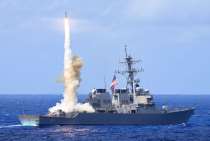
Seconds later, a mighty roar reverberated through the destroyer as the first of the anti-ship missiles left its container-launcher atop a long flame from its rocket booster motor, watched with fascination by the sailors and officers standing on the bridge wings. A second missile roared to life a mere five seconds later, with two more SSM-1 HAMMERHEAD anti-ship missiles following at equal intervals, first climbing at the vertical to clear the masts of the ship before inclining their trajectories toward the West and the Chinese ships. American sailors were not the only one to watch the missile firing, as Captain Zubin, on the S-25, was on the open ‘bathtub’ bridge of his submarine, watched on with his binoculars as his boat was navigating on diesel engines on the surface of the ocean, some fifteen nautical miles behind the American battle group.
‘’Tchyort5! What is that?’’
At first, Zubin thought that one American ship had somehow exploded, possibly from ammunition mishandling, but he quickly revised his opinion on seeing a succession of four plumes rising and then flying away towards the West at incredible speed.
‘’Rockets! The Americans are using a new type of weapon. RADIO ROOM, BE PREPARED TO SEND AN URGENT MESSAGE TO VLADIVOSTOK!’’
On the bridge of the USS MISSOURI, its captain also watched the four missiles fly out, fascinated, then spoke to the other men standing on the bridge of the battleship.
‘’Gentlemen, you just saw the future of naval warfare start up with a roar. Let’s hope that those missiles will fulfill their promises and will hit their targets. Radar Officer, how far away are those Chinese ships?’’
‘’I don’t exactly know, sir: they are still well out of range of our own radars. However, those Chinese ports are a good hundred nautical miles away from us.’’
‘’A hundred nautical miles...and our own big guns are still well out of range.’’
After accelerating the missiles to the blazing speed of Mach 3.5, or 2,300 miles per hour, their solid rocket booster motors, now burned out, detached themselves from the main body of the missiles, with their second stage ramjet engines taking over and sustaining their speed as their inertial guidance systems guided them on their programmed trajectories while flying at an altitude of 15,000 feet. Then, when they attained the points at which they were programmed to target, the missiles started a steep dive, while their Ku-band targeting radar and FLIR sensors started searching for their targets on the surface of the ocean. Ingrid Dows and her engineers had decided to equip the HAMMERHEAD with dual targeting sensors in order to defeat possible enemy
5 Tchyort: ‘Hell’ or ‘Damn’ in Russian. electronic jamming or decoys: if a radar target was found to have no thermal signature, then the missile would ignore it and search instead for a combined radar and thermal signature more typical of a ship. In this engagement, the four missiles were helped by the fact that many of the ships or boats in the Chinese armada were old wooden junks converted to transport troops and were powered by small diesel engines, thus offered weak radar and thermal signatures. However, the four ships leading the armada, ex-Soviet GORDY-Class frigates now designated as ANSHAN-Class ships fitted for minelaying, had radar and thermal signatures which immediately attracted the lethal attention of the incoming SSM-1 HAMMERHEAD anti-ship missiles. Diving at supersonic speed, the missiles gave no chances to their targets to shoot at them or to even detect them before they plowed through the top decks of the Chinese ships. Their 250-kilo semi-armor piercing-incendiary warheads penetrated deep inside the hulls before exploding, with one missile detonating as it was about to go through the bottom of its target. That unlucky Chinese frigate was then broken in two by the explosion and started quickly sinking. The three other frigates, while they temporarily survived the missile hits against them, still suffered some catastrophic damage and were rendered at once combat-ineffective. One of the three survivors then exploded after a minute or so, fires touching off one of its 130mm gun ammunition magazines. The two remaining frigates, already in deep trouble, were soon abandoned by their poorly trained, inexperienced crews as they started slowly sinking, leaving the rest of the armada basically leaderless.
On the USS LOWRY, the surface search radar operator watched with jubilation as the four blips he had designated as targets for his ship’s missiles disappeared one by one from his radar scope.
‘’SIR, ALL FOUR TARGETS HAVE NOW DISAPPEARED FROM MY RADAR SCOPE: OUR MISSILES SUNK THEM!’’
‘’YEAH! THANK YOU, MISTER HUGHES!’’ shouted a happy Jackson before looking at his air search radar operator. ‘’WHAT IS THE RANGE TO THOSE CHINESE AIRCRAFT?’’
‘’THEY ARE NOW SOME 46 NAUTICAL MILES AWAY, SIR, AND ARE STILL APPROACHING.’’
‘’Too bad for them. Mister Kelsee, you may start firing our SA-1 anti-aircraft missile at your convenience once those Chinese aircraft are within range. However, remember that we have only sixteen such missiles, while we have 54 aircraft coming at us. I will thus slow down our ship, so that we could be nearer to our other ships and use their gunfire to improve our anti-aircraft protection. Thus, fire at a slow rate, to avoid wasting two missiles on the same target.’’
‘’Understood, sir.’’
The next few minutes were nervous ones in the C.I.C., as the Chinese aircraft got closer and closer. Then, on cue from the radar operators, the weapons officer fired off the first of his sixteen SA-1 SEA LANCE medium-range anti-aircraft missiles. Propelled by the same type of solid rocket booster motors and ramjet engines of the HAMMERHEAD anti-ship missiles, the SA-1s climbed and accelerated to Mach 3.5 while pointing at a pre-calculated intercept point. Once at that point, some sixty kilometers away from the destroyer, its millimetric wave radar and FLIR sensor searched their limited frontal targeting search cones, actually finding five possible targets within that cone. The missile then selected the nearest target and locked on it, using its canard fins to fly towards it, still under ramjet power. The poor pilot of the Chinese Petlyakov Pe-2 dive bomber targeted by the first incoming SA-1 didn’t have time to react before the missile passed within one meter of his aircraft. The forty-kilo high-explosive fragmentation-incendiary warhead of the SA-1 then exploded, activated by its proximity fuse. The blast and rain of fragments from that explosion broke off one wing from the dive bomber and also severely wounded its crew. The Chinese aircraft then entered a terminal, spinning dive before crashing into the sea. As soon as that blip was gone from their radar screens, Kelsee ordered a second missile to be fired. That missile also hit and destroyed its target. However, that engagement, including its flight time, took a bit long in Kelsee’s taste, as the rest of the Chinese aircraft were now approaching rapidly, so he gave new directives to the weapons officer of the LOWRY.
‘’Mister Levarton, fire pairs of missiles, but with each missile in the pair targeting enemy aircraft on opposite wings of the enemy formation. Let’s accelerate this process.’’
‘’On it, sir!’’
By the time that the surviving Chinese aircraft were within visual sight of the destroyer, a total of eight of the enemy bombers had been shot down already. Still, ten of the surviving Pe-2 started diving on the USS LOWRY, while the rest continued towards the MISSOURI and the three other destroyers of the battle group. Lieutenant-Commander Jackson then had a hard choice to make: prioritize the defense of his own destroyer or that of the MISSOURI. It took him only seconds before he took his decision.
‘’MISTER LEVARTON, CONTINUE TO FIRE YOUR SA-1 MISSILES AGAINST THE CHINESE AIRCRAFT ABOUT TO ATTACK THE MISSOURI. LET OUR SPDS DEAL WITH THE ONES DIVING ON US.’’
‘’AYE, SIR!’’
In the Ship Protective Defense System, or SPDS, of the LOWRY, which sat atop the helicopter hangar of the destroyer, Petty Officer First Class Henry Bolton nervously looked through the transparent armored dome of his gunner’s station, trying to acquire visually the incoming Chinese bombers. That actually proved easy, as the Ku-band radar and FLIR sensor mounted on his turret automatically pointed his four 30mm cannons and eight short-range SEA BOLT missiles at the approaching aircraft they detected. With a number of red dots now visible on the heads-up display visor of his targeting helmet, Bolton, who had previously been a gun chief for one of the twin five-inch turrets of the LOWRY before going to train on the new SPDS, lined up his visor’s reticle on the nearest aircraft and pressed a button on one of his two control handle, obtaining nearly instantly the range to that target.
‘’Three thousand and four hundred yards to the first target: good! Let’s see what my SEA BOLT missiles are capable of.’’
As he said that, he heard in his earphones a shrill noise, which signaled to him that the heat-seeker head of the missile he had selected for firing had acquired its target. His next action was to press the firing trigger on his left control handle. One of the eight ready-to-fire missiles then flew off, the flames from its rocket motor temporarily blinding Bolton. That missile then sped away at a tremendous acceleration rate, with its rocket booster motor still burning when it achieved a direct frontal hit on its target. The kinetic energy of the missile, combined with its forty-kilo warhead, disintegrated the Pe-2 it had been aimed at, creating a large fireball and sending debris all around. Yelling briefly in triumph, Henry Bolton then aimed at another Chinese aircraft and fired a second missile. By that time, the five-inch guns of the LOWRY had started firing proximity-fused shells at maximum rate at the incoming aircraft. To Bolton’s fury, one of those shells exploded near his second missile, destroying it. He then spoke on his sh ip’s internal communications network, his voice forceful.
‘’C.I.C., FROM SPDS: OUR GUNFIRE JUST DESTROYED MY SECOND MISSILE AS IT WAS ON ITS WAY. REQUEST YOU SUSPEND IMMEDIATELY OUR GUN FIRING.’’
‘’Negative, SPDS!’’ replied the voice of the weapons officer, Lieutenant Levarton. ‘’We need to use our maximum firepower to...’’
In the C.I.C., Captain Jackson frowned on hearing that exchange and shouted at the young officer.
‘’BELAY THAT, MISTER LEVARTON! SUSPEND OUR GUNFIRE AT ONCE: LET OUR SPDS DO ITS WORK UNTIL IT WILL BE OUT OF MISSILES.’’
‘’Uh, yes sir!’’ could only say the weapons officer, evidently frustrated. ‘’ALL GUNS EXCEPT SPDS: HOLD FIRE! HOLD FIRE!’’
Seeing the five-inch turrets of his destroyer stop firing, a relieved PO1 Bolton fired his third missile. This time, it was able to complete its interception and destroyed another Pe-2 dive bomber. Seeing how things were going badly for them, the surviving Chinese pilots attacking the destroyer gave up in disgust and interrupted their diving attacks, then turned away and fled westward. A jubilant Bolton then immediately switched his attention to the bombers approaching the MISSOURI and fired his fourth missile. Even though the battleship and its three other destroyers were putting up a dense curtain of five-inch gunfire, at least Bolton’s missile was not flying parallel to those shells, instead coming from behind the bombers. It was thus able to shoot down the Pe-2 it was targeting. Seconds after that, two more Chinese bombers were hit and destroyed by five-inch shells. The surviving planes and their escort fighters then quit the fight and fled westward, still pursued by gunfire and by Bolton’s missiles.
In the C.I.C. of the USS MISSOURI, Rear Admiral Fisher slapped a hand on top of the tactical plot table.
‘’By God, we beat those bastards! Nice shooting, people! Report any damages and casualties on our ships.’’
After a few minutes, Fisher had more reasons to rejoice.
‘’Twenty-three enemy aircraft shot down and four enemy ships sunk, with zero casualties and damage on our side? That’s awesome!’’
‘’It seems that the Hughes VLS system on the LOWRY just proved its worth, Admiral.’’ said his flag operations officer, Commander George Stanfield, making Fisher nod.
‘’It sure did, George. Hopefully, we will be able to have more ships refitted with those VLS systems, and quickly. As for the Chinese, I doubt that they will try this again in the near future. This ought to have stung them badly.’’