

The Ultimate Guide to Dominating Google Business Profile by Dennis Yu - HTML preview
Download the book in PDF, ePub, Kindle for a complete version.
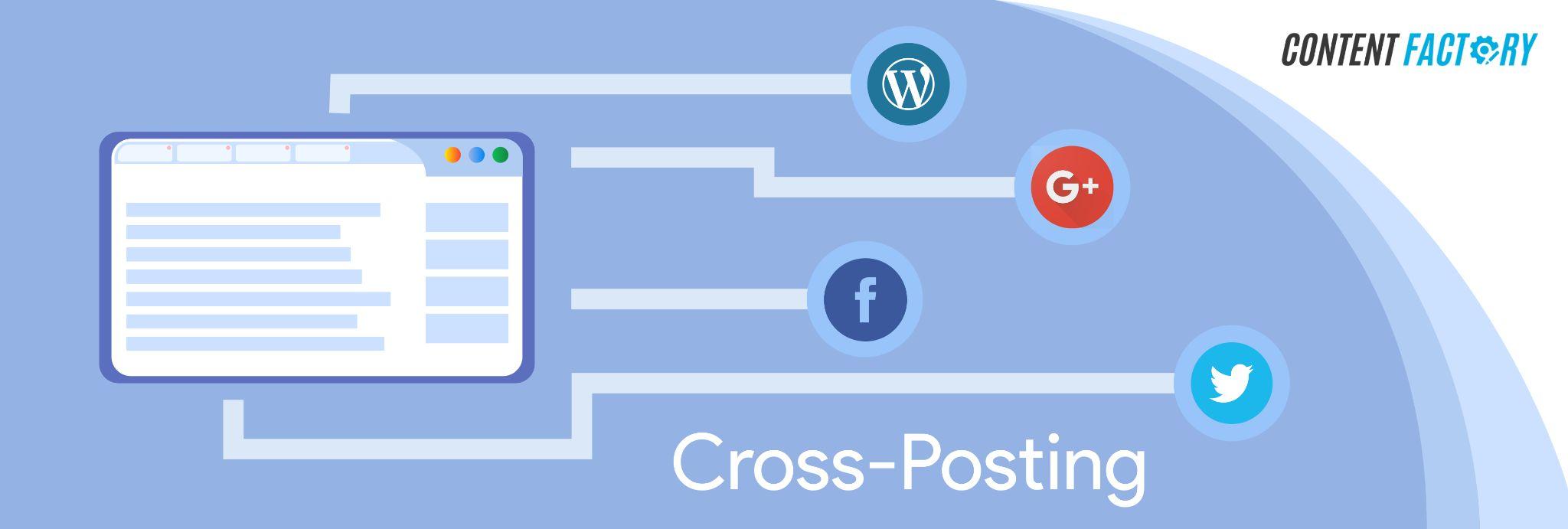
Cross-Posting
Most people don't know what to post. They're thinking they have to create new content every time. They don’t realize they can repurpose what they’re already using on social media — meaning any content from their website, Google Business Profile, or Facebook — and cross-post it.
When you see a post on Facebook, what's the likelihood that you're going to engage on that post even a couple of days later or a week later, or even see it again a month later?
The likelihood is very small, if not zero.
Because society is based on a feed. And there's decay on the feed so that it's only showing you the freshest things that have just happened.
You don’t care what the news was eight months ago or the stock price a year ago.
Social media is about “What are my friends doing right now”. But Google is completely different because it's not about what's going on right now.
It's about “What is the answer?”.
So here's how you arbitrage digital marketing as a local business owner:
Initially, you post something to Facebook and Twitter because that's how you get something right now.

Some people who are purists in digital marketing will want to argue with me, but if you're practical, 99% of people agree with me on this.
You take the same content — the photo, post, phrase — whatever it is.
In WordPress, you can just create a post, and you don't have to write a whole blog.
You can just paste the photo, write 2–3 sentences, and publish the post. For example, if you had a customer celebrate their birthday at your restaurant you could put a photo and say “Happy birthday Amanda! We’re happy you chose to celebrate at our place and we can’t wait to have you back.”
Maybe put a tag on it, put it in a category if you like.
And now you're just putting out more blog posts, which are more web pages on your website.
Then you can post it to LinkedIn because you're the restaurant owner and you say “I'm so happy that Amanda came to celebrate her birthday and brought her friends to the restaurant”.
We call that repurposing or cross-posting.
You don’t need to hire a consultant, expert, SEO, or anyone selling magic tools.
It’s not magic, software, or engineering. It’s simply interacting with your customers and posting content.
Because when you pull up at a Thai or Italian restaurant in your area, how likely is it that those restaurants are doing this?
Very unlikely — so all you have to do is stay ahead of them.
When I ran analytics at Yahoo over 20 years ago, my team did a little research on food.
What percentage of people do you think decide where to eat within two hours of dining?

25%!
That means 75% of people haven’t decided where they’ll have dinner. So there are two hours left and they're obviously going to eat, so then how do they decide in the next two hours?
They search, ask friends, text their wife, or ask their buddy.
“Oh, let's pick up some food along the way”
Or they're on social media and they see a friend eating at this one place. It’s like, “I want to eat at that place too.”
For restaurant owners, food — except for weddings, special events, or high-end dining — is often a spontaneous decision.
So what you've got to do to win is to marry your search and social media together.
The way you get in front of these people in that window, when they're deciding, is by publishing content constantly.
So you have to hit them multiple times. The more you honor your customers, and your employees, and the more you share... the better you’ll do.
Think of yourself as an awards manager — you’re constantly elevating other people by showcasing their wins and giving them credit in public.
You love your customers and you show that you love your employees.
You love when people come into town, you love going between the different tables and asking how people are feeling, and sharing it on social media.
And when someone says something good - ask for a review. Feature them everywhere you can.
They will most likely feel honored. They feel like it's first-class, they feel like “Oh yeah, these guys really care about me.”

That’s free content for you.
Share it everywhere
Facebook, Instagram, Google, your website, Twitter, or whatever social platforms you use or your customers use.
The biggest one is your website. Next is your Google Business Profile listing, which acts like a mini-website.
The 3rd most important is Facebook.
Don’t have time to do it yourself? Do you have some waitstaff who want to earn a few extra dollars or be able to build a career in social media instead of just serving food and taking orders? Get them to do that for you.
Assuming that you have analytics set up properly, you’re going to get a lot more business from Google than from Social Media.
Social is a great way to create content because people see it when it’s posted. You have a 24 to 48-hour window to see content on social media before it disappears.
But with Google, the more you keep adding to your GBP, the more you keep adding to your website, that stuff lives on and on, and it builds momentum. Once you have that ranking and you're in the top spot, you don’t need to put in as much effort.
It will continue to bring in more business. Google is a steady source of business. Social, you have to keep coming up with something every day because whatever you did before disappears.
That's how you balance search and social.
Use social media to gather original content you can reuse elsewhere. You can post it there, but the key is you've got to move it to a place where you can keep getting value out of that asset, which is the website, Google Business Profile, YouTube, etc.
If you get this right, it will change your business.

Secrets on Ranking in the Local Three Pack
1. You need to understand local and organic link attempts.
That's two algorithms– the local algorithm and the organic algorithm basically share a lot in common. So you've got X amount of signals that are being utilized for organics. And for locals, they are actually not that much. It’s proximity, relevance, and prominence– three things. And those three things can be chopped down into a couple of different areas.
2. Nailing your category.
Getting your primary category is the most important aspect.
So for instance, if you're doing real estate agent versus realtor versus real estate agency, those are completely different types of queries and different types of intent that you're trying to match up.
So nail your primary category first. And then what you can do is you can do up to eight more or nine more subcategories and those are going to be your secondary categories. They're almost as powerful as your primary category, but not so much which is like with heating and air conditioning companies, for instance, that switch up their categories depending on the season.
How can you tell what's the best category to use?
It might sound simple, but it's actually not. So we recommend installing the chrome extension GMB Spy and what it does is you just visit any Google Business Profile listing, you click on the dude with the hat and it's going to give you what category that listing is optimizing.
If you want to get a little bit more intense and you're an SEO professional, or you want to be an SEO professional, then you can use a tool from PLEPR.com. You download the extension and then what you do is you have to go to PLEPR and register for the API. It's free and you just have to register.
What this tool will do now is when you visit maps.google.com and you type in your query, it'll look at all 20 listings, and then it'll basically compile all of that and express it in a graph of percentages. And it'll break down everything from the reviews to the categories.

The primary purpose of the tool is to show you the categories and the percentages of those main views.
Why would that be important?
You might find that the guy who's number one or number two in your competition is using a category you never thought of. So it's very powerful.
3. The webpage that you link your GBP listing to.
So the school of thought on this is that you want to link to a page, which is going to be all set and also rank well organically. And from that, the content of your website actually will impact the queries that you also show up for. So there's a lot of semantic relevance that's going on between your GBP profile and your website.
You can check out Google Business Profile Queries in your insights—now called the performance report—to see the queries where your GBP listing is being found. The beauty of these queries is that they're actually built off the raw log files in Google's data center. This is what people are using to find you. You can also use these queries in AdWords and other tools.
And you can also look at the queries, which are delivering less than 15 searches.
Why is that important?
Because obviously you're being found.
4. Your reviews.
When it comes to reviews, there are a couple of ins and outs here. Based on studies that we've seen, reviews are going to only help you to a certain point.
People might say, “I've got 100 more reviews than this guy. In some cases, this guy has zero reviews. Why is he outranking me?”
There is a limit to where your reviews are actually going to help.

And to understand that you have to frame it into how consumers behave. So consumer behavior is going to be looking at a majority, we're talking 86% of consumers are going to look at reviews that have been done in the last two weeks. Those are the most important reviews that you can have.
We need a consistent stream of reviews, since consistency impacts rankings more than the total number of reviews. The pure number is great, but it's also just like a social media following in that it's good, but it's more like a social proof than anything else.
You might have thousands of followers, and tons of reviews, but it's really the last two weeks that are most important, especially how you're responding to these reviews as 95% of users, when they're liberally searching in a business, they read your responses.
So even if you have a lot of reviews, but you've only gotten a couple in the last two weeks, it is not very impressive for your business.
Another thing that we need to look at is the quality of those reviews. So if the quality of those reviews is up there and they're not just like five stars, no content but they're actually like 2, 3, 4, sentences speaking about things, the true experience that the customer had, that's what's really powerful. Words people use in those reviews are extremely important.
So you want to guide people on how to leave a review because the keywords are absolutely being indexed–how they're being used, and if they’re being used in something which is called justification– when you're looking at a Google Business Profile and underneath the profile, you'll see usually a star or exclamation point or a little blue kind of bug badge thing and it's going to be based on the intent of the search.
Additionally, you'll notice that there are these little chips underneath your business profile near the reviews where it says professional or real estate. Those are picked up from the reviews and also show a number next to them. So the number might be 8 plus, 22 plus because it was just adding up the number of times people use those words.

The more people use these words, the more you're going to be found for these types of searches.
So if I’m looking for a personal, professional real estate agent in San Diego, those keywords will likely be in the reviews left for the business.
You want your customers to use the keywords you want to rank for, but you can’t directly ask them to.
Why can’t you just ask for a review?
Because if you are asking, then there’s a high chance that you're directing them. And it's not necessarily against the guidelines, but it's going to interfere with portraying the real experience that Google wants.
If you ask customers to leave a review by email or text message, you’re putting your business at risk because now your competitor or anyone to whom you send those messages will have that message as evidence and proof and they can go to Google and report it and say, “This merchant asked me specifically to do this.”
There’s one scenario where somebody came into a shop and they had a sign that they put right on their counter that says, “We will give you a free bud for a five-star review” and so the user, which was a competitor, took a picture of this, took a picture of the building, did a video, and showed that the sign was there.
This shop has been asking for reviews ever since it opened up. So Google wiped out 500 reviews overnight, and their ranking went down.
How to ask for a review and get those keywords the right way.
Let's say you're a real estate agent. You've just closed on a home. You're walking your client through the home and you say, “Congratulations. Here are your keys.” You've got a happy customer right in front of you. Super duper happy.
So what you're going to do is you’ll say, ‘Hey, would you mind — like your son, daughter, or whoever is here — taking a picture of us in front of this beautiful home?’

“Would you mind leaving us a review on Google?” and they're going to say, “of course great” and you continue with the reason, “...because what we can do is we can attach this picture to the review and show off your beautiful new home.” And then you say, “excellent, take the picture.”. When they are about to write the review, you say, “Okay, cool.”
With this review, here are the key components to it. This review is not a form. This review is to help everybody else that's going to talk to me in the future. So when you're writing the review, keep that in mind. So immediately that's “Oh wow. I get to help somebody else. Awesome. I like that.“
So it's just psychological. You're getting them prepped. And then the second part of that is “Would you mind mentioning where we're at? Like this city. Would you mind mentioning my name or my business? And would you mind talking a little bit about the process? And what we did here?”
Now that, of course, can be expanded—if you want to really drill into it, you can bring it out and expand on it further. So that way you're giving them the creativity. And so then they'll just go ahead. They'll write the review. Sometimes they might even say, ‘Hey, would you mind reading this?’ But then they'll post it.
And you've also had to coach them just a little bit.
What about pre-writing the review for them?
A lot of your customers might say, “Why don't you just go ahead and write it for me?”
You should avoid it to prevent getting flagged by Google. I haven’t seen a case where somebody has gotten in trouble for a pre-written review but again, it's better if it's coming from your customer’s words, their language.
The problem is that we, as human beings, have a very specific way of writing things. So we're not going to be extremely creative. And the fact is it's pretty much set in stone, our style. So you're going to keep on writing the same thing, basically over and over again. It's going to sound the same. It's going to read the same.
So now when a competitor sees this, they will go ahead and start reading your reviews and see that they sound the same, using the same words, phrased exactly the same. They will then assume that those could be fake review profiles or that your business is buying reviews. This will lead them to report your business to Google, claiming you didn't earn those reviews.

And the fact is that when someone from Google is hunting down and trying to get reviews or remove a business from Google Business Profiles, what they look for are patterns and once those patterns are found, they get those reviews removed.
So you can do that to your competitor but that's the nasty thing that competitors do to each other.
Why shouldn't we buy fake reviews?
Why you shouldn’t buy goes along the same lines as review gating. The penalty is basically the same.
So with review gating, what you're doing is you're basically putting a piece of code on your website, or you're sending somebody a text message where they are asked for a review.
If you put in a review rating of say, one to three stars, what will end up doing is it will end up directing your customers over to a form that they can fill out then this goes directly to the merchant and does not leave the review on Google, Facebook, Yelp, or anything else.
But if a customer puts something that's four or five, of course, that will be sent over to Google to leave us a review.
You may have actual business reasons for Review Gating which might be that you want to see every review–especially bad reviews, and I want to reach out to them but Google doesn't care though.
Google says if your review gating, you're basically going ahead and you're manipulating your review score.
There's one business, in particular, a master of over 6,000 reviews in a six-year period. Great ranking too. They were reported by a competitor who went in and looked at their website, looked through the code, and found a software company associated with Review Gating.

They looked at when it was installed and when it was removed. And then they took that and reported it to the Google community and that escalated to Google two weeks later. Google removed all 6,000 reviews even though a lot of them were legitimate, it didn't matter, what mattered to Google is they were breaking the rules.
Another reason that you should not buy fake reviews is that people who are selling these reviews are not the most intelligent people in the entire world, and like any good thief, they will leave tracks, lots of tracks.
Example: Singapore is a hub for fake reviews, so it was Japan and China where they get a bunch of cheap phones, put them on banks and you've got operators that are doing nothing but sitting there leaving reviews all day long, even if they're using a spoofed SIM, which most are still traceable by Google mainly through IPS.
Google got its tentacles everywhere, so it can detect these things. Again, the people paid to write reviews are usually not very smart about it.
And they'll sit there and leave a review, say for one real estate agent and then another one and then another one and another one and they're all in San Diego and they're all in the same day. Okay, cool — you just bought 10 homes. Good for you. Obviously fake. Sometimes they will leave reviews with crappy names, like Lenny Kravitz or Obama. And for these users who only have two or three other reviews, they're all in the same area and they're all five stars, so you can tell.
And then they leave a one-star review for somebody else because they're paid to leave a negative review as well. That happens a lot too, building fake listings and all sorts of different little things.
What happens if you buy fake reviews?
When you start buying fake reviews, your competitors are going to notice almost immediately because they are watching you like a Hawk. And then they're going to be like, “This is not fair. How could this guy go ahead and get 30 reviews in one day when normally he only gets one review a week? Again, it doesn't look right”.

So what's it going to do? It's going to report to you.
What Google's going to do is the bot will go to take a look at it and see if there's any kind of identifiable pattern in the reviews, which they're usually going to find or somebody is going to point it out and Google will go ahead and remove at least the fake reviews.
Sometimes, this is the bad, horrible part, what Google will do is now they're going to look at your entire review history. And they're going to say,
“You know what? These reviews are fishy too, because of our spam signals. So we're going to kill those too.”
Google will not investigate deeply. They are just going to kill them and the problem is that, and this is a general rule of thumb that anytime you reach out to Google support or somebody reaches out to Google support on your behalf, in this case, you always have a chance of losing your listing or losing your reviews. Always. It doesn't matter what it is.
So let's say you went out and bought a hundred fake reviews. All of a sudden, one day somebody comes along and your listing gets suspended out of the blue. So you reach out to get reinstated and you get reinstated, you end up moving, and proving that you're in a legit location.
But when you come back, you're like, “Crap, 50 reviews are gone. How'd that happen?”
You contact Google and say, “Thank you for reinstating my listing. I’ve lost 50 reviews,” and Google will tell you they were deemed spammy and removed.”
But they might've been real, however, that's the big thing. When you are buying fake reviews, you're immediately going to be suspected of other types of activities that are against Google’s guidelines.

