

O.K. Corral by Edward Drobinski - HTML preview
Download the book in PDF, ePub, Kindle for a complete version.
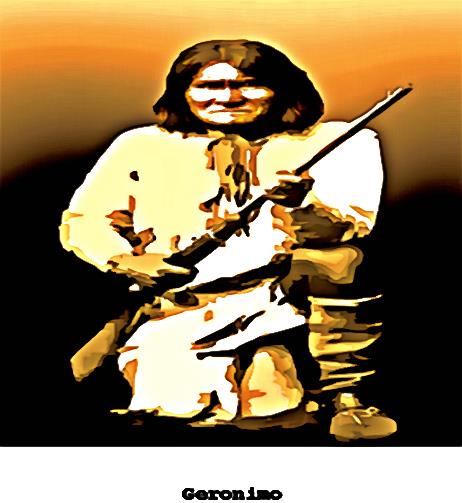
1909: Death of Geronimo
It’s really not so strange to realize that one of the reasons that the Wild West was wild was because Indians were there.
1344
O.K. Corral
At 80 years of age, Geronimo still wanted to keep fighting.
Geronimo, Mescalero Apache-Chiricahua, means “the one who yawns.”
He lived from June 16th, 1829 to February 17th, 1909, and was a prominent leader and medicine man from the Bedonkohe band of the Ndendahe Apache people. While he was a prominent leader, he was 1345
not a chief but rather a shaman. From 1850 to 1886, Geronimo joined with members of three other Central Apache bands; the Tchihende, the Tsokanende, and the Nednhi; to carry out numerous raids, as well as fight against Mexican and US military campaigns in the northern Mexico states of Chihuahua and Sonora and in the southwestern American territories of New Mexico and Arizona.
Geronimo's raids and related combat actions were a part of the prolonged period of the Apache–United States conflict, which started with the American invasion of Apache lands following the end of the war with Mexico in 1848. Reservation life was confining to the free moving Apache people, and they resented restrictions on their customary way of life. Geronimo led breakouts from the reservations in attempts to return his people to their previous nomadic lifestyle.
During Geronimo's final period of conflict from 1876 to 1886, he surrendered three times and eventually accepted life on the Apache reservations. As stated, while well-known all over, Geronimo was not a chief of the Bedonkohe band of the Central Apache but a shaman.
However, since he was a superb leader in raiding and warfare, he frequently led large numbers of 30 to 50 Apache men.
1346
In 1886, after an intense pursuit in northern Mexico by American forces that followed Geronimo's third 1885 reservation breakout, Geronimo surrendered for the last time to Lt. Charles Bare Gatewood.
Geronimo and 27 other Apaches were later sent to join the rest of the Chiricahua tribe, which had been previously exiled to Florida. While holding him as a prisoner, the United States capitalized on Geronimo’s fame among non-Indians by displaying him at various fairs and exhibitions. In 1898, for example, Geronimo was exhibited at the Trans-Mississippi Exposition in Omaha, Nebraska. Seven years later, the Indian Office provided Geronimo for use in a parade at the second inauguration of President Theodore Roosevelt. He died at the Fort Sill hospital in 1909, as a prisoner of war, and was buried at the Fort Sill Indian Agency Cemetery, among the graves of relatives and other Apache prisoners of war.
In his waning years, Geronimo presided over the slow decline of the Apache. By the end of his life, he’d taken eight wives, though he rarely married more than one woman at a time. The aging chief wrote often of the hollow promises of land and cattle made by United States troops.
1347
He lived until February of 1909, when he was thrown from a horse and left to lie in the rain for an entire night before he was found. A few days later, he succumbed to pneumonia. According to witnesses at the scene, Geronimo’s last tragic words were of regret; “I should have never surrendered,” he said. “I should have fought until I was the last man alive."
1912: Last of the Lower 48 States Admitted to the Union A singularly held characteristic of the Wild West was its lawlessness.
It was beyond the reach of governments. It is for this reason that 1912
might be considered a candidate year for the end of the Wild West.
In January and February, New Mexico and Arizona were admitted into the Union as the 47th and 48th states respectively. Both had become so well populated from ranching and mining booms that they now held the requisite population for statehood.
While this wasn’t exactly like dripping a law and order switch from it’s off to on position since these territories did have governments, it did mark the entry of the final states of the Lower 48. There were now no 1348
O.K. Corral
more unsettled territories in the contiguous country where one could migrate.
The United States, while not in its final form, was so close to it that an era had decidedly ended.