

Democratic License by Edward Drobinski - HTML preview
Download the book in PDF, ePub, Kindle for a complete version.
Written by Desmond Dekker.
Begin said; “Ima be see dat yu gots dem spirit.”
I said; “Yea. Now I ain’t saying they be gold diggaz, but they turnt da US country into broke niggaz. New ye finna drop n I can already hear the kvetching. Way ah be at, finna be nobody be dere but some bots ta kill.”
“Well, the bots might kill somebody and as their supervisor, you could be liable without the license.”
“Killer bots?”
“Yeah.”
“They might kill me.”
“No, they’ve been programmed to only kill who their supervisor approves killed.”
The Point Nemo location was the biggest selling point, that being the place on the water which is furthest from land. I was thrilled, what with a ship of my own, complete privacy, the right to steal, and a license to kill. Who could ask for more?
Even the Biden Crime Family didn’t have all that. I excitedly said; “When can I start?” The rest is boring detail.
Other errata with some significance to me. The “experts” say that teleportation is the hypothetical transfer of matter or energy from one point to another without traversing the physical space between them. It is a common subject in science fiction
literature and in other popular culture. Teleportation is often paired with time travel, being that the travelling between the two points takes an unknown period of time, sometimes being immediate. An apport is a similar phenomenon featured in parapsychology and spiritualism.
There is no known physical mechanism that would allow for teleportation. Frequently appearing scientific papers and media articles with the term teleportation typically report on so-called "quantum teleportation," a scheme for information transfer which, due to the no-communication theorem, still would not allow for faster than light communication.
Well. I have some news for them. I teleport regularly and it isn’t all that difficult. The key to the process is relaxing and making my mind go completely blank, and then visualizing where I want to be. Then poof, I’m there. Though it’s the height of aesthetics to be here on this ship, sometimes I’m in the mood for a change, especially when I sense that Patsy has been spying on me.
By the way, someone painted the name “JIGGS ‘N JOOS”
(hereinafter referred to as JNJ) on the ship. I’mnot sure if it was done by the manufacturer, or by some graffiti “artistes’ who reside in tents in the neighborhood. Whoever ostensibly made
what they considered to be some “cute” wordplay on the old
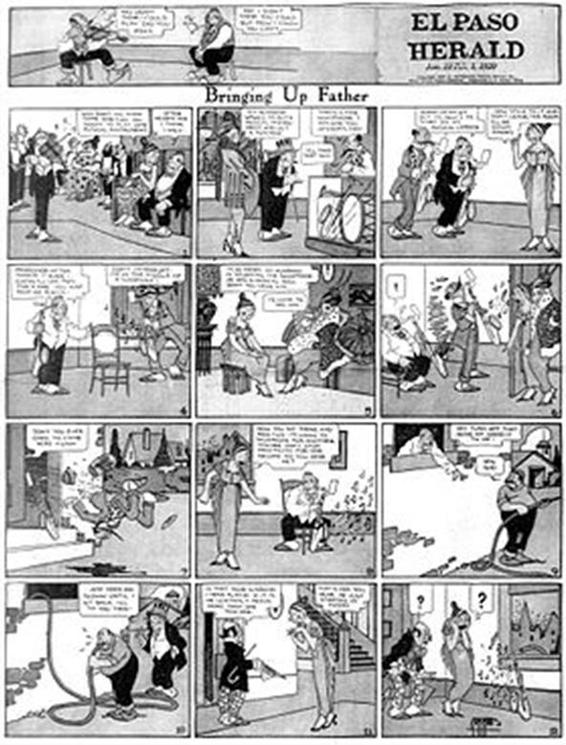
“Bringing Up Father’ cartoon which featured Jiggs and Maggie, the latter sometimes affectionately referred to as Joos. You may have seen it in your Sunday funnies. How outdated.
I really didn’t care. After all, I’d be on the ship in the middle of nowhere with no hominid company. Besides, it was paid for on Begin’s dime and I figured that if I asked him about it, it would be wrongly seen as some sort of objection, and I didn’t want any stupid shit. If you think about for a whole second, you’d realize that most things don’t make any difference whatsoever; just fodder consumed by the gullible originally designed primarily to keep the owners of the main stream media immersed in their “new improved” shequels.
“Bringing Up Father” was an American comic strip created by cartoonist George McManus, distributed by King Features Syndicate. It ran for 87 years, from January 2, 1913, to May 28, 2000, ostensibly not desirous of getting too entrenched in the twenty-first century.
The strip was later titled “Jiggs and Maggie” or “Maggie and Jiggs,” after its two main characters. According to McManus, he introduced these same characters in other strips as early as November 1911.
The humor centers on an immigrant Irishman named Jiggs, a former hod carrier who came into wealth in the United States by winning a million dollars in a sweepstakes. Now nouveau riche, he still longs to revert to his former working class habits and lifestyle. His constant attempts to sneak out with his old gang of boisterous, rough edged pals, eat corned beef and cabbage, known regionally as "Jiggs dinner," and hang out at the local tavern were often thwarted by Maggie, his formidable, social climbing and rolling pin wielding harpy nag of a wife, their lovely young daughter Nora, and infrequently their lazy son Ethelbert, later known as Sonny. Also a character presented in the strip portrayed as a miserly borrower was named, fittingly, Titus Canby; "tight as can be."
The strip dealt with "lace curtain Irish," with Maggie as the middle class Irish American desiring assimilation into mainstream society in counterpoint to an older, more raffish
"shanty Irish" sensibility represented by Jiggs. Her lofty goal was frustrated in nearly every strip, was to bring Father, the lowbrow Jiggs, up to upper class standards, hence the title,
“Bringing Up Father.” The occasional malapropisms and left footed social blunders of these upward mobiles were gleefully lampooned in vaudeville and popular song, and formed the basis for “Bringing Up Father.” The strip presented multiple
perceptions of Irish Catholic ethnics during the early 20th century. Through the character Jiggs, McManus gave voice to their anxieties and aspirations. Varied interpretations of McManus's work often highlight difficult issues of ethnicity and class, such as the conflicts over assimilation and social mobility that second and third-generation immigrants confronted.
McManus took a middle position, which aided ethnic readers in becoming accepted in American society without losing their identity. A cross country tour that the characters took in September 1939 into 1940 gave the strip a big promotional boost and raised its profile in the cities they visited.
Jiggs and Maggie were generally drawn with circles for eyes, a feature more often associated with the later strip “Little Orphan Annie.”
Democratic License