

Democratic License by Edward Drobinski - HTML preview
Download the book in PDF, ePub, Kindle for a complete version.
My review
It was amazing. If not the greatest living American novelist, Pynchon is one of the two greatest living American novelists, and a writer whose work, like Joyce, should really be read as a whole. But interestingly, a writer whose later, and in most
instances, more accessible, work will tend to clarify some of the themes and devices of his earlier, and more complicated aspects. I first accidentally ‘discovered’ him by googling
‘historian-absurd.’ And it seems that over the past 15 to 20
years of his output, he has become expressly concerned with this thing I am thinking of, and I don't think he would mind me calling it: ‘LA ‘RECONQUISTA’ DE AMÉRICA.’ You may be asking exactly what that refers to. Because, of course, the entire hideous, bloody history of this continent, is a history of reconquest. You know how that goes. Over and over and over; someone out there, alone in the dark, manages to find, what looks for a moment like safety or peace or even just a place to rest and very soon the same old, ugly forces that have been dogging this place since the ‘Native Americans’ first arrived here, tribes warring and reclaiming the vanquished tribe’s land as their own; a seemingly natural display of ethnocentrism. They show up, take it back, monetize it, and kick out whoever
“discovered” it. That's a history as old as the Americas themselves, since at least as far back as they've been called the Americas. But the particular ‘American Reconquest’ we're talking about here is essentially the history of the twentieth century, considered from a different angle. And although Pynchon's work takes in almost all of the twentieth century at one point or another, there's a specific focus on the
‘Reconquista’ as it happens in, say, right about the last third or the second half of the twentieth century, with a great deal of focus on the 1960s. Now, the 1960s are a difficult thing to talk about; not least because they have been, perhaps more than any other time in American history, repackaged into sepia tone, nostalgic bullshit. But Pynchon, in some very real way, is a writer from the 1960s. He wrote arguably his most famous and influential work during that period; ‘V,’ ‘The Crying of Lot 49,’ and a certain amount of ‘Gravity's Rainbow,’ though we will probably never know exactly how much. His later work often specifically focuses on the 60s as a time period, and even when it doesn't, is laden with 60s cultural references; sometimes intensely anachronistic ones. There's a lot to say, for example, about the inter-temporal penetration of the American 60s into the European 40s in ‘Gravity's Rainbow.’ All this to say, Pynchon can hardly be considered apart from the American 60s for a number of reasons, and the particular type of ‘Reconquest’ he has most persistently charted, especially in his later work, is a conquest of territory briefly opened in that same, well, I was going to say decade, but here's the thing about the 60s. They're not so much a decade as a kind of geological epoch; ‘The 60s,’
the way we talk about them, the way we think of and remember them, they're not necessarily every year beginning with one nine six in this particular calendar. I would say, for example, you
could say the 60s lasted from 1964 to 1974; something more or less like that. Or if you want to peg it to a particular event, from the moment the Beatles appeared on the Ed Sullivan Show to the moment in 1974 when Richard Nixon resigned over Watergate. I think that would be a, decent set of references in which to enclose the 60s as a cultural phenomenon. Now, admittedly, I wasn't around for the 60s, and I am no proponent of mere nostalgia. I look back at them and I see a lot of bullshit, self-indulgence disguised as spiritual discovery, a lot of bullshit self-importance disguised as political action, a lot of supposed counter culture which immediately sold out, mass produced, simplified, dumbed down, and made universal and ex-urban, and the outward adoption of all sorts of stylistic devices, with absolutely no concurrent change to the power structures and the individuals, which and who adopted those stylistic devices. I am not a big fan. I am not, as Thom Yorke used to sing, someone who wishes it was the 60s. To me, Woodstock is one of the more depressing moments in recent human history. What? The ultimate example of the Roman Carnivalesque overpowering whatever it was that people thought they were doing. But, you would have to admit, the 60s, especially, this concept of the long 60s, was probably the most inventive period for music in modern western history. And not just in rock or pop domains with which we identify the era, but in jazz, in that
kind of music we so awkwardly call Modern Classical. But in the equally awkward category of the thing we wretchedly call World Music; musicians from other countries, from other cultures, other musical backgrounds entirely, and I don't just mean stylistic musical backgrounds, I mean entirely different senses of how the scale works. Entirely different harmonic systems.
Entirely different patterns of rhythmic reference. All bumping up against this stuff coming primarily out of England and the United States and leading to an incredible musical ferment, the likes of which have never been seen and, in that specific form, will probably never be seen again. I could say more later about why I think that was the first and last time that'll ever happen, but I won’t. And, there was of course literature in the 60s apart from Pynchon. There were movies in the 60s. All of these media, or, if you prefer, artistic forms, found a kind of freedom to experiment that hadn't, apparently, been present.
Although I for one would argue that a whole lot of the hip or groundbreaking art of the 1960s was just the commercial codification of work that other and, this is important, much poorer, much worse known people, had been doing in the 40s and 50s. People laboring away in the darkness like experimental film makers, Maya Deren, Stan Brakhage, and Charles Olson, people who could scarcely feed themselves, let alone become counter cultural icons, who more or less characterized ‘what’s happening
now’ as the opening of Pandora’s box and/or the release of the devil. So, that is to say a conflicted territory to be sure; something that is difficult to approach with any kind of equanimity.
But, I have to take it from someone like Thomas Pynchon, a witness whom I trust, that there was this moment in the 60s, and, depending on who you ask, it may have lasted six months or a year or two years, when another world seemed, not just possible, but about to emerge from this one. When in one of Pynchon's favorite tropes, you could stand ‘Against the Day,’
or, just a few inches to the side of the day. Everything you had been taught; all the protocol of daylight and public behavior with which you had been inculcated, it all shifted off its axis just a little bit. And through the crack between that and the edge of the frame, you were able to perceive a world which, though ostensibly and outwardly identical to the world you knew, was so charged with the possibility for transformation, with a whole alchemical index of dormant changes, that you could never return to the official reinstalled public daylight as quite the same person, or feeling you had lived in quite the same world.
And, throughout all the best art of the 60s, there is this sense, alternately terrifying and liberating, of the radical artificiality of human life. Of the fact that, most of what we
do is simply made up; artificial. It, sure, comes from somewhere. It's the enormously complicated genetic project and product of a history going back tens of thousands of years. You can trace precursors. You can identify etymologies and lineages.
All of this is true. And it's not as if this made up world doesn't have the power to kill. It absolutely does. As a matter of fact it holds onto power primarily through killing. But, it is also made up. And, every once in a while, you get to have a moment in which you understand, not just intellectually, but viscerally, how incredibly flimsy the whole facade of the official world is, and how easy it should be, at least, to just step back, step to the side, take off at a strange diagonal, and find yourself in a world for which you had never been prepared.
A world, if no less artificial, at least beholden to different codes and tenets of artifice. And sometimes, as any number of ill-fated travelers learned in the 1960s, these other worlds can be as dangerous as hell. These other worlds are where the difference between living and dying is something as simple, and blunt, and stupid as the difference between dialects, or forms of slang, or knowing exactly what you can say, when, and to whom, or, rates of exchange that may or may not have anything to do with metal or paper currency.
I take it, because there are enough internet posts who or which tell me that it's true, that this sense of possibility was real.
And I take it likewise, that it was violently foreclosed upon by the likes of the Son of Sam and Manson. And this is a large part of what I'm talking about when I'm talking about the American Reconquest. This specific Reconquest, which lasted from, whatever year you wanna start it in, say, 1969, to the present, is certain to endure long beyond the present. It takes a lot of forms. It will no doubt take many more before I'm finished speaking. But, arguably, its primary engine is the technological control system; which, of course, brings along with it, any number of economic and political encumbrances to make sure that the technological control system is allowed to operate unimpeded. You have to hobble the rest of the world to make sure things are going alright for the machines and the few investors who own them. And, it says something about the speed of the evolution of this process that even the word machine seems rather outdated. Doesn't it? Once Dylan said he never discussed the meaning of his songs, because words change their meaning every ten years. Machine sounds like it's describing something with visible knobs and gears and levers and gauges. And the control systems we're talking about, they rest inside absolutely blank housing, the inner workings of which we scarcely understand; and refer to processes so apparently massive and
abstract that you would have to be a specialist even to be able to manipulate the most basic jargon about them. And if you were to become a specialist; well, the only way to do that is by enlisting in one of the various programs which will eventually convert you into an apostle for some small aspect of the regime as it already is. This is one of the great problems with economics, for example. Most instruction in economics is not to explain how anything works, or for that matter, how things don't work. It's to train you to be a rhetorical defender of the way things are. It is to inculcate into you what Nietzsche called Amor Fati. Love of fate. But this of course is an entirely artificial fate; a fate that has been constructed by a relatively small group of people for relatively comprehensible and brutal purposes. And it's important, I think, to note here, that when we talk about technological control systems, we are apt to lapse into the language of, as I said earlier, evolution.
See. Friends. Brothers. Sisters. It's got into me. It's burrowed into all of our spines. It's sucking on the roots of all of our brains right now. We are all apt to naturalize the process of technological expansion as if it were something that just had to happen. As if it were god almighty; that western phenomenon called Progressivism. Something that a number of you will have figured out by now doesn't exist. There's no such thing as progress. Never has been. Never will be. But that doesn't stop
us from making constant verbal recourse to it because that's the way we've been taught to speak. And in Pynchon's other work,
‘Gravity's Rainbow’ most obviously, we receive a thorough autopsy of the way that human society and the inmost, the most specific, the least tractable apparently, reasons of the human mind have been colonized by this virus that teaches us to think of, not just history in the human sense, but time itself, geology, cosmological evolution, as the linear dialectic of the emergence of technology. Now that's right at the heart of the American Reconquest, but that's something that starts a good deal before the 1960s, perhaps with Prometheus’ ‘gift’ of fire.
And, in order to make some of Pynchon's earlier work comprehensible, we want to start with some of the later work.
Some of the easier work. To do that, we have to speak of why Thomas Pynchon was uniquely well positioned, before the decade even started, to have a little bit of a different view of what was going on than most of his contemporaries. Thomas Pynchon was born in 1937, so he was a little young to be a beatnik, and was just a little old to be a hippie; twenty-three years of age when the chronological 1960s started and twenty-seven when the Beatles arrived on American shores; a guy who was clearly unusually bright, went to Cornell for physics at the tender age of 16, and whose acumen took in not only multiple disciplines, but disciplines that are generally considered diametrically
opposed in the humanities and the hard sciences, including the construction of run-on sentences.
Pynchon, worked as a public relations flack for the Boeing company magazine, was privy to the Boeing CIM-10 BOMARC, Boeing Michigan Aeronautical Research Center, its IM-99 Weapon System, a supersonic ramjet powered long range surface to air missile, controlled by SAGE; Semi-Automatic Ground Environment, a system of large computers and associated networking equipment that coordinated data from many radar sites and processed it to produce a single unified image of the airspace over a wide area at what would've been an astonishing speed for 1962, though I'm guessing now it would sound, frankly, kind of depressing. Funny isn't it? How we lend an emotional coefficient to these things.
How seeing 96kbps by an audio file is not just an inconvenience, but an occasion for active disaffection. SAGE eventually became the blueprint for ARPANET; Advanced Research Projects Agency Network, ARPANET the first wide area packet switched network with distributed control and one of the first computer networks to implement the TCP/IP protocol suite. Both technologies became the technical foundation of the Internet; which is mentioned specifically in ‘Inherent Vice.’ The point is that, Pynchon, as early as 1962, was aware that the United States was blanketed by an enormous electronic messaging network about which most
citizens had no idea at all. And though its ostensible purpose was to send data from missile site to missile site, and it did, I'm sure, do that; it could also be used to send almost any kind of data to any receiver properly outfitted. It would inevitably fall into the hands of, say, the police, or the various intelligence agencies, because that is what technology always does. And it didn't take a great deal of prescience, I don't think, although it should not be forgotten that Pynchon does have a great deal of prescience, to project from existence of something like SAGE, an era in which such a communications network would be public, would be widely known about, and would be used by tens or hundreds of millions of people; but would still have connections to its military and industrial roots that most of those users wouldn't know anything about. This geek was a watcher at the pond, never getting wet, as opposed to a fish which immerses itself, not realizing that this is water; a participant only to the extent of an early version of “Revenge of the Nerds,” insofar as ‘early’ applies to 1962. So, this is the knowledge with which Pynchon enters the 60s, and it is the root, I think, of the enormous suspiciousness that courses through all of his work, particularly his 60s focused work.
People call him the paranoid all the time. I mean, why not? He calls himself paranoid. The word paranoia is enormously common in his work. Clinically speaking, there is very little paranoia
in Thomas Pynchon. Almost all of his fears, or his character's fears, relate to something very, very real. And though their explanations for those real phenomena may not always be correct, that doesn't make them paranoid. That just makes them mistaken.
We should take some distance from that word paranoid. We should be careful with what we apply it to.
Now, ‘Inherent Vice’ was treated upon publication by all the middlebrow mediocrities of the literary review establishment as a lark. ‘Pynchon does detective fiction!’ as if the earlier ‘The Crying of Lot 49’ didn’t also contain this aspect, and most assuredly as thank god, an easy to review genre novel. Because if you're a thick skulled asshole like Harold Bloom, for instance, or Michiko Kakutani, or whomever, you know perfectly well how to deal with a piece of quote/unquote genre fiction.
You just look for the genre conventions and then you map the way that the author departs from them, and BANG, there's your analysis, if we want to kindly, and social media appropriate, confer that word upon it. And, particularly after ‘Against The Day,’ Pynchon's previous book, and by far the most sprawling thing he'd ever written, although arguably not the most complicated; after ‘Against The Day’ people were thrilled with the idea of a book that was going to be less than four hundred pages long and have something like a discernible plot, even if a
complicated one. Because you get a complicated plot in ‘Against The Day,’ and as a reviewer you're actually responsible for paying attention, knowing what's going on, and, I mean, that's not why anyone becomes a professional book reviewer, or rather, that's not how any of the reviewers who work at places like ‘The New Yorker’ or ‘Harper's’ get their jobs. If you pay that kind of attention, you are doomed to obscurity forever. But in a book that is, like ‘Inherent Vice,’ self-consciously a version of a film noir you can just assume that the enormous complication of a plot is supposed to function as a device for bewilderment, cause this is a famous cliche of the film noir genre. Right? The people who wrote the movie version of ‘The Big Sleep’ have talked about how they're not exactly sure what the plot exactly ends up meaning or in fact if any given plot point is necessarily resolved. We as readers and as putative reviewers are just kind of allowed to let all this complication wash over us and enjoy the bewilderment of it, both in terms of our overloaded sensoria and in terms of the characters' reactions. I mean, this is essentially the motivational force of ‘The Big Lebowski.’ Right? That it's a film noir, the central character of which doesn't particularly give a shit and doesn't know what's going on, and doesn't care enough to figure out what's going on, and pretty much just wants to fuck off and go home.
And people love that movie, for good reason. It's a brilliant
movie. So I think people generally treated “Inherent Vice” more or less the same way. In fact, I should say, from having read their reviews, I know that a significant part of the commentators treated it that way. And, it has been, I think, dismissed as a minor work. A bagatelle. Something Pynchon did, just sort of to keep the fires burning. Actually I think that description applies much better to “Bleeding Edge.” “Inherent Vice” however has a lot more going on than goofy film noir parody and outsized hippie caricatures. I think the 2014 film made by Paul Thomas Anderson hints very beautifully at this.
Though Anderson has to leave out a bunch of plot points and sometimes elide one scene into another to the point that certain narrative lines become pretty much inscrutable. I’ll stop here because I am more or less out of characters.”
I was thinking that I couldn’t agree less and that I was sorry I had asked, but didn’t say so in the interest of politically correct on-line chat protocol. It wasn’t easy. I mean; “To me, Woodstock is one of the more depressing moments in recent human history.” Get the fuck out of here! Ever hear of Hiroshima?
Nagasaki? Greta Thunberg? Instead I asked Patsy what is four times four, and I got the response “forty-four.”
It was apparently now fully forgotten that sometime during the First Great Depression, now discredited populist Louisiana
Governor and Senator, Huey Long said; “Corrupted by wealth and power, your government is like a restaurant with only one dish.
They’ve got a set of Republican waiters on one side and a set of Democratic waiters on the other side. But no matter which set of waiters brings you the dish, the legislative grub is all prepared in the same Wall Street kitchen.”
That was almost a century ago now.
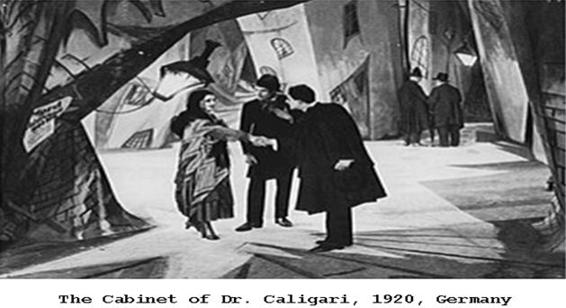
Dear diary; By now you must have noticed that my scribblings are heavy on the mise-en-scene. Mise-en-scene is an ill-defined and often overlooked aspect of any form of communication. If you find it irrelevant and/or inconsequential, et al, I merely ask you where the classic film; “The Cabinet of Dr. Caligari” would be without it?
“The Cabinet of Dr. Caligari” is a 1920 German silent horror film, directed by Robert Wiene and written by Hans Janowitz and Carl Mayer. Considered the quintessential work of German Expressionist cinema, it tells the story of an insane hypnotist who uses a somnambulist to commit murders. The film features a dark and twisted visual style, with sharp pointed forms, oblique and curving lines, structures and landscapes that lean and twist in unusual angles, and shadows and streaks of light painted directly onto the sets.
Democratic License