

ALT by Bilal Ahmed Shaik - HTML preview
Download the book in PDF, ePub, Kindle for a complete version.

Assembly Constants
There are several directives provided by NASM that define constants. We have already used the EQU directive in previous chapters. We will particularly discuss three directives:
EQU
%assign
%define
The EQU Directive
The EQU directive is used for defining constants. The syntax of the EQU directive is as follows:

For example,

You can then use this constant value in your code, like:

The operand of an EQU statement can be an expression:

Above code segment would define AREA as 200.
Example:
The following example illustrates the use of the EQU directive:

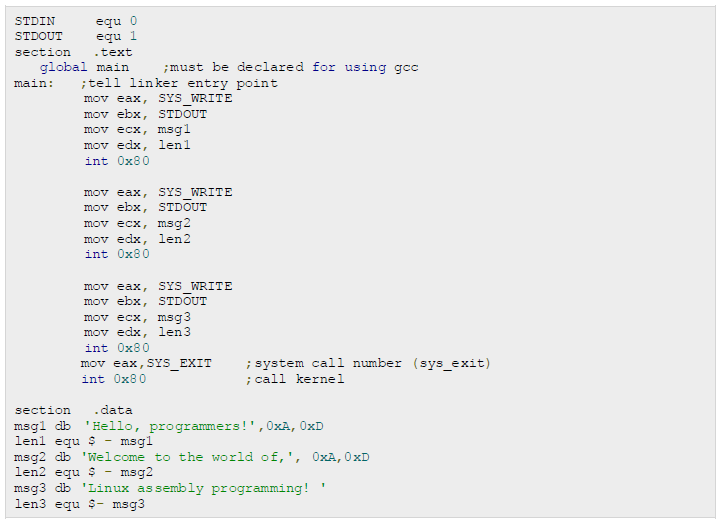
When the above code is compiled and executed, it produces fol owing result:

The %assign Directive
The %assign directive can be used to define numeric constants like the EQU directive. This directive allows redefinition. For example, you may define the constant TOTAL as:

Later in the code you can redefine it as:

This directive is case-sensitive.
The %define Directive
The %define directive allows defining both numeric and string constants. This directive is similar to the #define in C. For example, you may define the constant PTR as:
 The above code replaces PTR by [EBP+4].
This directive also allows redefinition and it is case sensitive.