

The Career Switch Playbook into Product Management by Nkeonye Akumah - HTML preview
Download the book in PDF, ePub, Kindle for a complete version.
Chapter 5: Creating Your Product Portfolio (1,200
words)
A product portfolio is more than a collection of documents. It is proof that you can think clearly, solve problems, and turn ideas into structured solutions. In competitive job markets, especially for graduates and early professionals, a strong portfolio often matters more than a perfect resume.
This chapter will guide you step by step on why a portfolio matters, how to write strong case studies, what projects you can include, and which tools can help you present your work professionally.
Why a Portfolio Matters
Showing Practical Skills
Employers do not hire product professionals based only on theoretical knowledge. They want evidence that you can apply structured thinking to real problems.
A portfolio demonstrates:
• How you define problems
• How you research user needs
• How you prioritize
• How you think through trade-offs
• How you measure success
Anyone can say, “I understand product strategy.”
A portfolio shows that you have actually practiced it.
For example, instead of claiming you understand onboarding improvement, you can present a detailed case study explaining:
• What was wrong with the onboarding process
• What research you conducted
• What changes you proposed
• What results you expected
This level of detail builds credibility.
A portfolio reduces uncertainty for hiring managers. It answers the silent question they always have:
“Can this person actually do the work?”
Standing Out from Other Graduates
Many graduates apply for product roles with similar resumes:
• Similar degrees
• Similar coursework
• Similar certifications
A portfolio differentiates you.
When recruiters review dozens or hundreds of applications, practical demonstrations attract attention. A well-structured case study shows effort, initiative, and commitment to learning.
It also signals seriousness. Building a portfolio requires time and discipline. It shows that you are not casually exploring product roles — you are intentionally preparing.
Even career switchers benefit. Your previous experience becomes stronger when presented as product-focused case studies rather than job descriptions.
For example:
Instead of writing:
“Worked in marketing for 2 years.”
You can show:
“Analyzed customer acquisition funnel and proposed feature improvements to increase conversion.”
That shift changes perception immediately.
How to Write Strong Case Studies
A product case study should feel structured and clear. It should guide the reader step by step through your thinking process.
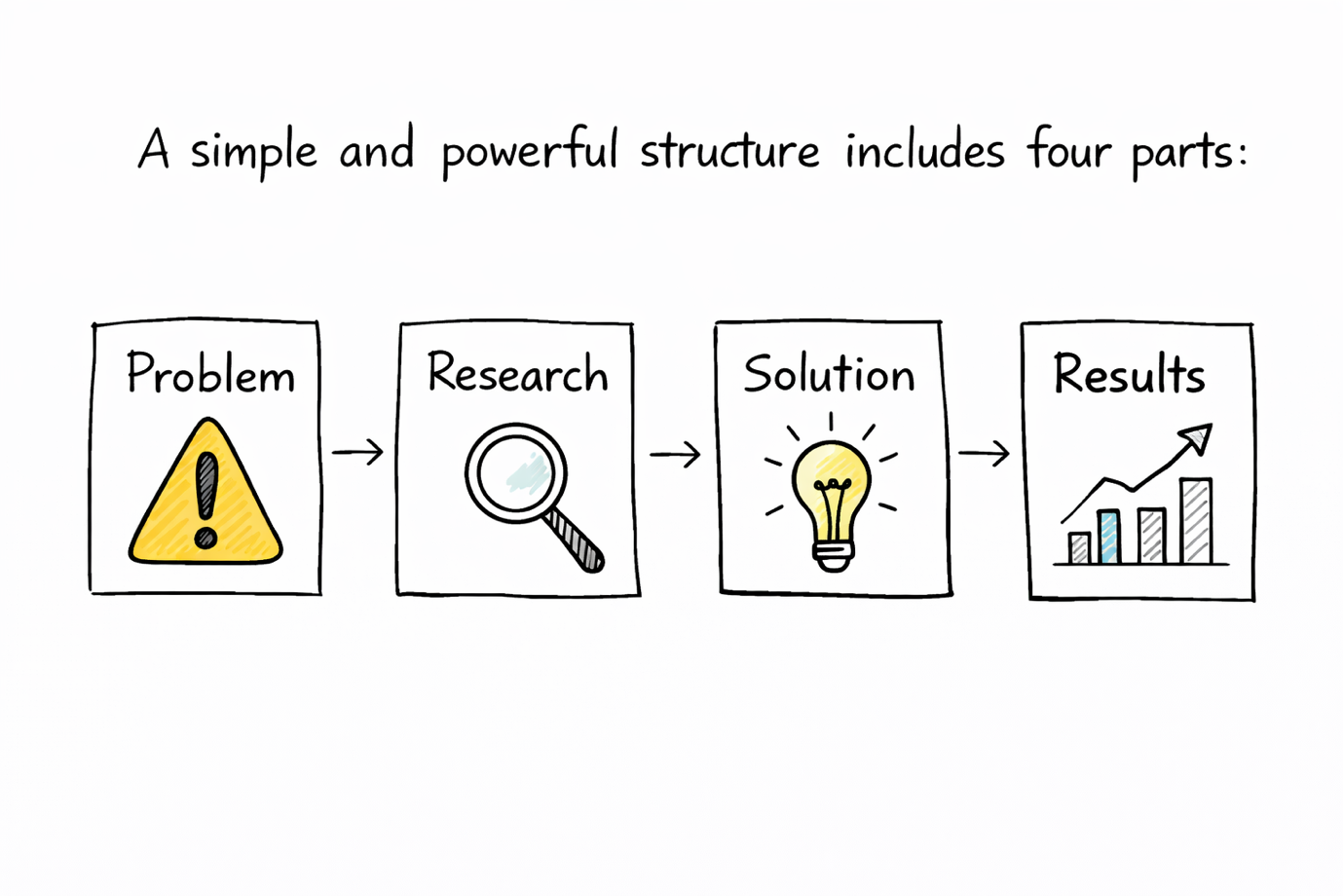
A simple and powerful structure includes four parts:
1. Problem
2. Research
3. Solution
4. Results
Let us break this down carefully.
1. Problem
Start with a clear problem statement.
Avoid vague descriptions such as:
“The app needed improvement.”
Instead, define the issue clearly:
“New users were dropping off during the onboarding process before completing account setup.”
A strong problem section includes:
• Context (What product or market?)
• Target audience
• Current situation
• Evidence of the issue
If possible, include:
• Data indicators
• User complaints
• Observed friction points
A good problem statement makes the reader think:
“Yes, this is a real issue worth solving.”
Keep it focused. Do not try to solve multiple unrelated problems in one case study.
2. Research
After defining the problem, show how you investigated it.
Research demonstrates depth and logical thinking.
Your research may include:
• Competitor analysis
• User interviews
• Survey insights
• App reviews
• Market research
• Behavioral data analysis
Even if you are doing a hypothetical project, explain your assumptions clearly.
For example:
“I analyzed 100 public user reviews and found that 45% mentioned confusion during signup.”
Or:
“I compared onboarding flows of three competitor apps and identified shorter setup processes as a common success factor.”
The goal is to show that your solution is not random. It is based on structured reasoning.
Avoid jumping directly from problem to solution. The research section builds trust.
3. Solution
Now present your proposed solution.
Your solution should directly address the problem identified earlier.
For example:
If the problem is onboarding drop-off, your solution might include:
• Reducing required fields
• Adding progress indicators
• Introducing tooltips
• Offering social sign-in options
Explain:
• Why this solution makes sense
• How it improves user experience
• How it aligns with business goals
You can also discuss trade-offs:
• What risks exist?
• What resources are required?
• What assumptions are being made?
Strong product thinking includes awareness of limitations.
Structure your solution clearly:
• Feature changes
• Process changes
• Technical adjustments
• Measurement plan
Clarity is more important than complexity.
4. Results
If the project is real, share actual outcomes:
• Increased retention by 15%
• Reduced drop-off by 20%
• Improved engagement metrics
If the project is hypothetical, explain expected impact:
• Estimated improvement in activation rate
• Predicted increase in subscription conversion
Also describe how success would be measured:
• What metrics would you track?
• Over what time period?
• What defines success?
This shows outcome-focused thinking.
End each case study with a brief reflection:
• What did you learn?
• What would you improve next time?
Reflection demonstrates maturity and growth mindset.
Sample Portfolio Project Ideas
If you do not yet have formal product experience, you can create meaningful projects independently.
Here are practical ideas.
Redesign an Existing App
Choose a popular app you use regularly.
Steps:
1. Identify a specific weakness.
2. Gather user complaints from reviews.
3. Analyze competitor solutions.
4. Propose design improvements.
5. Define success metrics.
Focus on one area only, such as:
• Search experience
• Checkout process
• Navigation
• Personalization
Avoid redesigning everything. Narrow focus shows discipline.
Improve Onboarding Flow
Onboarding is a common product challenge.
Select any digital product and analyze:
• First-time user experience
• Required information
• Clarity of instructions
• Time to first value
You can:
• Map current flow
• Identify friction points
• Suggest simplified steps
• Add engagement triggers
Then define:
• Activation metric
• Drop-off rate
• Expected improvement
Onboarding case studies are powerful because they show user-centered thinking.
Launch a Hypothetical Startup
Create a structured product concept from scratch.
Steps:
1. Identify a clear problem in a specific market.
2. Define target audience.
3. Research competitors.
4. Define unique value proposition.
5. Outline MVP (Minimum Viable Product).
6. Choose revenue model.
7. Define key metrics.
This type of project demonstrates:
• Business understanding
• Market awareness
• Strategic thinking
• Prioritization skills
Keep it realistic. Avoid overly broad ideas like “A social media platform for everyone.” Focus on a specific niche.
Tools to Use
Presentation matters. Even strong ideas lose impact if poorly organized.
Here are practical tools to structure your portfolio.
Notion
Notion is useful for:
• Organizing case studies
• Creating clean documentation
• Structuring content sections
• Sharing portfolio links
It allows easy navigation and professional formatting.
You can create:
• Separate pages for each project
• Clear headings
• Embedded visuals
• Roadmap sections
Keep layout simple and readable.
Figma
Figma is ideal for:
• UI mockups
• Wireframes
• User flows
• Design improvements
Even basic wireframes improve your case study quality.
You do not need advanced design skills. Clean, simple layouts are enough.
Use Figma to visualize:
• Before and after comparisons
• Proposed feature changes
• User journey flows
Visual clarity strengthens communication.