The Art of Presenting Successfully by Pavlos Pavlides - HTML preview
Download the book in PDF, ePub, Kindle for a complete version.
The Presenter
Your performance as the presenter will determine whether one presentation will be successful or not. The audience attends your presentation because they expect to gain from your knowledge and your expertise. The knowledge you have on your topic will not be helpful to the audience unless you relay your message clearly.
Your ability to communicate effectively and to wisely use or handle the other four elements of a presentation is crucial.
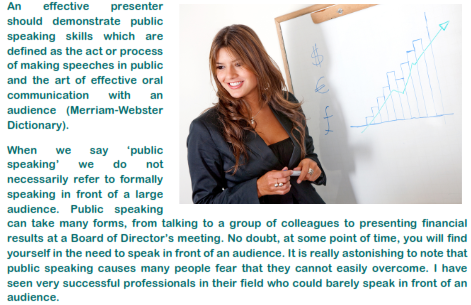
Good public speaking skills are essential in every aspect of life, professional or personal. Just think about the positive impression a good speaker makes as opposed to an average one!
The ‘bad’ thing about public speaking is that you do not know when you will need it. It could be at a family gathering, at a friend’s wedding or at work.
In this section I refer to public speaking in the professional and academic environment. Good public speaking skills are a definite plus when you try to build a professional image. A sales meeting or presentation, a training, a briefing to your superiors, a presentation of an academic project are only some examples when may need to use your skills.
Communication is the core of public speaking. Communication is a two-way process. To achieve effective communication you need to get your message across and at the same time to be able to receive feedback from the other party. According to the 7 Cs theory, communication, written or oral, must have the following characteristics:
Clarity

Makes understanding easier
Enhances clarity of message
- Define the purpose of the communication.
- Emphasize on a specific message or goal at a time.
- Do not try to convey too many messages in one communication.
- Use appropriate and exact words.
- Ideas should be clear and not subject to assumptions or different interpretations by the audience.
Conciseness
Better comprehension by the audience
Makes the message more appealing and more apparent
- Use the appropriate number or words.
- Avoid the excessive use of adjectives.
- Avoid the use of unnecessary expressions or ‘filler words’
- Avoid different forms of repetitions.
Coherence
Your message will make sense.
- Check the relevance of your points.
- The communication should be consistent in tone and flow.
Concreteness
Gains the confidence of your audience.
Provides a clear and lively picture to your audience.
- Be precise.
- Be focused.
- Support your message with appropriate amount of facts and figures.
Correctness
Enhances the impact of your message.
Increases your credibility.
- Make sure your communication is free of grammatical and syntax errors.
- Proof read your written communication. Do not rely only on the spell checker.
- Use appropriate and understandable technical terms.
- Check the accuracy of facts and figures used.
- Use appropriate language-avoid jargon.
Completeness
Enhance the reputation of the organization
Persuade your audience
- Establish what your audience expects from the communication
- Convey all the facts and figures so that the audience can make decisions or take action.
- Be ready to provide any additional information if required.
Consideration
Helps you to gain the trust of your audience
Creates a positive attitude towards the communication
- Take into consideration the characteristics of your audience, their views, background, educational and social level.
- Respect your audience.
- Be friendly and honest.
- Be positive and optimistic.
Build your self-confidence
Self-confidence is the cornerstone for a successful presentation. Even if you believe that ‘you don’t have it’, it is in your hands to succeed by consistently using exercises to boost your self-confidence and to follow some useful guidelines.
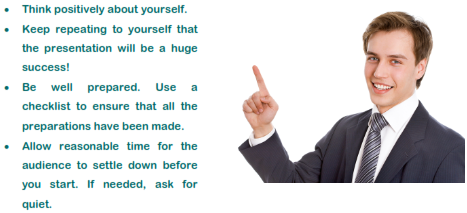
- Eliminate tension by using simple techniques like using a stress ball and taking a series of deep breaths.
- Familiarize yourself with the arguments of your presentation.
- Do not apologize to the audience for being inexperienced! Why are you there then?
- Keep calm and move on if you missed your point or forgot what you wanted to say! Move on to the next point and return to the missed point later!
- Do not hide behind a lectern or a desk. It implies a ‘physical’ apology.
- Read your material over and over again and get used to hearing your voice.

Appearance
A proper appearance will give a good first impression to your audience and will be vital for the success of your presentation. First impressions are sometimes hard to change. By the time you begin your presentation, the audience will have formed a positive or negative idea about you. How can you make a good first impression then?
- Dress appropriately, business-like and smartly.
- Do not wear clothes or accessories that are distracting for the audience.
- Avoid extravagant hair styles.
- Hide any ‘perspiration problem areas.’
- Do not overdo it with makeup or perfume.
- Make sure that your clothes are well-fitted and properly ironed!
- If applicable, make sure your tie is at the right length and the knot is well made.
- Hair is brushed and tidy.
- Make sure your shoes are polished.

Body language
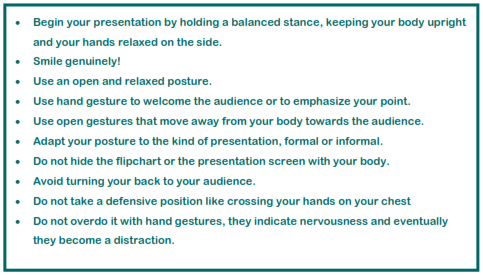
Believe it or not, our body is a means of communication. How we stand, the gestures we make and facial expressions transmit messages to the audience. So it is important to have in mind some important guidelines in order for the body language to work in your favor.

Voice
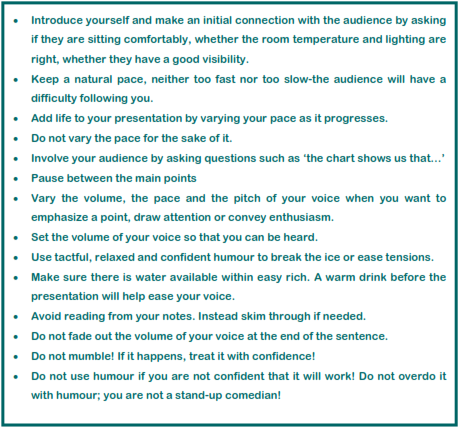
Your voice is critical to the success of the presentation. The volume, the pace and the pitch of your voice are equally important as all the visual messages you will be transmitting during your presentation.

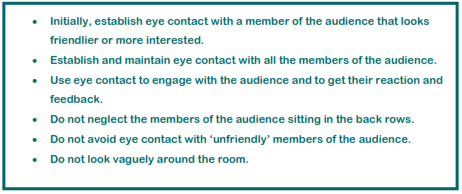
Eye Contact
Eye contact is a powerful tool! Establish a connection with your audience so that they keep following the presentation. Losing the eye contact will most probably mean losing the audience.