Sons in the Shadow: Surviving the Family Business as an SOB (Son of the Boss) by Roy H. Park Jr. - HTML preview
Download the book in PDF, ePub, Kindle for a complete version.
APPENDIX I
DOG STORY
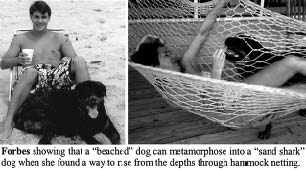
Following the death of my Russian wolfhound, our family had a number of dogs including a Belgian shepherd, Alaskan malamute, and inherited from a member of our family, a mixed breed that died of old age. After that, we went dogless for a while until 1984 when my mother gave my son an eight-week old female Rottweiler puppy we named Forbes.
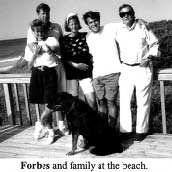
We named her after the magazine that ran the interview with my father that resulted in my leaving his company, since she arrived during that time. With her name later being a reminder of an altercation that actually became a turning point for better days, Forbes grew up as a devoted, playful and trea
sured member of the family.
Sadly, Forbes died of advanced bone cancer at age eleven in my wife’s arms on our kitchen floor. When you lose a dog, it rips your heart right out. The wrenching sadness that eats into your soul can only begin to be relieved by the happiness a new puppy can bring.
As Dean Koontz recognized in his book The Darkest Evening of the Year, “...you can’t support the illusion that a dog can be your lifelong companion: There’s such beauty in the hard honesty of that, in accepting and giving love while always aware it comes with an unbearable price.”65 It took me a year to convince Tetlow to get another Rottweiler, but we did. We named the puppy Brook after Tet’s father. As Brook grew up and the years went by, we began to remember the sadness at the loss of Forbes and the reality of a dog’s short life span. I knew my wife could not again survive the gap between the loss of a beloved dog and the decision to even entertain the idea of going through it again with another.
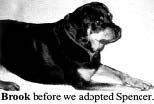
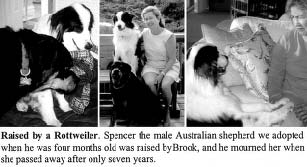
So while Brook was still young, we decided to get a second dog, this time an Australian shepherd, a smaller breed which was said to have the same intelligence (but a much more active temperament) as a Rottweiler. And like a Rottweiler, they also have no tails. Spencer came to us through the Aussie Rescue Society when he was four months old, and Brook immediately adopted him.
So our male Aussie was raised by a female Rottweiler and this upbringing not only had a calming influence on the Aussie, but showed great tolerance on Brook’s part, which was a good thing. Because Brook also died with cancer, this time at the early age of seven, leaving the Aussie she mentored grieving and alone.
It was then my wife and I decided that although dogs, being pack animals, bond well with humans, they do better when they have a second dog to bond with. And we needed that second dog to carry on the tradition of the first dog, and to help us bridge the gap when, God forbid, the oldest went to the place where Will Rogers said he wanted to go to be with all the dogs that have died.
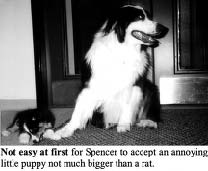
That said, we bought a totally hyperactive eight-week old puppy we named Sadie for Spencer to raise. It was painful for Spencer to put up with at first.
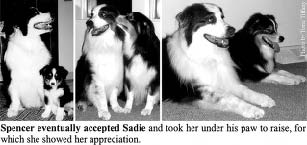
But then the relationship improved and as Brook had done with him, he raised her as his companion and a responsible part of our family.
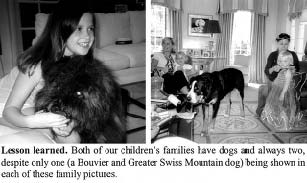
And the moral of this story, and a word to the wise, is that two dogs are better than one if your family wants to avoid the heart-rending pain of a dog passing away, from which it is almost impossible to recover.