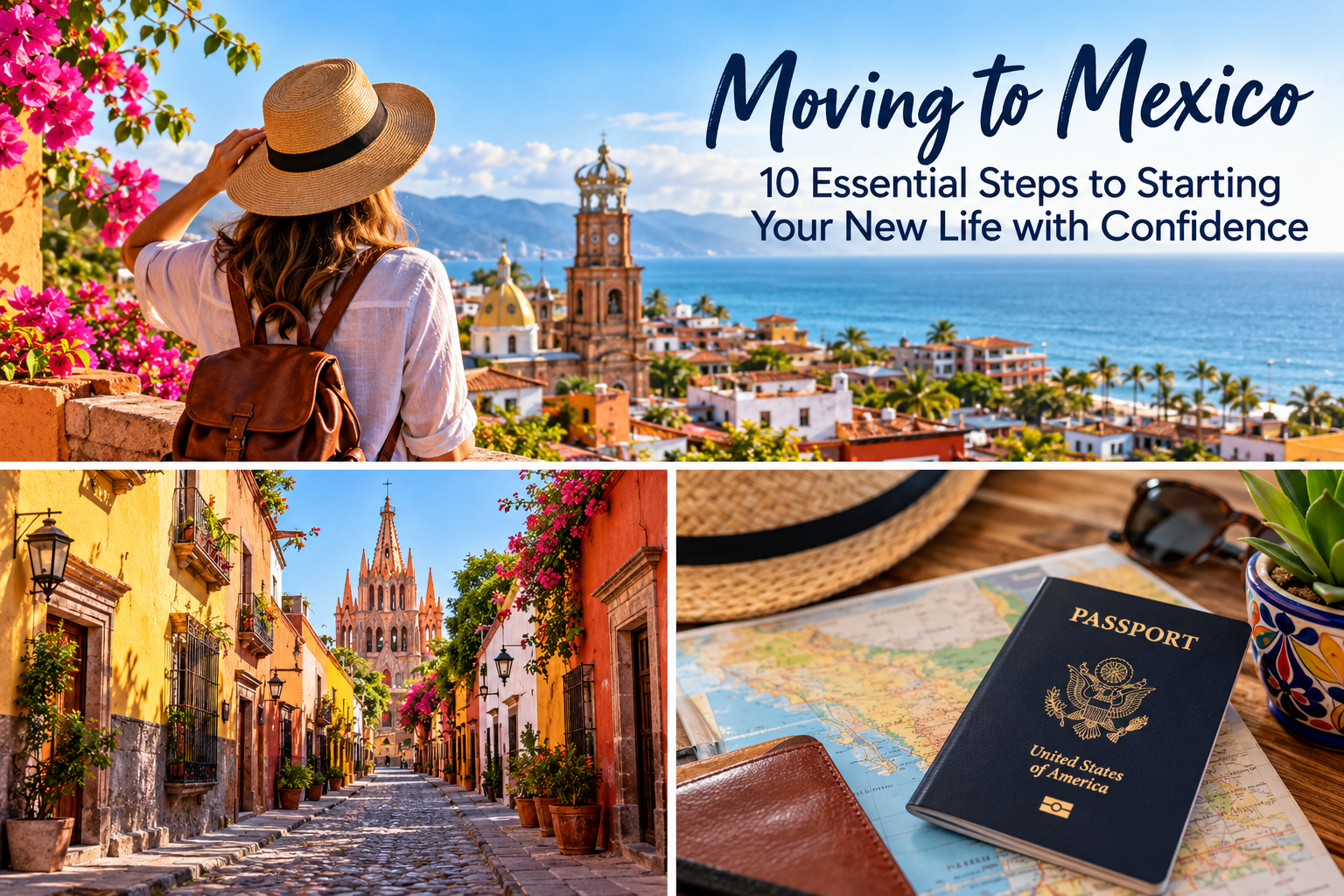
Dreaming of a new life in Mexico? Here’s how to turn that dream into reality.
Imagine waking up to sunshine, enjoying freshly brewed coffee in a charming town square, exploring colorful markets, and discovering a lifestyle that feels more relaxed, affordable, and fulfilling.
For thousands of Americans and Canadians, Mexico represents an opportunity to experience a different way of life. Whether you’re planning to retire, work remotely, enjoy a slower pace, or simply begin a new adventure, Mexico offers an extraordinary variety of possibilities.
But moving to another country involves more than packing your bags and booking a flight.
A successful relocation requires research, planning, flexibility, and a willingness to embrace new experiences.
The good news? With the right preparation, you can make your transition to Mexico considerably easier.
Here are ten essential steps to help you get started.
Moving to Mexico: the 10-step checklist at a glance
- Choose where to live — visit for several weeks before committing.
- Budget realistically — costs vary widely between big cities, beach towns, and inland towns.
- Sort out residency — temporary or permanent residency starts at a Mexican consulate outside Mexico.
- Rent before you buy — your first home doesn’t have to be your forever home.
- Build a support network — with both expats and Mexican neighbors.
- Learn Spanish — even basic phrases change everyday life.
- Embrace the culture rather than recreating home.
- Arrange healthcare and insurance before you need them.
- Organize banking and taxes — talk to a cross-border tax professional.
- Plan the move, then give yourself time to adjust.
1. Discover Your Ideal Place to Live in Mexico
One of the most exciting aspects of moving to Mexico is choosing where to live.
And with so many incredible destinations, that decision can also be one of the most challenging.
Do you picture yourself enjoying the ocean breeze in Puerto Vallarta, strolling through the colonial streets of San Miguel de Allende, or relaxing near beautiful Lake Chapala in Ajijic?
Perhaps you prefer the energy and cultural attractions of Mexico City or the laid-back lifestyle of a smaller, less touristy community.
Before choosing your destination, think about what matters most to you.
Consider the climate, cost of living, healthcare facilities, transportation, safety, and availability of everyday services. If connecting with other foreigners is important, investigate whether your preferred destination has an established expat community.
Online communities, Facebook groups, YouTube channels, and relocation forums can provide helpful insights from people already living in Mexico.
However, remember that everyone’s experience is different.
The best way to discover whether a location is right for you is to experience it firsthand.
Spend time exploring neighborhoods, shopping in local markets, visiting cafés, and talking to residents.
Whenever possible, stay for several weeks rather than just a few days. A location that feels perfect during a vacation might feel very different when you’re managing everyday responsibilities.
Take your time. Mexico isn’t one destination; it’s a collection of wonderfully diverse regions, each offering a different lifestyle.
Many of Mexico’s most livable small towns are part of the government’s Pueblos Mágicos (“Magic Towns”) program, which recognizes communities with special cultural and historical significance. To explore them region by region, download my four free guides on Free-eBooks.net:
- Northwest Mexico: Where Desert Meets the Sea: A Guide to Mexico’s Northwest Pueblos Mágicos
- Northeast Mexico: Desert Winds & Hidden Legends: Exploring the Pueblos Mágicos of Northeast Mexico
- Southwest Mexico: Beyond the Volcano’s Shadow: Journeys Through Mexico’s Southwest Pueblos Mágicos
- Southeast Mexico: Whispers of the Tropic Wind: Exploring the Pueblos Mágicos of Mexico’s Southeast
2. Understand the Real Cost of Living in Mexico
One of Mexico’s biggest attractions is the possibility of enjoying a comfortable lifestyle at a lower cost than in many parts of the United States or Canada.
But how much does living in Mexico actually cost?
The answer depends heavily on where you live and how you choose to spend your money.
Living in an upscale neighborhood of Mexico City or a popular coastal destination can be surprisingly expensive. On the other hand, smaller inland towns may offer excellent value.
Housing will likely be one of your largest expenses, so begin by researching rental prices in several locations.
Then consider your other monthly costs, including groceries, utilities, internet, transportation, healthcare, insurance, entertainment, and dining out.
Shopping at traditional markets, eating at neighborhood restaurants, and using local transportation can help stretch your budget.
Imported foods, luxury accommodations, and frequent international travel can quickly increase your expenses.
Before relocating, create a realistic monthly budget based on the lifestyle you actually want.
Include a financial cushion for emergencies and unexpected costs, such as medical care, immigration fees, or exchange-rate fluctuations.
For more ideas on managing money abroad, the free ebook Spending Money on Vacation compares everyday costs of living overseas.
The goal isn’t necessarily to live as cheaply as possible. It’s to create a lifestyle that gives you greater freedom and value for your money.
3. Understand Mexico’s Visa and Residency Requirements
Before making long-term plans, it’s important to understand your legal options for living in Mexico.
Mexico offers several immigration categories, and the right choice depends on your circumstances and how long you intend to stay.
Visitors may be admitted for a limited period, but the authorized length of stay is determined by Mexican immigration officials. You should never assume that every visitor automatically receives 180 days.
If you’re planning to make Mexico your home, temporary or permanent residency may be more appropriate.
Temporary residency lets you live in Mexico for more than 180 days and up to four years, while permanent residency has no renewals and is available to people who meet stricter financial requirements or have qualifying family ties. As a rough guide for 2026, most consulates ask for:
- Temporary residency: about US$4,300–4,500 a month in net income over the past six months, or about US$73,000–75,000 in savings (average balance over the past 12 months).
- Permanent residency: about US$7,400 a month in income, or roughly US$300,000 in savings.
These thresholds are set in Mexican pesos, are recalculated every year, and vary by consulate, so treat them as a starting point.
Depending on the category, applicants may need to provide financial documentation, proof of qualifying family relationships, or other supporting records.
Many residency applications begin at a Mexican consulate outside Mexico, followed by additional procedures with Mexico’s National Immigration Institute (INM).
Because requirements, financial thresholds, and procedures can change, always verify current information with the relevant Mexican consulate or immigration authority.
Consulting a reputable immigration professional can also be worthwhile, especially if your circumstances are complicated.
Getting your paperwork in order before your move can prevent unnecessary frustration later.
4. Find a Home That Fits Your Lifestyle
Finding the right home in Mexico is about much more than choosing a beautiful property.
Your neighborhood, access to services, transportation options, and daily surroundings will have a major influence on your quality of life.
Begin by deciding whether you want to rent or eventually purchase property.
For most newcomers, renting first is a smart strategy.
A temporary rental allows you to explore different neighborhoods and discover what daily life is really like before making a long-term commitment.
Websites such as Airbnb can be useful for initial research, while local real estate agents and community groups may help you find longer-term rentals.
Whenever possible, inspect a property in person before signing an agreement or transferring a substantial deposit.
Pay attention to details that might not appear in online listings, including street noise, water pressure, internet reliability, ventilation, accessibility, and the surrounding neighborhood.
If you’re considering a coastal destination, investigate the effects of humidity, seasonal storms, and maintenance requirements.
Remember that rental agreements, utility arrangements, and landlord responsibilities may differ from what you’re accustomed to.
Give yourself permission to explore before committing. Your first home in Mexico doesn’t have to be your forever home.
5. Build Friendships and a Reliable Support Network
Moving abroad is exciting, but starting over in a new community can sometimes feel isolating.
Building relationships is one of the best ways to make Mexico feel like home.
Start by connecting with people who share your interests.
Local community groups, volunteer organizations, language classes, walking clubs, and social events are excellent opportunities to meet others.
Expat communities can be particularly helpful when you’re learning how everyday systems work, from finding a trustworthy mechanic to choosing a dentist.
However, don’t limit your social life to other foreigners.
Developing friendships with Mexican neighbors and residents can make your experience much richer.
You’ll gain a deeper understanding of your surroundings, discover local traditions, and learn about places and experiences that may never appear in travel guides.
Be willing to introduce yourself, ask questions, and participate in community activities.
Over time, those connections can become one of the most rewarding parts of your new life.
6. Learn Spanish and Open the Door to New Experiences
Can you live in Mexico without speaking Spanish?
In some communities, particularly those with large English-speaking populations, it’s possible to manage many everyday activities in English.
But learning Spanish can dramatically improve your experience.
Even basic conversational skills make ordinary tasks easier, whether you’re ordering food, arranging transportation, visiting a doctor, or speaking with a neighbor.
More importantly, speaking Spanish helps you build meaningful relationships and connect with the culture around you.
Start with everyday vocabulary and useful phrases.
Language-learning apps, online lessons, local classes, and a free pocket phrasebook such as Phrasebook 5 Languages can help you develop a foundation.
But don’t rely exclusively on studying.
Practice speaking whenever you can.
Visit neighborhood markets, talk with shopkeepers, ask simple questions, and listen carefully to the responses.
Don’t worry about making mistakes. Learning a language requires patience, repetition, and a willingness to occasionally sound a little awkward.
Watching Mexican television, listening to Spanish-language podcasts, and spending time with Spanish-speaking friends can also accelerate your progress.
Every new word you learn makes your world in Mexico a little bigger.
7. Embrace Mexican Culture Instead of Trying to Recreate Home
One of the greatest opportunities that comes with moving to Mexico is discovering a different way of living.
Mexico’s cultural heritage is extraordinarily rich, with traditions shaped by Indigenous civilizations, regional identities, historical influences, and generations of family customs.
You’ll encounter vibrant festivals, regional cuisine, music, art, and strong community traditions.
Participate in local celebrations, including Día de los Muertos and Mexican Independence Day festivities.
Explore traditional markets, try unfamiliar foods, and learn about the history of your new community.
Remember that customs and expectations can vary significantly from one region to another.
Approach those differences with curiosity and respect.
Rather than constantly comparing Mexico with your home country, try to appreciate the reasons things are done differently.
You may discover that adapting to a new culture changes your perspective in unexpected and wonderful ways.
For an honest, personal account of what that transformation can feel like, read Laura Labrie’s free memoir I Ran Away to Mexico.
Moving to Mexico isn’t simply about changing your address.
It’s an opportunity to broaden your horizons and create a different relationship with the world around you.
8. Arrange Healthcare and Insurance Before You Need Them
Healthcare is an important consideration for anyone planning to relocate, particularly retirees and people managing ongoing medical needs.
Mexico has both public and private healthcare systems, but access, costs, quality, and availability can vary considerably by region and individual eligibility.
Major cities and established expat destinations often have private hospitals, specialists, and medical clinics.
Smaller towns may offer fewer services, meaning certain treatments could require travel to a larger city.
Before choosing where to live, investigate nearby hospitals, emergency facilities, pharmacies, and specialist care.
It’s also important to explore your insurance options.
International health insurance, Mexican private insurance, and certain public healthcare programs may be available depending on your circumstances. U.S. readers should note that Medicare generally does not pay for care outside the United States.
Compare policies carefully, paying particular attention to age restrictions, preexisting-condition exclusions, deductibles, emergency coverage, and annual limits.
If you take prescription medications, check their availability in Mexico and determine whether you’ll need a local prescription.
Finding a reliable doctor and understanding how to access emergency care should be among your early priorities.
Good healthcare planning provides peace of mind and allows you to focus on enjoying your new surroundings.
9. Organize Your Banking, Taxes, and Financial Affairs
Moving to another country creates financial considerations that go beyond exchanging dollars for pesos.
You’ll need to decide how to access your money, pay everyday expenses, manage accounts, and handle potential tax obligations.
Many newcomers initially use foreign bank cards and international money-transfer services.
Opening a Mexican bank account may become useful once you have the required identification and immigration documentation.
Banking requirements vary by institution, so compare fees, services, and account eligibility before making a decision.
Become familiar with Mexican pesos and pay attention to exchange rates.
Although electronic payments are widely accepted in many urban and tourist areas, cash remains important in smaller businesses, traditional markets, and certain rural communities.
Maintain access to emergency funds and consider keeping financial resources available in more than one account.
Tax planning also deserves special attention.
Depending on your residency status, personal circumstances, and financial connections to your home country, you may have tax obligations in Mexico, your country of origin, or both.
Speak with a qualified cross-border tax professional before making major financial decisions.
A little financial preparation now can prevent expensive complications later.
10. Plan Your Move and Give Yourself Time to Adjust
Once you’ve chosen a destination, explored residency options, and developed a realistic budget, it’s time to organize the actual move.
Start with a relocation timeline.
List the essential tasks you need to complete before departure, including securing documentation, arranging transportation, reviewing insurance, and organizing your belongings.
If you’re bringing household goods, research international moving companies and Mexican customs requirements.
Some personal belongings may qualify for specific import procedures or exemptions, depending on your immigration status and circumstances.
If you’re moving with pets, verify current animal-entry requirements and airline policies well before departure.
You should also decide what to do with your possessions back home.
For some people, shipping furniture and personal belongings makes sense.
For others, selling, donating, or storing possessions creates a simpler and more flexible transition.
Consider arriving with only your essentials and renting a furnished property while you settle in.
Once you’re in Mexico, allow yourself time to adjust.
Everyday tasks may take longer than expected. You might encounter unfamiliar processes, language barriers, or cultural differences.
That’s a normal part of adapting to life in another country.
Stay flexible, remain patient, and remember why you wanted to make the move in the first place.
Frequently Asked Questions About Moving to Mexico
Can a U.S. citizen move to Mexico?
How much money do I need to move to Mexico?
What are the best places to live in Mexico for expats?
Do I need to speak Spanish to live in Mexico?
Is healthcare in Mexico good for expats?
Final Thoughts: Your New Life in Mexico Begins with One Decision
Moving to Mexico can be one of the most exciting and rewarding decisions you’ll ever make.
Whether you’re attracted by the climate, the culture, the cost of living, or the opportunity for a fresh start, Mexico offers an incredible range of lifestyles and experiences.
But creating a fulfilling life abroad requires more than finding an attractive destination.
It means understanding your finances, making informed residency decisions, choosing the right community, preparing for healthcare needs, and embracing a culture that may be very different from your own.
Most importantly, it means approaching your move with an open mind.
You don’t need to have every detail figured out before beginning your journey.
Start by researching a few destinations. Visit the places that interest you. Talk with people who already live there. Explore your options before making major commitments.
And remember, you don’t have to move permanently on your first visit.
You can begin with an extended stay, explore several communities, and gradually discover where you feel most at home.
The best move to Mexico isn’t necessarily the fastest or the cheapest. It’s the one that helps you build a life you’ll genuinely enjoy.
Your next chapter could be waiting just across the border.
And the adventure begins when you decide to explore what’s possible.
Free Mexico Travel Guides to Download
Explore Mexico’s Pueblos Mágicos region by region with Scott Paton’s free guides, available in PDF, ePub, and Kindle formats:
- Where Desert Meets the Sea — Northwest Mexico
- Desert Winds & Hidden Legends — Northeast Mexico
- Beyond the Volcano’s Shadow — Southwest Mexico
- Whispers of the Tropic Wind — Southeast Mexico
Browse more in our free travel ebooks collection.