

The Bugs Stop Here Pest Control Guide by Mr. Steven Free - HTML preview
Download the book in PDF, ePub, Kindle for a complete version.
42


The Bugs Stop Here Pest Control Guide
631.563.3900
Baldfaced Hornets (White Faced Hornets)
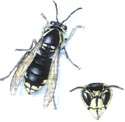
Bald Faced HornetBaldfaced hornets are large black wasps 5/8" to ¾" long, with yellow markings and a mostly white face. They are social insects which live in aerial nests. The adults are represented by
workers (which are sterile females), queens, and males (which come from unfertilized eggs) and usually appear in the late summer. Only inseminated females winterover in sheltered
places.
In the spring the females use chewed-up cellulose to build a paper carton nest of
several dozen cells covered by a paper envelope. Each cell contains one egg
which was laid as the cell was constructed. After about 30 days, the first 5-7 workers emerge and shortly thereafter take over all the work except for egg laying. The nest will eventually consist of 3-5 rounded paper combs which are attached one below another, and are covered with a many-layered grayish-colored "paper carton". Nest size varies up to 3,500 cells in 5 combs but usually consists of less than 2,000 cells in 3-4 combs and contains 100-400 workers at its peak.
Later in the season, larger reproductive cells are built in which queens and males will
be reared, though males are often reared in old worker cells. Newly emerged queens
and males leave the nest and mate. Only inseminated queens hibernate and survive
the winter. The founding queen, workers, and males all die.
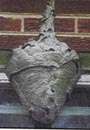
Gray Paper Nest
The large grayish-colored "paper carton" aerial nests are constructed in shrubs at ground level to 66 feet or higher in trees. Nests may also be built on overhangs, utility poles, houses or sheds. At maturity, nests can be quite impressive with sizes of up to 14" in diameter and over 24" in length and usually hang in an exposed location such as from a tree. Adults are extremely protective of the nest and will sting repeatedly if disturbed.