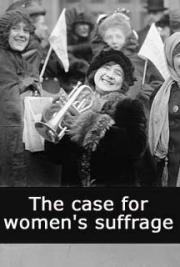
Women's suffrage or woman suffrage[1] is the right of women to vote and to run for office. The expression is also used for the economic and political reform movement aimed at extending these rights to women[2] and without any restrictions or qualifications such as property ownership, payment of tax, or marital status. The movement's modern origins can be attributed to late-18th century France, although full suffrage did not come to France or the French-speaking Canadian province of Quebec. Limited voting rights were gained by some women in Sweden, Britain, and some western U.S. states in the 1860s. In 1893, the British colony of New Zealand became the first self-governing nation to extend the right to vote to all adult women, and the women of the nearby colony of South Australia achieved t...
Mary Wollstonecraft ( 27 April 1759 – 10 September 1797) was an eighteenth-century British writer, philosopher, and advocate of women's rights. During her brief career, she wrote novels, treatises, a travel narrative, a history of the French Revolution, a conduct book, and a children's book. Wollstonecraft is best known for A Vindication of the Rights of Woman (1792), in which she argues that wo...
German-born Käthe Schirmacher studied at the Sorbonne, worked for a time in England, and earned a doctorate in Zürich. She traveled around Europe delivering lectures on various aspects of German culture and women's issues. She co-founded the Association of Progressive Women's Groups and the World Association for Women Suffrage in 1904. During World War I, her politics shifted rightward; after th...
This is an HTML version of the ebook and may not be properly formatted. Please view the PDF version for the original work.
An excerpt is a selected passage of a larger piece, hence this is not the complete book.
HTML Format is ideal for: Immediate preview in any browser, Translations
PDF Format is ideal for: PC's & Macs, iPhone, and Printing
The ePub format is ideal for the Sony Reader, Barnes & Noble Nook, BeBook, Bookeen, COOL-ER, Hanlin eReader, Hanvon and many other ebook readers
Note: For VIP Members Only.
Mobipocket Format is ideal for: Amazon Kindle, Mobile Phones, Blackberry, Palm, IRex, ILiad, Hanlin, BeBook and other mobile devices
Note: For VIP Members Only.
The Text (TXT) format is the simplest format and can be read in any word processor. Plus it is printable.
Standard Members enjoy free HTML views and5 PDF/TXTaccesses per month. For Unlimited Access, please upgrade.
Comments for "The case for women's suffrage"
Mary Wollstonecraft and the beginnings of sexual emancipation
By: Jacob Bouten
Mary Wollstonecraft ( 27 April 1759 – 10 September 1797) was an eighteenth-century British writer, philosopher, and advocate of women's rights. During her brief career, she wrote novels, treatises, a travel narrative, a history of the French Revolution, a conduct book, and a children's book. Wollstonecraft is best known for A Vindication of the Rights of Woman (1792), in which she argues that wo...
The modern woman's rights movement; a historical survey
By: Kathe Schirmacher (member of the right wing party)
German-born Käthe Schirmacher studied at the Sorbonne, worked for a time in England, and earned a doctorate in Zürich. She traveled around Europe delivering lectures on various aspects of German culture and women's issues. She co-founded the Association of Progressive Women's Groups and the World Association for Women Suffrage in 1904. During World War I, her politics shifted rightward; after th...