IN the trilogy "With Fire and Sword," "The Deluge," and "Pan Michael,"
Sienkiewicz has given pictures of a great and decisive epoch in modern history.
The results of the struggle begun under Bogdan Hmelnitski have been felt for
more than two centuries, and they are growing daily in importance. The Russia
which rose out of that struggle has become a power not only of European but of
world-wide significance, and, to all human seeming, she is yet in an early stage
of her career.
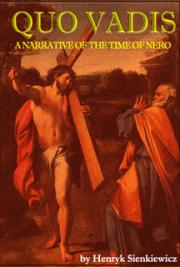
In "Quo Vadis" the author gives us pictures of opening scenes in the conflict of
moral ideas with the Roman Empire, -- a conflict from which Christianity issued
as the leading force in history.
The Slays are not so well known to Western Europe or to us as they are sure to
be in the near future; hence the trilogy, with all its popularity and merit, is not
appreciated yet as it will be.
The conflict described in "Quo Vadis" is of supreme interest to a vast number of
persons reading English; and this book will rouse, I think, more attention at first
than anything written by Sienkiewicz hitherto.
JEREMIAH CURTIN
ILOM, NORTHERN GUATEMALA,
June, 1896
QUO VADIS