

Download "A Treatise Concerning the Principles of Human Knowledge" by George Berkeley. for FREE. Read/write reviews, email this book to a friend and more...
A Treatise Concerning the Principles of Human Knowledge
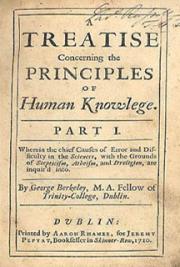
A Treatise Concerning the Principles of Human Knowledge (Commonly called "Treatise" when referring to Berkeley's works) is a 1710 work by Anglo-Irish Empiricist philosopher George Berkeley. This book largely seeks to refute the claims made by his contemporary John Locke about the nature of human perception. Whilst, like all the Empiricist philosophers, both Locke and Berkeley agreed that we were having experiences, regardless of whether material objects exist or not. The world which caused the ideas one has within one's mind, Berkeley sought to prove that the outside world was also composed solely of ideas. Berkeley did this by suggesting that "Ideas can only resemble Ideas" - the mental ideas that we possessed could only resemble other ideas (not physical objects) and thus the external wo...
Hume began writing A Treatise of Human Nature at the age of sixteen, finishing the work ten years later. Although many scholars today consider the Treatise to be Hume's most important work and one of the most important books in the history of philosophy, the public in Britain did not at first agree. Hume himself described the (lack of) public reaction to the publication of the Treatise by writing ...
The four elements--earth, water, air, and fire have a connection to mankind. We attempt to build a bridge between the physical and the spiritual with them. Come join the search for the missing link--not of fossils, but rather of knowledge.
This is an HTML version of the ebook and may not be properly formatted. Please view the PDF version for the original work.
An excerpt is a selected passage of a larger piece, hence this is not the complete book.
HTML Format is ideal for: Immediate preview in any browser, Translations
PDF Format is ideal for: PC's & Macs, iPhone, and Printing
The ePub format is ideal for the Sony Reader, Barnes & Noble Nook, BeBook, Bookeen, COOL-ER, Hanlin eReader, Hanvon and many other ebook readers
Note: For VIP Members Only.
Mobipocket Format is ideal for: Amazon Kindle, Mobile Phones, Blackberry, Palm, IRex, ILiad, Hanlin, BeBook and other mobile devices
Note: For VIP Members Only.
The Text (TXT) format is the simplest format and can be read in any word processor. Plus it is printable.
Standard Members enjoy free HTML views and5 PDF/TXTaccesses per month. For Unlimited Access, please upgrade.
Comments for "A Treatise Concerning the Principles of Human Knowledge"
A treatise of human nature
By: David Hume,
Hume began writing A Treatise of Human Nature at the age of sixteen, finishing the work ten years later. Although many scholars today consider the Treatise to be Hume's most important work and one of the most important books in the history of philosophy, the public in Britain did not at first agree. Hume himself described the (lack of) public reaction to the publication of the Treatise by writing ...
The Four Elements--Their Relation to Mankind
By: David Cecil Nurse
The four elements--earth, water, air, and fire have a connection to mankind. We attempt to build a bridge between the physical and the spiritual with them. Come join the search for the missing link--not of fossils, but rather of knowledge.